Showing posts sorted by date for query longevity. Sort by relevance Show all posts

Saturday, September 7, 2024

The World Is Dying and We’re Doing This

Amid the growing certainty and omnipresent evidence that our species will soon drive itself extinct along with many other species, it is harder each day to justify living in a way that enables it. This is especially true in a society with its physical and social infrastructure that demands doing so in exchange for the surviving and thriving of ourselves and the people we care about.

Collection, processing, distribution, and use of resources throughout a population to sustain and grow it is arguably the primary purpose of life for its members. As a consequence, some of those resources become waste, which is not directly usable or reusable for that purpose by the society or others outside of it. 

Part of the waste can be further processed, by generating more waste, to create and distribute artificial environments, or parts thereof, that enhance personal experience of life. An increasing focus on this secondary purpose eventually inhibits achieving the primary purpose; and, if continued, results in death leading to extinction as the waste overcomes other species whose existence depends on the same resources and contributes to those resources.

Members of a society who want to reduce the risk of extinction can do so by attempting to decrease the amount of waste that is created. This can involve limiting the use of tools like money that enable that creation. Direct destruction of resources such as habitat for members of other species and killing more of those members than what can be reproduced, also increases the risk of extinction, and can be avoided in order to reduce the risk.

A healthy ecosystem is a community of life whose members collect, process, and distribute resources in such a way that they can be reused without decreasing their quality and quantity over a long period of time, thus extending the lifetime of the ecosystem and the number of its members. A dying ecosystem is the opposite, which is what we have now on a global scale.

If we choose to create more waste, then we are demonstrating that we do not value the health, and therefore longevity, of life in our ecosystem. Since humanity has global impact, our ecosystem is the world ecosystem. If we promote the growth of life such that it can achieve a level that can be maintained with available resources and/or other resources that can be acquired without destroying life, then we are demonstrating that we value health, life, and longevity.

The world as an ecosystem is currently dying. What we’re doing, and what we will do with that knowledge, is up to us.


Saturday, April 6, 2024

Value Statement

“Exploring new ways of thinking, for fun and optimization of the amount, longevity, and quality of life.” – Bradley Jarvis profile, X (formerly Twitter) @bradjarvis

That introduction is a succinct statement of my values and how I most prefer to serve them. The term “life” is more general than I’ve typically used it elsewhere, applying to both humanity and other species. 

By my calculations, collapse of both populations is avoided where natural habitat that includes other species accounts for more than 63% of the sum of habitat and what people are consuming to survive. Put another way: The habitat that supports humans requires about the same amount of additional habitat to support it; less than that and it decreases, unable to support as many of us. If we were like other species and did not generate waste, our population would decrease to a level that could be supported by the remaining habitat which is supported by what it needs that grows back; but with increasing waste, that can’t happen, and we all die together.

What I just described accounts for the amount of life. How long both populations can survive is the longevity. Quality of life is how well members are matched to their environments, receiving benefits commensurate with what they contribute to the health of others. Humanity’s creation of waste, whose function as the essence of artificial environments is to provide benefits without requiring the giving of benefits, has enabled increasing quality of life for some at the expense of life itself for others – nonhuman and human.

One of my “new ways of thinking” is to tie amount, longevity, and quality as aspects of life to the values of people, habitat, and waste that I’ve identified in my other writing and described briefly above. How the aspects of life are to be optimized depends on the relative priorities of the values; and those priorities will be different for different people. For that reason, my recent research has been focused on deriving what those priorities might be (and how they might change) within given populations of people; and presenting the results as aspects of life within simulated “worlds” with similar pasts and different futures – one of which might be our own.

My greatest interest has been how to increase human longevity since our extinction would be the end of all our lives and our values along with them. The dependency of longevity on the amount of available habitat over time and the number of people consuming it to meet basic needs is a good reason to give habitat at least as high a priority as people. Waste would be the lowest priority, though it can serve longevity if a fixed amount of it is used as protection from threats to it that can’t be dealt with otherwise. Waste also can be, and has been, used to access more habitat if habitat is diminishing or population is growing beyond what existing habitat can support.

 From the perspective of other species, my guess based on extensive reading about biology and specifically ecology is that, for many, the value of population size (as procreation) would be the highest priority. Habitat (food supply and shelter) would be second. Waste wouldn’t even occur to them unless it was mistaken to be part of their habitat. Generally speaking, enabling development and maintenance of healthy, diverse ecosystems is the best way to optimize non-human life. This would, as a minimum, involve getting rid of waste and making the rest as harmless as possible.

As for the fun part of creative thinking, it’s a natural reward that draws me to do more of it no matter what circumstances I’m in.


Saturday, August 26, 2023

Groups of Value

The term “values” can be reduced to what someone uses to define “good” and “bad.” In my attempts to quantify it and relate it to behavior and global outcomes, I’ve identified a set of resources and amounts of them that everyone has and uses to some extent. Fractions of the totals of each per person throughout a population, representing how much each resource is valued, are ranked based on calculated distributions of each using historical projections of the totals over time that are embodied in simulations.

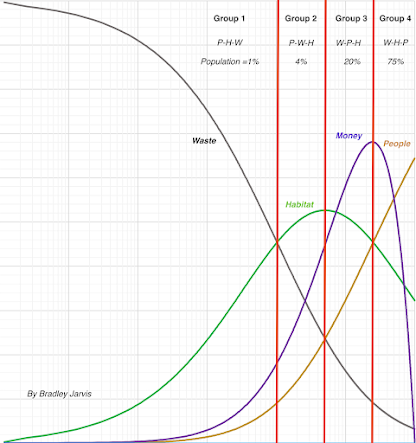
There are four identifiable groups that remain constant in their fractions of the population until too little habitat remains to support each person and members of the species that maintain it. The ranks of value placed on waste (artificial environments), habitat (natural environments), and people are unique to each group, as shown below. Note that the two middle groups could also be considered one group, as mentioned in Distributions.

Waste is valued most by the smallest group and people are valued most by the largest group. Habitat is valued most by the two middle groups, with one valuing waste second and the other valuing people second. No one in one group places the same amount of value on people or waste as anyone in another group. Members of either of the middle two groups can value habitat the same as members of the other group, but not members of either of the two remaining groups. Some members of the smallest and largest groups can value habitat the same, but no one can value habitat the same as members of the two middle groups.

If the value placed on each of the resources is exclusive of the others across the whole population, the fraction of the population valuing waste is 9%, the fraction valuing habitat is 40%, and fraction valuing people is 51%. Note that even for these groups, the fraction valuing people is much larger than the fraction valuing waste.

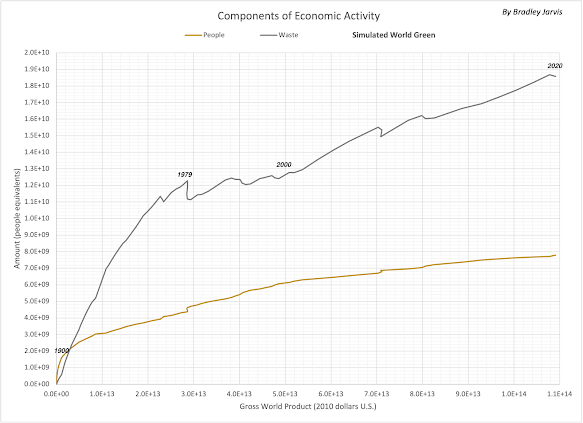
Money as a resource indicating relative economic activity (as indicated in the diagram for small populations and discussed in Economic Distribution) have favored equal value placed on people and habitat (corresponding to half the total habitat available to the population) while promoting increased waste by those who value it most. As shown in the following graph, waste production by a simulated world like ours has outstripped population growth (driving human transactions) as a component of economic activity and remains strongly associated with it. The “rich,” those benefiting most from that activity, and everyone else, represent another set of groups - defined by the value placed on money.

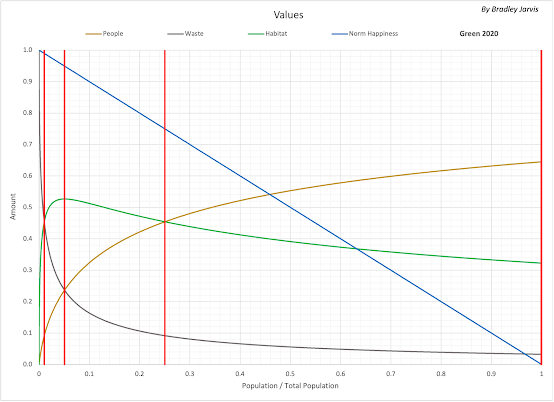
Implicit in this approach to quantifying what someone considers good and bad is the debatable assumption that their current conditions represent what they prefer, and that others they compare themselves to are likewise in preferred conditions. Even using change over time might not be a reliable indicator of preferences; the change could be so far beyond the person’s control and the destination is opposite to their preference. Referenced to groups, a person could move from one group to another due to the actions of others or environmental effects that force change in availability and consumption of resources. This appears to necessitate an additional variable for consideration: choice. Based on national statistics from 1800-2017, happiness varies as shown below, as does life expectancy, where the red lines mark the limits of each the four groups we started with; this suggests that members of a population will tend to prefer a higher value of waste.


As waste effectively decreases habitat, the ability of nature to provide basic biological needs decreases to a point where more people die than are born, beyond which the population crashes. Thus, increased waste decreases how long the population can exist (its longevity). Another set of groups could therefore consist of a group that cares about longevity being longer and the other that doesn’t. The group that cares about longevity would likely value habitat more than anything and waste less than people; the other group would consist of everyone else.


Monday, January 30, 2023

Lay of The Landscape


For many years I had a bad sense of direction when thinking about how to get from one place to another. One way I learned to cope with that condition was to embrace getting lost as a learning experience and develop a “feel” for the organization of the places around me. By focusing on exploration instead of going somewhere, I became aware of the many ways that places are connected as a landscape instead of as a network of paths.

When someone would tell me how to go someplace, or how to achieve a particular objective, I would use their procedure to imagine a landscape being revealed. What my guide considered useful features along a chosen path, I found to be slivers of visibility into a system-as-landscape that the path and its endpoints were likely just a minor part of. 

If I was responsible for achieving a particular objective, and therefore forced to limit my exploration, I would focus on how being at that end would look and feel, discovering what variables most clearly de-fined it in a way that could be experienced through translation into ideas that made intuitive as well as abstract sense. In many cases, “navigation” involved changing the configuration of a system either directly or by integrating myself into it, where the feeling was largely one of artistically sculpting experience until it matched my definition of the system’s end state.

Often in my careers as a test engineer and technical writer, I was tasked with helping others achieve a given objective; and my exploration expanded to include the people I was helping, as part of the inhabited space. Understanding it as the flip side of being helped, where I had to translate what others shared with me, either by communication or shared experience, I included helping their translation as part of my personal interpretation of the task (a service I greatly appreciated when people would do the same for me). 

I became more conscious of these facts as a consequence of trying to distill a lifetime of experience into a framework for dealing with multiple existential crises that threaten both personal and societal longevity. My personal longevity crisis is simply one of age: biological breakdown is inevitable and imminent for someone this close to his life expectancy. Society, which I think of as the whole of organized humanity, is facing a limit to lifetime that is more self-imposed than inherently inevitable. If the whole of experience is a landscape, the part we share, as well as our own lives, has a rapidly approaching edge. Death defines the space beyond the edge, a world without us.

Taken as merely a region in a vastly larger landscape, our experience may be unique, but it is hardly special in any universal sense. As co-creators of our experience with its many components, we arbitrarily assign value to both it and parts of it, with differences in value a function of how we choose to define it. Large differences in value create contrast in our minds, which we associate with degrees of “specialness” of the underlying experience. Since value is purely arbitrary and we can’t physically access the full range of experiences it would take to define a common standard, we can either acknowledge or deny the limitations of our experience and perception of it. 

At some deep level, I think I have always distrusted people who act certain that where they want to go is the right way to go. That attitude suggests a belief that their experience and their judgment are innately more valuable than the experience and judgment of others. Alternatively, I have no problem with someone who has learned enough to make more useful guesses about how to get somewhere as long as they are honest about what they don’t know and can’t do; and are willing to learn and adapt, encouraging the same for those they might lead. People I trust the most, and who I’ve chosen to emulate, are willing to challenge what they know and what they value, learning and testing both of these by getting more experience and engaging in respectful collaboration with other people. In short, I tend to distrust those who deny limitations and trust those who acknowledge them; but overall, in the spirit of acknowledging limitations, trust is always provisional - especially trust in myself – which might ultimately be the reason I got lost so easily.

Self-confidence is, literally, trust in yourself. With it comes a sense of power and focus that encourages action. The opposite is what I feel as fear and disorientation that elicits indecision to the point of paralysis. An early lesson I learned from my father and later proved for myself through living was that trust must be earned and its basis always tested through observation. This lesson demands a range of caution that accompanies every action and is proportional to uncertainty that never falls to zero (which an honest person knows is impossible) and has an upper limit that enables learning through experience. 

Discomfort is always present but doesn’t have to be intolerable. I discovered what can best be described as fun fatalism: playfully creating new experience that reflects my chosen values that will be frozen in space and time beyond the boundaries of my life wherever and whenever those boundaries might be. The discomfort of provisional trust in myself thus became comparable to the aching of muscles that are stretched will per-forming one’s favorite sport, which in my case is exploring the lay of the landscape of my limited existence.

Note: This post was updated on 2/4/2023 with the image above. It depicts relationships of variables in my Timelines model: population (yellow), remaining nature (green), and happiness (red), as functions of habitat density (horizontal, left to right) and waste per person (depth, close to far).

Saturday, October 8, 2022

Upgrades


For much of this year I nursed a slowing computer while attempting to further my research and to do some writing within time limited by working a full-time job (luckily at home). As has happened in similar experiences, I built up a cache of insights that I could share when conditions permitted while sharing tidbits of related wisdom and information on social media platforms, most notably Twitter (@bradjarvis), which also served as a tool for collecting relevant source information. Just when my computer became unusable due to “upgrades” in the operating system and software that its speed could not handle, I capitulated to the need for a hardware upgrade (a new computer) to keep up with them and maintain the most basic functionality.

My new insights, as the most useful have, came from taking a fresh look at the essence of the mathematical modeling of historical data that has dominated my decades-long research into how basic values and resource availability are coupled to affect how long and how large a population can survive. This phase of the research focused more on what happens to groups within a global population than on projections of what happens to the entire population, requiring many more calculations to provide meaningful results. I had enough results by the time my computer became unusable to begin drawing conclusions that could be tested and used to extract a simple set of rules that embody their derivation.

The most fundamental insight of the model has been that human consumption of ecological resources (provided for sustenance of life in ecosystems) varies predictably with habitat density; where habitat density is the ratio of consumption for needs to the number of resources that remain (which are available to members of other species to meet their needs). One of my new insights is how consumption for needs (which is proportional to the number of people) increases with habitat density, and how the amount not consumed for needs (what I call waste) decreases with habitat density. 

Economic activity, measured globally as Gross World Product (GWP) and on a national level as Gross Domestic Product (GDP), is a function of the number of potential exchanges of resources, which varies with the number of people and the resources they consume. The distribution of people and resources derived from their relationships to habitat density can therefore be used to estimate the range of habitat densities occupied by an economically active group like a nation for which that activity is measured. Related aspects of people’s lives such as life expectancy and happiness show looser correlations with habitat density that can therefore be used on a society level to infer the dominant values associated with those aspects along with the more direct ones: population size and longevity (how long the society can survive with its resource base).

The upgrades to the underlying historical data and its analysis showed that, in general, nations have kept their minimum habitat density the same as the world’s while varying their maximum habitat density. This maintains a link to the people in the society with the most access to resources that can be used to meet needs and are paid handsomely for it. In the extremely rare exceptions where that link has been severed, it appears to have been accompanied by rapid demographic transition or government collapse. If, as most of my simulations of the world’s future show, the minimum habitat density climbs in response to critically depleted resources, what triggered those exceptions may also become outcomes in a self-sustaining feedback loop that accelerates the process, enhanced by environmental feedbacks that further reduce available resources.

For now, my new computer is performing as well as I hoped, apparently matching what my not-too-old computer was able to do. Like humanity’s instinctive drive to increase the number of people in the world, which seems to be our dominant value, my hard drive is filling up with the inevitable upgrades to my software and the files (and increases in file size) that I am generating with each new increment of my research and writing. Some time when I least expect it, a critical amount will be used and a new set of upgrades will threaten to make this computer inoperable, just as our planet is on the verge of becoming unable to sustain life as we know it, forcing us to quickly (and impossibly) find and move to another one or die. Refusing that next upgrade is still an option, as is reducing what we’re already doing with it so we can use fewer resources. Unfortunately, our planet – like my last computer – may be doing the ecological equivalent of changing the operating system so that functions we need can no longer be done without a lot of adaptation. Time is running out to find and implement a solution to this conundrum, and I’ll keep doing what I can to help that process.


Thursday, March 11, 2021

Values and Responsibilities


Next month will mark three years since I quit my job to work full time on completing decades of research into how actions serve values and translate into global consequences. Beginning with the primary value of survival (because without survival there can be no other values) I had focused on how many people can exist, for how long, and under what conditions. The scope broadened to include life satisfaction, or happiness, which correlates strongly with the number of resources people consume that are provided by other species. Statistical analysis of historical data for population, life expectancy, economic activity, and other variables revealed other correlations that tracked consistently throughout the data and suggested a theoretical framework that linked them together.

Translation of the resulting mathematical model into experiences of individuals and groups enabled testing by comparison with events and stories from the past and present, along with projections of potential futures. The potential futures were extremely disturbing, since they indicated a high probability of an extinction-level population crash in the near future. Because of this, I worked mostly on deriving alternatives and actions that would enable them, much as I had used models of equipment and conditions to troubleshoot problems that I found during my career as a test engineer. I concluded that effort last year after simulations incorporating global warming variables and the effects of the COVID-19 pandemic converged on a narrow range of actions that might significantly delay catastrophe.

With my savings starting to run out and hardly any income from the writing business I hoped could support my efforts, I spent more time searching for another paying job. This experience has been both a necessity and a test case for how to live based on what I learned. Reading hundreds of job descriptions has reinforced a lesson learned during past job hunts and embedded in my model: money flows toward those taking risks to find, exploit, and trade resources that can be used for future growth. Servicing those people or becoming one of them is increasingly a key to individual survival; it is also a surefire way to help decrease the longevity of civilization by eliminating other species that we depend upon for our collective survival because there are no new ecosystems that can sustain us. The fastest and most direct way to extend our lifetimes is to clean up and leave habitat we have taken from use by other life, which is the opposite of what our economy rewards.

Hunting for income triggered an evaluation of successes and failures in past jobs so I could find better matches in the future. Defining success as the meeting of my expectations and my employer’s expectations with minimal difficulty for both of us, I realized that success for me depends on matching my responsibilities with my values. Ability is another factor, but I’ve been able to learn and adapt quickly enough in most situations to keep it from being a major one. Failure, when I experienced it, was typically associated with a conflict between an employer’s expectations and one or more of my values which couldn’t be remedied to the satisfaction of both of us. 

This insight about employment suggested a new way to characterize the results of my research, which I was coincidentally starting to formalize as a scientific paper that could be reviewed by academics and others for strengths, flaws, and potential use in further research. A person in any of three relationships with their environment (growth, overshoot, loss) focuses on attaining one or more states of being (survival, happiness, longevity) for one or more groups (self, other people, all people and other species). Values and responsibilities can both be categorized by focus, which usually includes self-survival, self-happiness, and self-longevity. 


Relationships to environments tend to predispose the people in them to get what they don’t have enough of, so the relationships can be used as proxies for common sets of values and responsibilities. In general, everyone prefers to be in the overshoot relationship - every person that is, since overshoot involves our consuming more than other species can replenish and therefore depends on them dying off. The inevitable decline in resource availability reduces how long the population can survive (its longevity), which is felt by individuals who are forced into the loss relationship and therefore value reversing what caused it. Meanwhile, people in the growth relationship value survival of themselves and people in their closest groups; this drives population growth along with individual consumption that increases happiness by enabling creation of personalized artificial environments.

Although most of my life has been spent in overshoot, I was strongly influenced by a culture of growth. I also experienced loss and have accepted its all-inclusive values. I’ve been questioning the wisdom of unlimited consumption and its impact on longevity since I was 16 years old; and for various reasons I avoided situations where I might have children until it was practically too late. As an older adult facing loss again while trying to maintain a hold on overshoot, I know from my research that the world as a system is about at the same point and is on the verge of moving every person and other species into the loss relationship either by choice or by force.

The scenarios that I derived for delaying catastrophe are simply summarized by one rule: Avoid loss. Keeping everyone from being in the loss relationship with the environment starts with freeing up habitat for those already there, which my most-likely scenario estimates could be 5/6 of the world’s population by mid-year. Completing that move by the end of this decade could also keep global warming from making parts of the world uninhabitable while we develop ways to reclaim even more habitat and learn to live with the result. Notably the (simulated) last time no one was in the loss relationship was in 2001, and the last time no one was in overshoot was in 1949, which provides some historical context for what we might expect.


As improbable as that scenario is, I suspect another one may be emerging that could be considered just another version of catastrophe by those valuing all life. Humanity’s ability to consume more than what other species can provide without harm (thus “overshoot”) is a consequence of large-scale replacement of natural habitat with artificial environments that contribute to happiness and together can be considered artificial habitat. In the new admittedly speculative scenario, attempts to escape the deathtrap caused by reducing the amount of remaining natural habitat are enlisting molecular engineering and machine intelligence to create a new biology that totally redefines what and who we value, including ourselves and our needs. Time is running out for this scenario to play out: my model projects that, on the current trajectory of consumption, people will start dying from lack of habitat by 2026 and humanity will be extinct by 2057. For the new scenario to match the expected one (and what I consider a reasonable timeline for new technology rollout), this may be a manifestation of how the rest of the population transitions from growth through overshoot over the period 2028-2044 while so many others are dying.

The next two decades will either validate or invalidate the concepts I developed over the past two decades. Since exploration is a process and not an endpoint, I expect that if I’m alive then I will have asked many more questions than I answered while helping to more effectively find other answers; and I will be happy to have done so. To the extent that my efforts, whatever they are, contribute to creating a longer and better past for those whose lives I affect directly and indirectly, my life will have served my values. By that standard, I intend to increase my overall positive impact until I can’t, choosing appropriate responsibilities along the way.


Tuesday, December 29, 2015

The Longevity Trap


A new set of simulations involving happiness, longevity, and population shows that when different isolated groups join together to form a larger, competitive group, population may be traded for longevity except when growth rate is the only difference.

Recall that longevity is the time it takes for a group to begin disabling the habitability of its environment by consuming species that keep alive the species it directly depends upon for survival, and that my calculations show that humanity recently reached that point. The simulations indicate that world history can be approximated by a lot of isolated groups, which is also equivalent to what would happen if isolated groups came together and allocated resources equally among them. If the world instead had competition among its subgroups for resources, then the average population over history would be smaller (such as 50%), and longevity would be longer by the same fraction (150%); happiness would have dropped only slightly (3%).

In general, any differences between isolated groups in population or per-capital consumption of ecological resources (footprint) will translate into differences in power to acquire resources and convert them into personalized environments. Those power differences will result in a loss of population when the groups are merged and they must compete for resources with too few available for some people to survive when the resources are allocated according to power. Having fewer total people enables those who are left to consume resources for longer at their current rates, thus increasing longevity. This is not the only way to increase longevity, though: by decreasing consumption rates, longevity can be increased without an accompanying drop in population.

Ironically, any growth at all ensures that a group's longevity will eventually reach zero. Pursuing more longevity, while insisting on growth, is therefore a trap. Even if we use the increased longevity to find more resources so we can accommodate more people, we will be forced to adjust and eventually limit the growth rate of consumption based on physical constraints of speed and availability of resources. To pursue more longevity and accept loss of life as its cost is to automatically assume that the casualties have less value than the survivors or their potential replacements.


Tuesday, December 15, 2015

Assessments


I spent the last two weeks immersed in environmental news, much of it associated with news about the COP-21 climate talks that were in progress during that time. The news came so rapidly that I took to Twitter to both track and comment about it. Coincidentally I was attempting to map out what the next ten years might look like in detail so I could do better personal planning and inform my research and writing (blogs and fiction).

The effort left me stressed and depressed, disappointed and exhausted. Despite the generally positive press about precedent set by COP-21, I saw the result as clear evidence that our global socio-economic system is simply incapable of adequately addressing urgent environmental problems that it has created as a function of its existence and values. Civilization needs to be slamming on the brakes of ecological consumption so we don't critically disable the means of maintaining habitability, but instead we're looking for ways to change the direction of our metaphorical train by tapping the brakes on only some of the wheels.

Toward the end of last week I began trying to frame my assessments of news in terms of the three basic values I've identified in my own research: happiness, population, and longevity. I dove back into my research, looking for a simple graphical representation of the relationships of their physical expressions to each other, and ended up creating a simple statistical simulation of probabilities for various combinations of the three variables.

The simulation showed that in September we likely hit the ecological limit I've been most worried about, an event that it calculated has a 28% of occurring. Furthermore, there was less than a one-in-ten-thousand chance that we would be able to increase our happiness, population, and longevity from their values a few months ago – even if the amount of total resources was twice what I expected. Decreasing minimum happiness from 66% to 60% provided a 3% chance of growing longevity and population with expected resources, and 2% for double the resources. Allowing 50% happiness, corresponding to its value in 1850, increased the chance to 11% with expected resources and 4% with double the resources. Allowing global warming to potentially decrease the amount of resources reduced the chances even more than the dismal numbers I mentioned.

If we did already hit the ecological limit, then we are possibly following one of the reference cases I discussed last. Trying to prevent it is no longer an option; we can only deal with what's to come and apply what we've learned in order to maximize the number of survivors over time. Unfortunately, we still have vestiges of our healthier past that support the delusion that growth is still possible; and there may be enough of a delay in the onset of consequences that we won't easily appreciate the causal link between those consequences and the environmental degradation that triggered them.


Monday, November 16, 2015

Group Interaction


Based upon a simple model of interactions between two groups, the people in those groups will choose among six options depending on their relative populations, resources, and how much they value people, happiness, longevity (how long the population can survive), and the carrying capacity of their environment (the maximum number of people that can consume a given amount of resources per person).

The first option (isolation) has each group and its resources effectively isolated from the other group and its resources, and the other five involve one or both groups having access to all of the resources. Both groups can share their resources (sharing), which averages their consumption patterns (amount per person and how fast it grows). Group 1 can kill off Group 2, keeping all resources for itself (extermination 1), or Group 2 can do the same to Group 1 (extermination 2). The last two options involve the groups living together, with one dominating the other by imposing its consumption pattern on the other (dominance 1 or dominance 2).

If the two groups and their resources are roughly the same size and at or near their carrying capacity, then extermination 1 and extermination 2 each have roughly a 50% chance of being chosen, with practically no chance of any other option. If they each have more resources than people to consume them, then isolation, sharing, extermination 1, and extermination 2 will each have a 20% chance of being chosen; and dominance 1 and dominance 2 will each have a 10% chance of being chosen.

Where one group is much larger than the other group, isolation has the same chance (25%) of being chosen as sharing, extermination of the smaller group by the larger group, and dominance of the smaller group by the larger group. This is mostly due to the larger group having overwhelming power compared to the smaller group, and is independent of how close each group is to its carrying capacity.

The probabilities I've quoted are approximate averages of simulated groups, with each group "member" and each simulation varying from the average such that at any given time one option may dominate the others. In reality, I expect that all options will be attempted, perhaps simultaneously. I introduced this model in part 3 of my BIOME novel, and will explore its implications in the remaining books as a critical aspect of the plot. Here and in my other writing, I intend to use it as a tool for exploring real-world events, and to test it in the process.

Two predictions of the model are particularly relevant to current events, particularly those involving conflict and the potential for conflict between a large group and a small group, such as we've seen recently in terrorist attacks. Viewed from the perspective of the smaller group, there is a 25% chance of being physically destroyed by the larger group, and a 75% chance of losing cultural purity (total control over happiness and longevity as determined by consumption). To eliminate these threats, isolation can be re-established (accompanied by adequate resources), or full control over the larger group can be achieved by domination or by killing its members. Each alternative requires a huge increase in power, ideally in excess of the power available to the larger group, and we can realistically expect the acquisition of such power to be an early step in the process of pursuing one or more of these courses of action. Interestingly, the same actions that deal with these threats from the larger group may also be used to pose a threat to the larger group (and would be perceived as such by that group, regardless of the smaller group's motivation, thus making more likely the extermination option being taken by the larger group).

Of the two threats perceived by the smaller group, loss of cultural purity is the largest (by a factor of three). If this wasn't an issue, then the extermination threat might be addressed by improving the chances of sharing or domination. Where it is non-negotiable, then isolation is the most humane option. Isolation has been crudely implemented in the past through establishment of penal colonies; but, since the world is currently close to its resource limits, it is practically impossible. Note that space travel would be an option for isolation if habitable planets were already available and reachable, but any settlements in the foreseeable future would be operating dangerously close to their carrying capacities with additional risks to life that would require new consumption patterns and associated cultural adjustments. Incarceration, an extreme form of domination, is commonly used as an alternative to extermination, but of course it is the embodiment of cultural loss for a group that is markedly different from the dominant group.

As our planet changes its requirements for survival with the ecological disruptions of climate change, raw resource depletion, and species extinctions, I expect we will all perceive ourselves as parts of small groups struggling to adapt while avoiding extermination. We will also need to see other species as something other than other groups that can be exterminated, since they and the services they provide embody the "resources" that we need to survive. Our consumption patterns, which are major components of our cultures, will need to be more flexible than ever in light of these conditions; and above all else, we must adjust our values so that our preferred options are more aligned with extending longevity and minimizing death.


Friday, September 25, 2015

Two Stories


My efforts to explain and project global trends in population and consumption have yielded two competing stories about the past and our potential future. With critical new insight about the second one emerging from work over the past week that may have reconciled the two, this is a good time to summarize them.

The stories are based on several key observations. First, happiness (life satisfaction) varies predictably with the amount of resources people consume, as measured by their ecological footprint, with smaller and smaller increases in happiness as consumption increases, approaching a maximum amount as any one person approaches consumption of the output of Earth's entire biosphere. Second, there is a minimum amount of such resources each person needs to survive. Third, the population of an average other species decreases linearly with the total amount of resources that humanity consumes. Fourth, global economic activity is proportional to the square of the product of population and happiness, which I interpret as transactions of artificial environments that provide happiness. Fifth and finally, in small groups life expectancy increases with consumption much as happiness does, while in large populations it varies with the total resources consumed by the group.

The first story comes from mathematically simulating "worlds" that each represent a point in time with a certain population, ecological footprint, and total amount of resources. A world can only "exist" when: (1) the resources consumed by the population is no greater than the total resources; (2) an average "person" consumes no less than the minimum; and (3) average happiness is less than the maximum. As total resources decrease, the number of worlds decreases, and the remaining worlds are clustered around more restricted combinations of population, ecological footprint, and happiness. Using historical data to identify the worlds occupied by humanity over time, it appears that as our species has consumed more resources, it has targeted the most dense concentrations of remaining worlds, with the objective of occupying as many worlds as possible without decreasing population in the process.

Behind both narratives is a more conventional backstory. All species collect and recycle energy and material, using it to exist as long as possible and to maximize the propagation of their forms over time and space. As the distribution and types of energy and material change, they adapt by changing their behavior and their form (evolving). From the perspective of members of any one species, other species either assist them, impede them, or are merely parts of their background environment that may assist or impede them later. "Assistance" can understood in economic terms as the provision of products and services, collectively considered as "resources" that include food (a primary source of energy and material) and purification of water (processing a resource for use and eliminating threats to survival), and those resources can be provided either on a continuous basis or a one-time basis. "Impeding" includes removal and degrading of resources (or the species that provide them) and, of course, being treated as a resource yourself. Happiness, as experienced by us and possibly other species, is a consequence of the degree that an individual's environment is optimally suited to maximize personal longevity and propagation of the individual's unique characteristics, and increasing it means using as many resources as possible.

The second story begins with two people, each using the minimum amount of basic resources (such as nutritional food, water, and breathable air) needed to live long enough to produce two more people and keep them alive long enough to survive on their own. Those resources are provided by a core set of other species ("supporters") which are doing the same thing and consuming resources supplied by another set of species ("producers"). For the system to last a long time, the supporters and producers must be allowed to reproduce so that their populations remain at least constant, otherwise the amount of resources drops, as do the populations of the creatures that depend on them – especially us.

Consuming the minimum amount of basic resources corresponds to a minimum level of happiness and lifespan, since none is left over for significantly altering an individual's environment beyond providing basic needs. The creation of physical and social technology (such as economics), especially since the beginning of civilization, has enabled the use of more resources as well as other types of resources besides the basic ones. This has translated into increasing happiness, longer lifespans (due to better health care, protection from predators, and a more reliable food supply). It has also supported larger populations, whose labor and ingenuity (higher probability of smarter and more capable people being born) has reinforced technology creation and use.

While we've so far protected the species that provide basic resources, we've consumed more than what other species produce, and have been consuming members of those species themselves. This consumption has included conversion of source material and energy into forms ("waste") that cannot be recycled by other species in a timeframe useful to humans, and may be harmful to them, even to the point of killing them off.

This brings us to the most important aspect of the second story. Humanity is now on the verge of consuming the producers that keep the supporters alive. Keep in mind that only the basic resources keep us alive and healthy; the other resources increase the quality and length of individual lives, and they enable growth in population by getting access to more resources. What will happen next?

In the first story, humanity is forced to retreat to a lower-consumption "world" which allows other species to grow back partially, thus providing resources for more people. We try to occupy this new world and then do the same thing again, resulting in oscillations in population ("popscillations") with a downward trend to a new value dependent on how much the species can bounce back before we overwhelm them again. If, with the second story, historical population and consumption trends are projected forward in time, humanity consumes some of the producers and stops when after our population drops in response to a shortage in basic resources. Then, after some settling, population and consumption both drop to much lower levels, potentially zero.

My new insight came from trying to understand that last drop, which at best seemed like radical overcompensation. After examining my underlying assumptions and being drawn back to the logic of the first story, I realized that humanity must be seeking a particular goal, manifested as reaching a limit in both population and consumption. Historical data showed that the best candidate was a condition where all that remains in the world is us, what we're consuming, and the supporter species. In short, we don't recognize the value of keeping producers around. Incorporating this into the story resulted in popscillation behavior like that in the first story: population drops in response to lack of basic resources, the species providing those resources partially recover, and the cycle starts over and over again, with an overall downward trend in our population. In this case, continuously increasing individual consumption repeatedly causes attempted overshoot of resources that drives down population in response.

As with someone who is banging his head against a wall harder and harder in the hope that it will move out of the way, avoiding further injury is best achieved by stopping the banging. If we're smarter, we'll avoid hitting the wall the first time (immediately stop population and consumption growth). Following this analogy, if the wall starts to move toward us, which is a conceivable consequence of climate change as species start to die off without our help, we should move backward (reduce our consumption) at least as fast as it is moving toward us. If we're lucky, and emphasize reduction of our greenhouse gas waste, the "wall" may slow down or stop before we are forced to reduce our population.


Monday, September 14, 2015

Impacts


My latest simulation of the future, which integrates personal priority-setting like that discussed in "Groups, Goals, and Actions" with the potential futures described in "Shutdown Scenarios," indicates that the best way to reduce major casualties over the next few years is to have everyone in the world immediately stop increasing both population and consumption of ecological resources (ecological footprint).

The urgency is a consequence of the possibility that humanity will breach a critical environmental limit in less than a year, killing off species needed to sustain those species we directly depend upon for our own survival. With global warming getting worse and threatening to push us over the limit anyway, we need to also work on decreasing our footprint with an emphasis on greenhouse gas emissions. This is the equivalent of slamming on a car's brakes before it flies into a ditch, and then backing up to escape collapse of the eroding ground under it.

Changes to personal behavior have an effect on the global whole that is inversely proportional to the size of the population and therefore extremely small (currently one in 7.26 billion). The best way to have a significant effect is to therefore convince many other people to make the same changes. For the expected ("combined case") scenario, I estimate that about nine times as many people can be saved as are convinced per year to stop growth in population and consumption, with the potential for billions of lives to be saved over the next 16 years.

In the worst case, higher population growth is projected before we make changes, and this results in higher speed toward the limit. To avoid hitting the limit and to minimize casualties we would have to now be decreasing our personal consumption by twice the rate we increased it last year, and stop at no more than 88% (and no less than 60%) of the current global average by the end of the century. Ideally, we should be following this approach anyway, following the sound advice of preparing for the worst case and hoping for the best case.

That "best case" is not, of course, my best case – it is the "limitless case" that seems to be the main planning scenario for the world. For that, there is no need to consider changing anyone's way of life, except to convince them to help increase our own happiness, population, and longevity. Given that our influence over our lives and those of our friends and family is much greater than any influence we might have over the rest of the population, it makes sense under this scenario to focus only on these groups. Doing so inevitably results in more consumption and a growing population, which a lack of limits allows so long as the corresponding complexity can be managed.

If I am wrong about the nearby limit my models indicate we are about to hit, there is another limit behind that: the effective depopulation of other species that includes those we directly depend upon. If we can proceed along the trajectory of the limitless case, I estimate we will hit that final limit by 2029 with a population of 8.5 billion people. If growth continues after that, then we are indeed on a world without limits, and I will stand corrected. There is, however, the very real threat of climate change that is expected by scientists to get much worse in the near future, as well as verifiable increases in pollution and species extinction that are a source of justifiable worry for the foreseeable future. 

We already know, or should know, that as biological entities our fates are intricately tied to the fates of our fellow creatures, and that we are collectively responsible for their fates taking a catastrophic turn for the worst. If our species follows them, then our personal and familial priorities will be forced to include the "others," and it may be too late to stop the worst from happening to us.


Sunday, August 30, 2015

Groups, Goals, and Actions


Motivated by the threat of global catastrophe that has become more real every day, I recently set about identifying personal goals so that I could determine what actions to take that would best serve my needs and values. That requirement made the scope of the search general and specific, global and local, and incorporated key findings from my research along with thoughts about the essence and physical manifestations of "right" and "wrong."

The result builds on the fact that we are each part of a family (or closely related group of people), which is part of a species, which is one of many species that interact and comprise the totality of life on Earth. It incorporates what I consider the most fundamental value of all: "good" is that which maximizes the quantity and variety of life over all time. Limitations in awareness and power force each individual member of a species, like us, to collaborate with other individuals like us in the transformation of the parts of the world not like us, living and non-living, into environments that enable us to contribute to this good; and for that we are rewarded with an increased sense of life satisfaction (happiness).

Each of three basic goals can be pursued simultaneously, and to varying degrees, by any group: maximizing happiness, maximizing population (the members of the group), and maximizing longevity (how long the group can exist as a group with distinguishable characteristics). I include individuals, or the "self," as a group whose longevity is the same as lifespan and whose maximizing of population is the propagation of his or her genetic uniqueness. Each of these goals will be prioritized by the group on an ongoing basis depending on conditions, history, and success.

A group may even choose to work against one or more of these goals by, for example, serving one or more goals of another group. This may be justified, at least in the short-term, if the other group needs help providing resources that maintain the first group's longevity and population, and if that help can be provided by delaying or postponing growth. If future growth of both groups is impossible, then the population and happiness goals would have been reached and maximizing longevity would be the primary focus by preserving the production of resources. If longevity is threatened as it is for humanity and other species today, then larger groups will need to prioritize the goals of their sub-groups as resources become too scarce to maintain current happiness and, potentially, population.

Goals can only be reached through action. Theoretically, any action will have an impact on each of the goals discussed here, and can be prioritized based on both the relative impacts of other actions and on the priorities of the goals themselves. Other goals may be added and addressed, ideally as supporting sub-goals (if not, then as totally independent of the basic ones). I personally choose to include as my own, at least as placeholders, all basic goals for all groups, and to prioritize them based on my preferences and understanding of their interdependencies.

As I gain more experience with this approach, and because I consider "others" to have a high priority, I will share details and insights in future discussions that can be enhanced by them.


Monday, February 16, 2015

Evaluating Competition

It seems that here in the United States we compete for everything. This is certainly the case with politics (managing government) and business (managing the economy), which arguably have the the largest direct impact on our lives. Most of us are effectively slaves to the economy, where we must constantly convince someone that we are better than other people in order to survive. Lost in this competition are answers to some fundamental questions:
  1. What are we ultimately competing for?
  2. Are the winners really "better" than those they defeat?
  3. Is the competition worth the cost?
Biologists would say that most competition can be best understood in evolutionary terms, as a selection of mates whose offspring have the best chance of surviving long enough to have offspring. In this case, the net result of the competition defines its goal: extending the collective lifetime of our species as long as possible. The term "better" is more than just a verdict of who wins a particular competition; it is a value judgment, assessing who supports a particular value more than others. If the value is "human life," then the better people are those who do the most to maximize the amount of human life over time. The cost of the competition must be weighed against the results to determine if the competition is worth it, which involves an additional value judgment used to identify what constitutes a "cost." We can most simply use the same value (or values) for both costs and benefits; for example, assessing whether the rules and conditions of a competition will lead to a net increase or decrease in human life over most potential outcomes.

From the perspective of an individual person or organization of people, the primary value is personal happiness, which is intimately tied to longevity, physical consumption, and the assistance of related individuals. Individuals can choose to collaborate or compete, a choice that is determined by both personal predilection (some of us are more prone to compete than collaborate) and the availability of resources (when resources fall below a threshold where everyone can meet their needs and wants, people will be forced to compete with the others to get what they need and want, unless collaboration can increase the amount of resources).

Artificial competitions, such as those between businesses, manipulate these variables by imposing goals, rules, and conditions, and often selecting participants with particular inclinations and abilities, with the effect of (at least temporarily) increasing happiness for those who win and those who support the competitions with resources. Little, if any, consideration may be given to the net gain or loss to anyone or anything else because the values embodied in a competition do not extend to them, unless additional values are imposed by an outside entity which acts on their behalf, or are inherently shared by the competition's participants who are part of an impacted group.

Political competition is perhaps the most critical of artificial competitions, because it determines the leadership of government, whose influence is derived from its function to enforce and support values common to a society, especially the the lives of its citizens, by for example acting as the "outside entity" influencing other competitions. For societies such as ours that have global impact through artificial (abstract and technology-driven) means, the natural large-scale value of human life should be explicitly discussed and accepted or rejected by all citizens on a routine basis; and, if accepted, it must be intentionally integrated into the values that underlie all activities contributing to that impact, especially the governance of our society and how we choose our leaders.

Due to the world's complexity and global proximity to natural resource limits, those of us with significant influence can no longer follow our natural proclivity to increase our happiness, with its attendant and excessive consumption requirements. Humanity has arguably passed the point where significant additional resources are available, and some of us are already using technology and wealth to manipulate institutions like government and business, which enabled our growth, to facilitate the opposite: competition (with unfair advantage) for what is already being used by the rest. Together we need to reexamine the competitions we are participating in, and consciously decide whether the values they serve are in line with the future we want, before that future is decided for us.

Sunday, May 18, 2014

Complexity


There is a fixed amount of time any of us can do something. We also have a limited range of abilities, partly innate and partly determined by experience. Knowledge is often incomplete, and not always accurate. Even if we have the knowledge and abilities, we may not have the opportunity to do it, depending upon conditions that aren’t under our control. If we are successful in doing that “something,” it will almost certainly cause other things to happen, which we may or may not be able to anticipate, fully understand, or control: things that could either support or get in the way of meeting the goals that govern what we’re doing in the first place. In short, we’re pretty much stuck with the fact that our decisions will be imperfectly conceived and executed, and have unintended consequences.

In a complex system like a business, a government, a society, or a natural ecological community (“ecosystem”), there is a lot of activity with a lot of consequences, intended and unintended. The system survives if, on average, the healthy consequences are greater than the harmful ones; and it dies if the reverse is true.

Nature deals with the problem of survival by spreading out risk. In a healthy ecosystem, no individual or species has too much power over the others; so that if something happens to it, something else can pick up the slack. There are also many interactions, but none that will have such a large impact on the entire community that everyone will suffer if its consequences are unhealthy. Because each individual is both a consumer and a resource, the amount of life in the system increases to a maximum; and because there are many types of resources (species), the longevity of the system is also increased.

For most of humanity’s existence, hunter-gatherers lived in small groups that used what they found, and limited their populations accordingly, resulting in a trade of population for longevity. Since the beginning of civilization, perhaps out of necessity stemming from changing conditions, and aided by improvements in technology, we reversed that trade by enlisting more people to find resources and then used them to create artificial environments increasingly tailored to the wants and needs of individuals. Today’s organizations (such as governments and business) are the latest innovation in “cultural technology,” systems that have enabled this dynamic to proceed exponentially.

The complexity of our organizations (indeed, civilization as a whole), is exactly what we need it to be, as long as we can count on getting more people and more resources to help make up the difference between what we’ve actually got and what we want to get. What’s causing pain now, is that we’ve hit a limit in resources and people, and the unhealthy consequences of our actions (especially those of a few people who have a large amount of power) are not being entirely offset by healthy ones.

Saturday, March 10, 2012

Changing Values

A community is held together by shared values, beginning with the lives of its members, and extending to what makes those members happiest. Happiness (and survival) requires resources, which, while being consumed, are not available to anyone – or anything – else.

If the definition of the community is extended to include more members, the community must either make more resources available (such as acquiring the resources already used by the new members), get more use out of the resources already consumed (increase efficiency), or settle for a lower level of happiness. If the amount of happiness is increased, statistical trends indicate that consumption – and the amount of available resources – will need to increase exponentially to compensate.

If the community defines itself more restrictively, then it may view former members as competitors or even resources to be "consumed." This could result in an increase in happiness, an increase in longevity (the amount of time that resources can last), or both, by decreasing the happiness and longevity of the members it shed. A more humane way to shed members is to send them to other areas, voluntarily or otherwise, which has the potential benefit of providing access to additional resources.

Changing values is especially costly if a community reclassifies someone or something it typically consumes (uses and throws away) as a member. Slaves and species used for food are obvious examples. The community's resource base must be redefined in fundamental ways that can fundamentally change how the community deals with itself and its environment. What was good is now evil, and what could be counted on to enhance happiness must either be replaced or happiness must be reduced. Understandably, a reduction in happiness (which is proportional to life expectancy) would be considered unacceptable by many people, so we could expect a lot of resistance to a such a change in values.

With humanity's ecological impact rising so high that it threatens the habitability of our planet, our values must change in such a way as to reduce that impact to a safe level, and this must happen soon – in much less than 20 years. Arguably, all of the alternatives are already being tried. Environmentalists are promoting the redefinition of community to include more of the biosphere (other species), while limiting population growth as a multiplier on individual impact/consumption; this potentially has the additional benefit of growing the resource base, especially when combined with efficiency-increasing measures. Those who favor restricting communities are promoting the "shedding" of members of the population, most without acknowledging the threat, by favoring perpetual warfare and declining working conditions as "others" either become slaves or die. Space enthusiasts are pushing for the settlement of other planets, which is the equivalent of humane population-shedding – though most of the places people might go are uninhabitable wastelands, just as the Earth is in danger of becoming.

Given the urgency of the task of reducing our ecological impact, the first two options have the best chance of working, while the third (space settlement) is at best a desperate insurance policy against total extinction. If all human life is valued, the second option must be ruled out, though it is arguably built into human nature (and some humans more than others). Unfortunately, the environmentalist's approach requires the most change, and is therefore prone to facing the most resistance – which it is getting.

For those of us who favor an emphasis on the environmentalist's approach, reducing resistance to it is critical. Based on this discussion, it should be clear that attempting to counter the resistance without addressing the associated values is likely doomed to failure.