Showing posts with label survival. Show all posts

Saturday, March 22, 2025

Life vs. Artificial Life


Of the simulated worlds I've explored in my research and fiction, the most fantastical is the subject of my novels which I hope one day to compile into a trilogy if the real world and I survive long enough to complete it (a condition that appears less probable every day). Nicknamed Futuria for a fictional community that plays a prominent role in the novel Biome, this simulation explores a potential escape from human extinction through bioengineering. 

In the post Earl's Myth, I discussed an inspiration for doing this as an interpretation of economies as artificial biomes (types of ecosystems) inhabited by people and organizations functioning as species of organisms that feed on each other and biological ecosystems of which they are ultimately a part. A consequence of this is destruction of life both directly (by overconsumption) and indirectly (by the production of waste that reduces quantity and quality of needed resources). Because generation of waste is essential to the existence and functioning of economies, a choice must ultimately be made between the survival of artificial life (economies) and human life (along with other biological life). Fictional Earl Oldfield realizes that he has accidentally been provided an alternative to that choice: alter some of life, especially humans, so that it can consume waste and ultimately become it.

Here on Earth, some worshippers of technology as the ultimate savior of humanity have apparently embraced variations of that alternative and are crafting different ways to apply it. One way is the physical merging of humans with machines beginning with the use of neural implants to enhance the functioning of our brains. Pharmaceuticals have long been used to supplement or offset our natural abilities and characteristics, typically on an ad hoc basis. As other species struggle using behavior change and natural evolution to adapt to the damage we are inflicting, it is perceived as a logical next step for us to augment our own changes in behavior (including alteration of environments) with changes to our biology and controlled evolution, the latter two having already been experimented with on other species throughout our history up to and including the use of invasive bioengineering.

Another alternative, the one I favor because I value life, is to reduce the waste and help other species to repair the damage and grow healthy ecosystems that primarily support biological life. The denizens of simulated world Hikeyay (also named for a fictional community and featured in my Simulated News blog) effectively embrace this approach and the ultimate consequence of having a smaller population consuming much less than when they started their "global strategy" to fight the extinction threat. Much of my recent thinking of how to implement this alternative was developed during the writing of that blog, which I am continuing even as the probability of its implementation in real life drops closer to zero. While improbable, partially implementing this alternative is theoretically possible (as I indicated in the post Best Future) but it soon won't be without significant loss of life if we are already on the cusp or in the beginning stage of collapse.

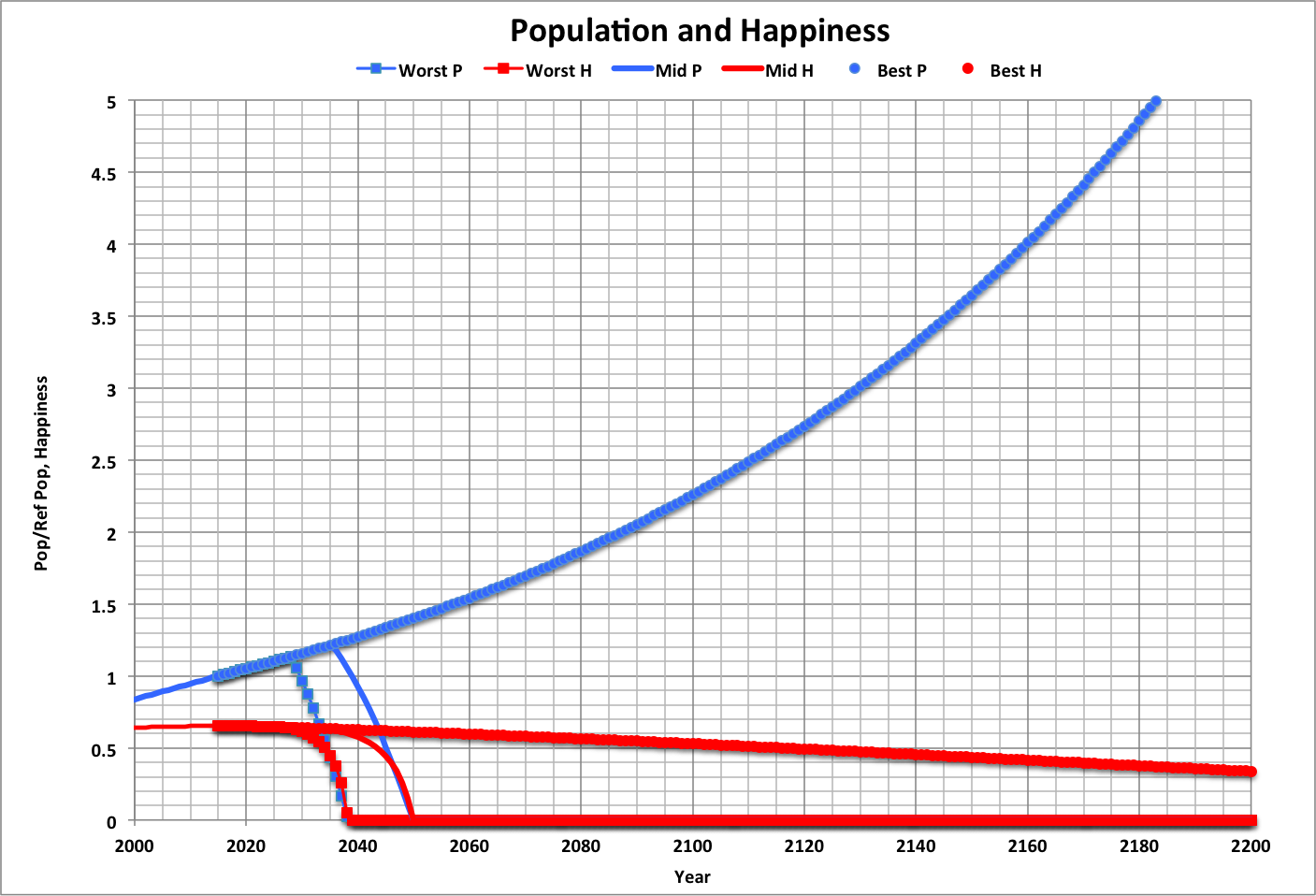
Total elimination of humanity, what the alternatives are trying to avoid, is manifested in simulated world Green (the name of a mountain and a fictional research station), which is my best approximation of our own past and future. Over the next 15 years, that world's production of waste will rapidly increase, destroying the natural habitat that supplies what's needed for basic survival, and killing off the human population as a result. Waste will become irrelevant after that, unless part of it has been replaced with actually artificial life (particularly artificial human life). Because my simulations are based on historical trends of biological life, they offer no guidance about whether techno-saviors would be successful or not.

The people in simulated world Futuria, however, will see gradual growth in waste and a corresponding decrease in habitat, with population peaking about now and then dropping gradually. Rising global temperature is a serious problem for them as well as us and the worlds that choose to increase habitat; this is because there is a lower limit to how much people can consume, and temperature is dependent on the cumulative amount of waste as heat-trapping gas in the atmosphere. The fate of Earl's plan is to be determined, though it will play a major role in this year's events, not the least being those featured in my novel Lights Out.


Saturday, January 4, 2025

Can’t Give Up

Two days ago, I started a social media thread on Bluesky and adapted it for distribution to my U.S. senators and others in anticipation of the upcoming certification of the presidential election votes:


If Donald Trump is allowed to become president, the coup that started on 1/6/2021 will be complete and we will no longer be living in the United States of America.


‪He has openly and brazenly violated laws he swore to “faithfully execute” as his presidential duty, and assaulted the Constitution they derive from, which he swore to "preserve, protect and defend” and might do so again. To entrust its protection to its enemy is the ultimate act of treason.


The clearest way to avoid this disaster is to sustain Trump's disqualification from holding office under Section 3 of the Constitution's 14th Amendment.


It is my contribution to the work done by many others who are making cases for the remedy. The next and last chance of stopping Trump will be just before he takes the oath of office on January 20, after which he will likely be protected by the foolish presidential immunity granted by the Supreme Court and begin taking revenge on all those who have tried to hold him to account for his crimes, charged and otherwise.


I am under no illusion that the chance of success is extremely low, just as I have been realistic about the chances of humanity avoiding extinction due to overconsumption and destruction of the parts of our planet’s biosphere that provide our most basic needs. But I can’t give up.


A survey of past blog posts and my earliest research into the subject of humanity’s survival reveals many echoes of what I know and feel now. The introduction to my writing and music YouTube channel, created four years ago, is a reminder of how long I have nursed the now-suspect expectation that facts, logic, informed speculation, and frank discussion of values can enable and persuade enough people to do what it takes for individuals, communities, and our species to survive and thrive for as long as physically possible. Other videos clearly show my exasperation, weariness, and sadness bordering on depression about the growing evidence that our species is committed to exterminating other life in selfish pursuit of an artificial existence that would ultimately exterminate us too. But I can’t give up.


If, as I suspect based on my modeling and study of history, our global civilization has begun the process of collapse, and what is happening in the U.S. is both a cause and effect of it, then the next logical alternative to giving up is to do whatever can be done to slow and then stop it, knowing that loss of human life  - something I’ve avoided in my search for solutions - is now inevitable. In this context, we will collectively be sacrificing more people than are added by birth and immigration for the quality of life that increasing waste can for now provide to a very few. My personal valuing of all life, especially human life, above all else, has translated despondency into anger that drives me to prioritize fighting the taking of life. In that fight, stopping death is a natural focus; when population stops dropping, then the focus will shift. 


To stop the collapse, our collective focus as a species must be on growing natural habitat while reducing waste, both new and existing, and enabling that is where I prefer my personal focus to be. But I’ll do whatever I can wherever I can to serve the ultimate goal, long-term surviving and thriving of all life. Because, as a bare minimum to succeed, we can’t give up.


Tuesday, December 31, 2024

Best Future

Humanity is on the verge of escalating its generation of waste that destroys or makes useless the natural habitat we most depend upon for our survival, a process that could result in our own extinction. Alternatively, we could avoid it and attempt to grow back habitat both directly and by reducing the waste we already produced. 


These options are illustrated below with two simulations over time of total resources and its components (in units of habitat consumed for basic human needs). Simulation Green displays our current course. Simulation Green’ (Green Prime) displays one version of the alternative that attempts to reduce global warming, a consequence of waste, as much as possible without destroying civilization and resulting in loss of life. Needs and waste comprise our total consumption, while habitat is what other life consumes. 


If we were to choose Green’ or a variant where we halt collapse after it starts, what would the result look like? Based on the amounts of resources over time, it appears that is might be like how the world was between 2000 and 2010, with the main difference being that the population size is about 40% higher.


The following graphs show the population distributions of resources and values for 2024 and 2035, illustrating how big a change in people’s lives would be required.


Saturday, June 8, 2024

Belief and Reality

Belief is ultimately based on reality: the believers’ experiences, how they explain those experiences, and how much they trust their explanations. The experiences can be direct or shared by someone else. Explanations can be created by the believer or provided by others. Trust is based on how well explanations match with experience, and how well other explanations from the sources have matched with experience.

Explanations are used to craft expectations of what exists and what is likely to exist as a result of certain actions by oneself and others. Treating those expectations as reality is a fundamental outcome of belief, enabling action unhindered by doubt that could trigger diversion of resources into investigating the validity of the reasons for it. Belief thus increases the efficiency of attaining goals that depend on actions, with a maximum that is limited by how closely its basis matches reality.

Another outcome of belief is reduction of stress triggered by uncertainty, especially about what affects one’s survival. Belief masks the unknown with a fictional alternative that feels known, or at least knowable, often with a narrative that provides prescriptions for interpreting and dealing with its experiential manifestations. People have different tolerances for this kind of stress, and so will prefer to rely on belief to varying degrees and in different ways. 

Social pressure, partly due to dependence on others for surviving and thriving, can enforce a set of beliefs that supersedes personal preference in order to maintain group coherence that sustains that dependence, experienced by its members as part of a shared identity. In an increasingly unpredictable environment, where explanations underlying current beliefs cease to match current experience to an extent necessary for survival (and maintain tolerable stress), trust in the beliefs will necessarily erode; and for a group whose identity is strongly tied to its beliefs, that environment will be perceived as a threat to its existence.

Threats can be tolerated, escaped, or confronted. Changing beliefs is an approach to toleration. Changing location is a way to escape with beliefs intact. Confronting a threat might be successful with current beliefs; but if it isn’t, then developing new understanding of the threat is a critical first step that might require changing beliefs, especially if actions taken based on those beliefs are found to have contributed to the threat or could in the future.

Constant development and test of explanations based on growing collection of experience is an alternative to belief that attacks uncertainty directly and reduces stress by providing a realistic basis for identifying and managing both opportunities and threats. The consequences of actions can be better understood and predicted, increasing their efficiency in pursuit of goals that themselves can be better chosen in the pursuit of surviving and thriving, if that is what people want to do. This approach, in its most organized form known as science, treats alternate descriptions and explanations as means toward ultimately achieving a common set that accounts for all of experience: past, present, and future. Identity based on favored descriptions and explanations is considered counterproductive except to the extent that it promotes competition that can help in the process.


Saturday, April 6, 2024

Value Statement

“Exploring new ways of thinking, for fun and optimization of the amount, longevity, and quality of life.” – Bradley Jarvis profile, X (formerly Twitter) @bradjarvis

That introduction is a succinct statement of my values and how I most prefer to serve them. The term “life” is more general than I’ve typically used it elsewhere, applying to both humanity and other species. 

By my calculations, collapse of both populations is avoided where natural habitat that includes other species accounts for more than 63% of the sum of habitat and what people are consuming to survive. Put another way: The habitat that supports humans requires about the same amount of additional habitat to support it; less than that and it decreases, unable to support as many of us. If we were like other species and did not generate waste, our population would decrease to a level that could be supported by the remaining habitat which is supported by what it needs that grows back; but with increasing waste, that can’t happen, and we all die together.

What I just described accounts for the amount of life. How long both populations can survive is the longevity. Quality of life is how well members are matched to their environments, receiving benefits commensurate with what they contribute to the health of others. Humanity’s creation of waste, whose function as the essence of artificial environments is to provide benefits without requiring the giving of benefits, has enabled increasing quality of life for some at the expense of life itself for others – nonhuman and human.

One of my “new ways of thinking” is to tie amount, longevity, and quality as aspects of life to the values of people, habitat, and waste that I’ve identified in my other writing and described briefly above. How the aspects of life are to be optimized depends on the relative priorities of the values; and those priorities will be different for different people. For that reason, my recent research has been focused on deriving what those priorities might be (and how they might change) within given populations of people; and presenting the results as aspects of life within simulated “worlds” with similar pasts and different futures – one of which might be our own.

My greatest interest has been how to increase human longevity since our extinction would be the end of all our lives and our values along with them. The dependency of longevity on the amount of available habitat over time and the number of people consuming it to meet basic needs is a good reason to give habitat at least as high a priority as people. Waste would be the lowest priority, though it can serve longevity if a fixed amount of it is used as protection from threats to it that can’t be dealt with otherwise. Waste also can be, and has been, used to access more habitat if habitat is diminishing or population is growing beyond what existing habitat can support.

 From the perspective of other species, my guess based on extensive reading about biology and specifically ecology is that, for many, the value of population size (as procreation) would be the highest priority. Habitat (food supply and shelter) would be second. Waste wouldn’t even occur to them unless it was mistaken to be part of their habitat. Generally speaking, enabling development and maintenance of healthy, diverse ecosystems is the best way to optimize non-human life. This would, as a minimum, involve getting rid of waste and making the rest as harmless as possible.

As for the fun part of creative thinking, it’s a natural reward that draws me to do more of it no matter what circumstances I’m in.


Saturday, January 6, 2024

Troubleshooting and Understanding

For more than two decades I have known that civilization and possibly the life of our entire species might end before I would naturally be expected to die. The past year brought ample evidence that it was likely. Most significantly, there was a growing lack of interest and will on the part of millions to help protect other people and other species from increasingly catastrophic consequences of their behavior. From the spread of disease and misinformation to the destruction of ecosystems by creation and distribution of waste, the ability of life to support life has been degraded to the point where a cascade of death like the collapse of a house of cards is virtually certain to be unstoppable.

A big part of my personal effort to forestall this catastrophe has been to use imaginative thinking coupled with communication and troubleshooting skills to identify and motivate actions that a critical fraction of the population can take physically and socially to achieve the best possible outcome. I have been both heartened and dismayed that others far more knowledgeable and skilled than me have made a lot of progress along similar lines, but with nowhere near the success that’s needed. This has been a variation of a lesson learned and relearned at various times and scales: if you’re not going where you want to go, try going somewhere else that’s as good or better.

An effective approach to testing and troubleshooting in both my professional personal experience has been to observe the behavior of something and attempt to identify basic variables in its makeup and its environment that can help to predict that behavior. Changing conditions to establish how values of those variables are associated with behavior of interest is then done creatively so that the relationships between the variables along with the behavior can be represented in a conceptual or quantitative model. The model is then tested for its correspondence with reality while being used to converge on a solution to a problem at hand, which is essentially a question that needs answering and can lead to other questions whose answers deepen understanding of the system and help identify other behaviors that might be of interest.

Arguably the most wanted result of troubleshooting is a simple summary of a problem’s cause and a single, easily implemented solution. The least wanted result includes a detailed description of what was learned and could be learned, along with a list of potential new problems. As a scientist by personality and training, I tend to favor the least wanted result, which is also the least conducive to convincing people to act, no matter how well it is communicated. I’ve found that communicating the most wanted result is easy and effective, but only if the problem completely disappears after the solution is implemented and nothing obviously related to it takes its place.

In the case of the multiple threats facing humanity’s survival, the complexity of the involved systems and their behaviors makes it highly unlikely that simple and practical solutions can be found and acted upon. Essentially, we all must become experts in understanding at least some of the systems and both their healthy and unhealthy behaviors. Scientists and engineers who have studied and worked with many of the systems out of curiosity or affinity can provide some guidance to the rest of us, but they cannot impart the understanding needed by us to manipulate the required variables on an ongoing basis; we must get it for ourselves and become effective troubleshooters.


Saturday, October 8, 2022

Upgrades


For much of this year I nursed a slowing computer while attempting to further my research and to do some writing within time limited by working a full-time job (luckily at home). As has happened in similar experiences, I built up a cache of insights that I could share when conditions permitted while sharing tidbits of related wisdom and information on social media platforms, most notably Twitter (@bradjarvis), which also served as a tool for collecting relevant source information. Just when my computer became unusable due to “upgrades” in the operating system and software that its speed could not handle, I capitulated to the need for a hardware upgrade (a new computer) to keep up with them and maintain the most basic functionality.

My new insights, as the most useful have, came from taking a fresh look at the essence of the mathematical modeling of historical data that has dominated my decades-long research into how basic values and resource availability are coupled to affect how long and how large a population can survive. This phase of the research focused more on what happens to groups within a global population than on projections of what happens to the entire population, requiring many more calculations to provide meaningful results. I had enough results by the time my computer became unusable to begin drawing conclusions that could be tested and used to extract a simple set of rules that embody their derivation.

The most fundamental insight of the model has been that human consumption of ecological resources (provided for sustenance of life in ecosystems) varies predictably with habitat density; where habitat density is the ratio of consumption for needs to the number of resources that remain (which are available to members of other species to meet their needs). One of my new insights is how consumption for needs (which is proportional to the number of people) increases with habitat density, and how the amount not consumed for needs (what I call waste) decreases with habitat density. 

Economic activity, measured globally as Gross World Product (GWP) and on a national level as Gross Domestic Product (GDP), is a function of the number of potential exchanges of resources, which varies with the number of people and the resources they consume. The distribution of people and resources derived from their relationships to habitat density can therefore be used to estimate the range of habitat densities occupied by an economically active group like a nation for which that activity is measured. Related aspects of people’s lives such as life expectancy and happiness show looser correlations with habitat density that can therefore be used on a society level to infer the dominant values associated with those aspects along with the more direct ones: population size and longevity (how long the society can survive with its resource base).

The upgrades to the underlying historical data and its analysis showed that, in general, nations have kept their minimum habitat density the same as the world’s while varying their maximum habitat density. This maintains a link to the people in the society with the most access to resources that can be used to meet needs and are paid handsomely for it. In the extremely rare exceptions where that link has been severed, it appears to have been accompanied by rapid demographic transition or government collapse. If, as most of my simulations of the world’s future show, the minimum habitat density climbs in response to critically depleted resources, what triggered those exceptions may also become outcomes in a self-sustaining feedback loop that accelerates the process, enhanced by environmental feedbacks that further reduce available resources.

For now, my new computer is performing as well as I hoped, apparently matching what my not-too-old computer was able to do. Like humanity’s instinctive drive to increase the number of people in the world, which seems to be our dominant value, my hard drive is filling up with the inevitable upgrades to my software and the files (and increases in file size) that I am generating with each new increment of my research and writing. Some time when I least expect it, a critical amount will be used and a new set of upgrades will threaten to make this computer inoperable, just as our planet is on the verge of becoming unable to sustain life as we know it, forcing us to quickly (and impossibly) find and move to another one or die. Refusing that next upgrade is still an option, as is reducing what we’re already doing with it so we can use fewer resources. Unfortunately, our planet – like my last computer – may be doing the ecological equivalent of changing the operating system so that functions we need can no longer be done without a lot of adaptation. Time is running out to find and implement a solution to this conundrum, and I’ll keep doing what I can to help that process.


Friday, October 29, 2021

Learning As We Go


This week my contract ended and I'm available for work. I've done technical writing about as long as test engineering (14-15 years). Add 12 years of part-time or full-time educational research. Throw in “free time” of writing, research, and other art of my own, and it’s a start.

I try to learn as much as I can so - given enough time - quality matches or exceeds quantity of what I produce. Positive experience is most likely if the definition of quality is the same for producers and consumers, so finding what it is for each is part of that learning.

Understanding the time and resources needed to achieve mutually acceptable quality is part of learning that can ensure fair trade of products and services that embody them. That trade is also part of the experience, beyond use of what’s traded.

Effects of producing and trading on others (not just people) should also be understood, since they have value that may not be included in definitions of quality for what is traded. Neglecting this third “dimension” of learning is fraught with danger for all concerned.

What I’ve learned and ways to better learn are what I’ve carried with me from job to job, while money has evaporated and sometimes the projects have too. For me they’re embodied in the process of living, which I’m doing wherever I am, increasing them however possible.

A “job” in the wild is how one contributes to the life support system that everyone is an integral part of. The key feature, life, is increasingly optional in the substitute systems we humans create and inhabit, where quality can be defined with or without it.

In my “free time” research, I’ve learned that life support isn’t just getting what we need to live, it’s supporting the life that provides it by not consuming too much of it and the life it depends on. Whatever we do must include that as a priority, or risk mass death.

Getting to the point where I understand all of this ideally should have been a “start” to my career instead of coming so close to its end. My skills and hopes are based on the trajectory I followed, which diverges radically from the path I and the world must follow next.


Monday, August 24, 2020

Marginal Hope


I watched the last two nights of the Democratic National Convention, during which my chronic trepidation was replaced with the alternating concern and hope that I last felt before the disastrous U.S. election of 2016. Now as then, there is a choice between bad and insufficiently good responses to the threat of global extinction that could occur within decades.  The main difference is that bad choices, here and in other influential countries such as Brazil with its critical rainforest, have drastically reduced the range and practicality of good responses that might be taken now. 


One of the foreseen drivers of our own population loss - disease - has ironically bought humanity perhaps a couple of more decades by slowing its destruction of ecosystems needed for survival. That time should be used to stop and then reverse the destruction by reversing the drivers of extinction: habitat loss, invasive species, pollution (especially climate changing carbon), overharvesting, and human population growth that multiplies the others. 


Much of the world's attention has been on fighting climate change while improving people's quality of life. This aim is behind the most conspicuous environmental plan advocated by the Democratic party's presidential nominee, which attempts to eliminate all carbon emissions by 2050 by developing new "green" technologies that a revitalized economy can deploy over the intervening period and maintain afterward. 


I have used my Timelines model of global variables over time to explore implications of this plan, and found that it would require a 97% decrease in total ecological footprint (what I've been calling consumption) from 2021 to 2050. With our present capabilities, the decrease would almost necessarily require a huge drop in population so that those alive in 2050 could at least meet their most basic needs with the resources they can use, and leave nearly two trillion tonnes of already emitted greenhouse gases in the atmosphere. 


What may be the most obvious alternative for those of us who reject mass casualties is to simultaneously reduce per-capita ecological impact, and to fully develop and deploy technology that can quickly convert previous emissions into forms that will not raise global temperatures or cause harm through other modes of extinction such as habitat loss and (different) pollution. Reducing the pollution load on natural carbon sinks such as soils and oceans would be a reasonable priority in this phase of the effort, which must be completed over the next decade (after which we won't all be able to meet needs).


My trepidation over the plan as presented by the only political party willing to admit and address the extinction threat is that it does not demonstrate an appreciation of the urgency, scale, focus and sacrifice that is required. It is, however, a vast improvement over existing alternatives which almost certainly will push us and the world further along our trajectory of doom.


Friday, June 28, 2019

Focus on the Future


The fictional "world like ours" portrayed in the Simulated News blog is about to execute a global strategy for confronting a threat of imminent global extinction that was confirmed nearly seven months ago. Definitions of the threat and the strategy have evolved along with my progress in simulating the future and evaluation of options for making it better than the alternative that we are living.

Our real-world trajectory is bleak, as any open-minded perusal of recent scientific research on climate and ecology will attest. Timelines for action to limit mass death of people and members of other species are converging on the period that my simulations have identified, along with a similar scale of effort. 

Humanity's extinction, which results from all of my simulations if action isn't taken, is generally considered an extreme worst-case scenario by mainstream science, and taken as an article of faith by a growing minority that is focused on what I call "self-sustained feedbacks" (such as the melting of permafrost and polar ice, and the decimation of species at the base of ocean and land food chains). Global catastrophe involving sizable fractions of the world population by the middle of this century is a likely alternative outcome, which can at best (with current capabilities, as I understand the literature) be delayed until the end of this century. 

The apparent dependency on available ecological resources of population (among other variables) modeled by my simulations has yet to be proven as more than a strong correlation. Demographic transition is the generally accepted explanation for the observed changes, involving reduced fertility in response to better economic conditions that are notably a reward – if not the goal – of dominating our natural environment. Both explanations logically ascribe a peak in population to a peak in economic activity (which I model as a function of a group's population and total consumption – essentially the trades of resources). A decline in economic activity would naturally accompany a reduction in resources that can be traded; and people (traders) dying from harmful environmental conditions, reduced resources, or both. Population loss is effectively inevitable; the main uncertainty lies in how soon and how much.

Probability is not destiny. As individuals and as groups we can take actions that will alter the trajectories of our lives toward something better, however we choose to define that. Alteration does not ensure success, but it changes the probability. I personally define success as, at a bare minimum, extending the survival of our species – and the species it depends on – for as long as possible; beyond that, "better" includes minimizing pain and suffering for as many people as possible, and extending to the affects of our actions on other non-human lives. My writing and research related to this topic are part of a set of personal actions intended to increase the probability of success.

In the imaginary world that I call "Hikeyay," representing one of several simulations resulting from my research and the subject of the Simulated News blog, the overwhelming majority of the global population has chosen to reduce their personal consumption and let the population decline naturally by not replacing those who die from old age until it is almost too late to maintain a constant level. Activities are focused on putting the drivers of extinction in reverse: creating habitat, controlling invasive species, cleaning up pollution, and eliminating over-harvesting of "resources" that largely include members of other species. Gaps in capability will be filled by the development and deployment of technology, especially relating to pollution and self-sustained impacts. 

Hikeyay's global strategy is based on success as I define it, taken to an extreme that is unlikely in our world but dictated by the logic of the model on which it is based. The inhabitants readily admit (as my proxies) that the intended end-state is a very unlikely, even with their civilization's extraordinary level of commitment. The effort will, in the worst case, buy time that they wouldn't otherwise have to live, and do so according to their values. I believe their example is worthy of emulation to the extent possible in this world.

Wednesday, December 12, 2018

Future Cases


For several months now I have used Twitter (@bradjarvis) to react in real time to news that impacts the timing and quality of the survival of our species. My Timelines model has been gradually updated and tested in response to what I've learned and decided was worth exploring in more detail. So far, it seems to be very robust, and like any good tool of its kind is generating as many questions as it answers.

The most useful variable for tracking our past and future survival continues to be what I've called the "species ratio"Sratio, which compares the consumption of resources needed for basic survival by humans to that of other life that can be used as resources. Based on extrapolation of historical statistics, I estimate that Sratio is currently 51% (about 1:2, or one-half). Population tracks with Sratio, nearly-symmetrically rising to a peak at 54% and falling back down to zero at 117%. The peak will likely be reached in 2020 and hit zero in 2038 if Sratio continues to increase after that. I have seen no evidence to suggest that the timing of these events will be markedly different from what I expect.

As I've said before, one of the main functions of a model is to identify what it would take to change projected outcomes, and our extinction is an outcome that definitely needs to be changed. One such solution is a "Fix" which would have started six months ago and involved slowing total consumption (population times per-capita consumption) enough to keep Sratio from forcing population past its peak. Not surprisingly, the Fix wasn't implemented, which has made the required changes more drastic but theoretically not impossible – that point will be reached when we actually reach the peak.

Unfortunately the specter of self-perpetuating climate change due to climate feedbacks has grown in both probability and magnitude. This threatens to decrease the amount of resources available for future consumption, with the effect of driving Sratio higher regardless of what we do. Scientists focusing strictly on global warming have concluded that total emissions of greenhouse gases must decrease to have any chance of avoiding such a scenario, which means that a "fix" isn't good enough: we must decrease our consumption rather than keep it from growing. I and others have advocated this in terms of overall ecological impact (which is equivalent to what I call "consumption"), which would have the benefit of enabling other species to enable recovery by reducing the stress on their survival. 

There are at least two problems with the option of reducing consumption. One problem is the risk of increasing global warming and triggering more climate feedbacks as a result of decreasing air pollution because some of it reflects radiation from the Sun. The second problem is that population might decrease in response to people's reduced consumption, especially if it is forced (resulting in violent resistance) and/or today's life-saving technology is not replaced with a less ecologically impactful equivalent. In the first case, Sratio would be driven higher; and in the second, the lower Sratio values would be roughly matched with the historically lower values of population.

In my opinion it would ideal if everyone in the world would be willing to do whatever is necessary for our species to survive, even if it involves valuing the lives of others as much as their own and alllives more than power and property. This is ideal in large part because it would run counter to what it's taken for humanity to dominate the world to the extent it has. Competition practiced by a majority of people has been accompanied by a perception of other people and other creatures as resources – things to be used (consumed) for one's own benefit – and is this is unlikely to change at any time, especially in the short time we have available to adapt to the new world that we and our ancestors created. It is ideal for another reason: humans have a great capacity for self-delusion; this includes faith that something or someone else (new technologies or a parent figure such as a group leader or a hypothetical creator of the Universe who cares about us more than all others) will save us from any major threats to our preferred ways of life.

Because the history and future depends on the actions of individual people, I've refined my model to tease out how people in a population under given circumstances perceive their world and act within it. Intellectually this is just interesting, but it also has the potential for identifying how to influence people to take appropriate action for the survival of their population. Part of this process has been the identification of twelve groups of people within a population who each have basic characteristics and behaviors that can be compared to real people both as a test of the model and as a potentially helpful thought experiment. As I prepare a book that combines the related things I've learned with what I hope to learn, these twelve groups ("samples") are expected to figure prominently as they evolve over time in runs of the model that I think of as alternative universes or timelines

On Twitter I have already rolled out some of my thoughts and observations in this effort, including a preliminary approach to identifying expression of personality types among samples in the model's best approximation of our present world ("Timeline 2"). For example, one promising hypothesis is that each sample has a unique viewpoint shaped by the changes of variables as a function of changes in effort (enabled by, and measured as, basic consumption), what I'm calling focus, and that the Big Five personality dimensions find their expression based on that focus. If this hypothesis is correct, then neuroticism varies more than any other dimension with effort, being most affected by the resources available for meeting what people want instead of need in a totally natural environment.

Another example is an exploration of the effects of changes in the distribution of happiness over a population. Since happiness is primarily dependent on Sratio, increasing the population's total consumption creates more variability of happiness within the population which could be an indicator of conflict. As a minimum, it is reasonable to expect that frustration would become widespread as a larger number of people experiencing high neuroticism discover that more effort decreases instead of increases their happiness (the model projects that one-fourth of the world population is currently in that situation).

Cutting per-capita consumption by nearly half to what it was in the 1920s without changing population would restore the happiness distribution to what was in 2002, right before it reached its maximum and started to drop for those expending the most effort. It would have the added benefit of total impact on the planet equivalent to what it was in 1970 when humanity was consuming only what Nature could spare without harm. I have no idea whether these benefits would be sufficient motivation to make such a change (even if my analysis could be proved to everyone's satisfaction), but just the possibility is a valuable insight provided by the model. 

Implementation of this scenario is subject to the concerns about reducing consumption that I mentioned earlier, which implies to me that, if undertaken, it should be done as soon as possible – no more than the 19 years it would take for us to otherwise go extinct - to get the most gain from assistance by other species. In the worst case, it would buy us some time (a rough estimate is 15 years); while in the best case we could avert catastrophe altogether. If the model is right, and my analysis of it is right, then we will soon be forced to make a choice between taking this risky approach and being forced to take even more casualties without hope of recovery.


Tuesday, June 19, 2018

Fix


Beginning in the 1960s, a growing number of people felt that something ominous was approaching. Scientists began warning that the global natural environment was degrading to unsafe levels, and that critical resources were at risk of overconsumption. Use of tools designed to model complex systems revealed that this jeopardized the survival of civilization and even the entire human species. While a majority of proposed solutions focused on acquiring more resources (especially energy) in less damaging ways while accelerating economic growth, a minority argued for reducing overall consumption – even at the expense of economic growth. 

After 1990, economic growth in Timeline 2 generated noticeably less wellbeing than people expected based on previous decades, despite acceleration of economic activity that reached a peak in 2006. Attempts to increase that acceleration by promoting consumption had the opposite effect because of its newly significant slowing effect on population growth, and in 2017 the rate of economic growth began dropping for the last time.

A third timeline was born of this last event. Its inhabitants had a better chance of surviving because a critical number of them simultaneously came to understand that an alarming degradation of social order in recent years was inextricably linked to the degradation of their world's natural environment, of which pollution-linked global climate change was only the most obvious manifestation. Their number was critical because radical change on a world-wide scale was needed immediately, and they had just enough influence to pull it off.

With only two years left before population reached its own peak and more people started dying than being born, stopping the growth of global consumption was the most effective strategy to use. This artificial peak in consumption would similarly require a decrease in consumption by some people that was equal to any increase in consumption by the rest. Ideally, to reduce pain and suffering (as well as social tension that could result in violence and death), the difference between the two would have to be small, and could be aided by avoiding replacement of people who died of old age. But since the passing of several geophysical tipping points had all but ensured that the amount of available resources would diminish without any additional consumption, everyone would still need to learn how to – and agree to – decrease their consumption to match the supply.

Without voluntary initiation of the strategy, the practical difficulty of social engineering required in its absence was too much for Timeline 2 to avoid catastrophe, and humans there would be effectively extinct by 2038. Immediately following the trigger that started the "Fix" timeline, current Gross World Product grew at a rate one-twelfth of what it did in Timeline 2, and within ten years fell to an annual increase of only half a percent.

Facing the threat of a rapidly uninhabitable planet if they kept living the way they had, more and more of the people in the Fix timeline split their newly "free" time between finding ways to survive that had lower impact on natural systems and removing or rendering harmless as much toxic material as possible. Those who insisted on doing otherwise were steadily deprived of the resources that enabled that behavior, isolated themselves, and then died off.

As natural disasters multiplied and people in the Fix timeline became more familiar with their artificial and natural environments, it became clear that most of the built infrastructure existing until 2018 could no longer serve its intended purposes. Useful and safe material was salvaged for use in new structures resembling Earthships, while the rest was rendered as harmless as possible before being abandoned. Various "hot zones" remained, such as nuclear power plants and weapons stockpiles, which were staffed by volunteers who worked on decommissioning them at high personal risk using what technology was necessary and could itself be rendered safe in the process.

Several fundamental shifts occurred organically as the population of the Fix timeline learned to survive in the long term. One was decoupling the economy from ecological impact. Historically, economic activity was a function of the number of transactions of resources, which depended on both the number of people and what was traded between them; all such activity was measured the same way, without regard to its individual qualities. As restricting both individual consumption and the number of people became more intrinsically valuable, this measure became useless. As people learned to reduce their experience to its essentials as a price for survival, they came to treat interactions with others as part of an almost artistic collaboration whose value was in the result rather than their individual contributions. Like their replacement of largely useless physical infrastructure from the past, they developed new ways to efficiently coordinate their activities based on net benefit, maximizing prioritized qualities over time at all conceivable scales, with survival having the highest priority.

Another fundamental shift was a reshaping of group identity. Taken globally, the world's many nations, cities, and smaller groups behaved as one composite population. The global environment was likewise a composite of ecosystems with their own subpopulations of myriad species with functional elements common to the rest. As physics inexorably moved energy and matter around the planet to create temporarily stable states independent of artificially defined boundaries, members of all species – including humans – had to be able to move to regions that improved their chances of survival, and then interact with others in those regions to get what they needed. If a small group of individuals or species attempted to dominate a region, it took the risk of being unable to adapt to specific conditions within the region that others could, and might otherwise assist them to do the same. The people of the Fix timeline were aware of these facts, and organized their groups to improve their chances of survival by maximizing adaptability. This meant that most groups would need a mix of knowledge, abilities, and environmental affinities that could be applied to a variety of places they might need to go. Emphasizing respect within those groups, and applied to other groups of people and species, would reduce the possibility of local population collapse in any given environment.

At the moment, we have the most in common with Timeline 2, and still barely have the option of branching onto the Fix timeline. To the extent that we can apply insights that come from imagining that timeline, we might gain more time for ourselves.


Friday, February 23, 2018

Timelines


Since November I have continued to struggle with the "Rabbit Hole," with a little more success. That success is, in part, due to a decision to give in to my troubleshooting instincts and follow a process that served me well as a test engineer: simulating the system under test, and then using that simulation to reproduce a problem in order to identify its cause and potential solutions. The fact that there are multiple problems made this approach even more attractive. Having done so, I am ready to share what I learned.

The main problem, as it's always been, is the limitation of humanity's population growth and collective lifetime due to unavailability of resources critical to survival. The other problems have to do with limitations to maintenance and growth of the quality of life for the people in that population, not to mention the ultimate consequence of our definition of members of other species as "resources": their dying to the point of extinction. Evidence for these problems is found in the news, results of scientific research, and personal experience that people share (as well as my own). One of the most obvious consequences is stress from growing uncertainty about our own fate and the fate of those we care about, and lack of trust in the people and institutions that we've counted on to reduce that uncertainty.

For me, understanding is a remedy for uncertainty, even if that uncertainty can only be measured. I already had a good start on addressing that. The "population-consumption model" I've been working on for more than a decade has yielded some interesting insights, which have been the basis of much of my writing over that period. To be useful as a troubleshooting tool, though, it needed a lot more refinement. It especially had to be able to address specific behaviors of people, which I considered one of its main deficiencies. It also had to better match the historical data, which was helped by the addition of more data about ecological impact as a proxy for consumption, along with economic activity.

The most basic output of the model was a presentation of the past and most likely future of global population and consumption, similar to what I generated with previous versions. This time, though, I chose to focus on types of consumption, needs and wants, and a new type of impact – waste. Needs are the resources consumed to maintain the most basic survival, while wants are additional resources directly used by people, and waste is everything else that was part of overall impact. I also tracked what is left to consume – mainly members of other species (nature) and what they produce.

Unlike previous attempts, though, I left open the possibility of simulating timelines of history that didn't necessarily match with real experience: thought experiments describing what might be in other universes whose past, present, and future look significantly different from our own. This appealed to me because it could provide valuable context what we observe in our daily lives; and it could suggest actions we might not have anticipated by sticking strictly to reality. It also would inherently reduce confusion between real history and simulated history in my discussions, as I referred to timelines rather than actual events.

The first timeline I simulated, arbitrarily called "Timeline 1," was my best match to reality based on personal judgement about the variables and methods used, as well as tracking of differences between my source data and the outputs. By contrast, the source data represents "Timeline 0," which is essentially reality, though subject to change as more data is added – especially about future events. In Timeline 1, humanity is producing vastly more waste than wants, leading to peak population in 2020, peak economic activity in 2025, and extinction by 2037 as nature is depleted to a point where needs can no longer be met. This is accompanied by, and facilitated by, individual economic reward for waste that is equivalent to reward for meeting needs and wants, along with what the model shows is an inevitable and increasing unequal trade of waste for wants.

I will be adding more detail later, but the main points I just outlined for Timeline 1 are very consistent with the lessons I've learned from the bulk of my research, which is an argument for its usefulness in troubleshooting the real problems the model was created to simulate. Since Timeline 1 is based on human activity and does not include the potential influence of external changes to the environment such as self-sustaining climate feedbacks, it can mainly suggest actions we can take to delay, if not stop, our extinction in the absence of those changes. For example, one such action would be to reduce or remove reward for waste, beginning with calling it out for what it is.

One of the discoveries I made in preparing the new version of the model is a mathematical relationship between ecological impact and economic activity. If it's correct, then the residents of Timeline 1 can't just redefine how economic activity is distributed throughout the population without factoring out the waste they produce. Such a redefinition would, however, alleviate the grossly unequal quality of life that is among the other problems some of them – and some of us – might want to address, and may be a feature of another timeline.


Tuesday, August 15, 2017

Avoiding Harm: A Primer


Who or what is likely to do you harm, and how can you keep them from doing so? This question, always a pervasive part of our lives, has been amplified in public discussion by news of killing by both individuals and groups, and restrictions placed on freedom by governments.

The worst kind of harm is death, followed by physical impairment and pain, denial of resources needed for sustenance, and degradation of lifestyle above and beyond what we need to survive. Each has its own range of possibilities, including who is targeted and why.

Sources of harm are threats, and they can vary from specific individuals, to groups, technologies (physical and cultural), other species, and non-living natural phenomena. The particular threats that might affect you depends on where you are and what relationships you have with each of those potential sources – including how much you know about them.

How we avoid harm depends on the threats and our own capabilities, but tends to involve either confrontation, mitigation, or escape. Confrontation is elimination of the threat, while mitigation is an attempt to limit the harm it causes while living with it, and escape is separation from the threat.

Errors in threat identification and application of avoidance strategies can themselves cause harm, including the creation of new threats, so it is critical that they be minimized as much as possible. This requires robust acquisition of accurate knowledge and understanding of the world around us, and the formation and maintenance of healthy relationships with the people, species, and objects we might interact with. Taking such action has the added benefit of reducing the possibility and magnitude of harm under any circumstance, though of course it can't be expected to totally eliminate it.

When we experience non-lethal harm, we will naturally attempt to discontinue it and then recover from it. We must be just as careful in this process as we are in avoiding it in the first place. This includes learning from the experience so we can reduce errors in avoidance after our recovery.

These basic concepts will hopefully provide useful context for thinking and discussion about related issues.


Saturday, July 29, 2017

Diminished Futures


My latest research confirms that humanity remains on track to go extinct within a few decades as the result of our consumption and degradation of the natural environment, both directly and indirectly.

If our survival depends on keeping other species alive (those that directly support us, and those that support them), I now estimate that the combination of our consumption and worst-case global warming impact will drive us extinct by 2032; if not, then we'll have only another seven years. Without global warming impact, I expect humans will be gone by 2124 if killing those critical other species kills people; but if people can survive killing those species, then by 2160 over 29 billion people will be forced to live on fewer resources per person than anyone in history (with that consumption dropping rapidly).

The most reasonable expectation is that global warming will continue to increase for at least several decades, both in magnitude and impact; only how much and how fast is open for debate – until it happens, of course. While much attention has been rightly placed on this particular influence on our future, it is critical to keep in mind that it is a consequence, rather than the cause, of our imminent demise. The cause is humanity's pursuit of total dominance over the world, using its resources (living and not) to create environments suited to people's needs and wants. That pursuit unleashed the greenhouse gases now driving global warming, and it has diminished the ability of natural processes to compensate and keep that warming in check, all the while driving other species extinct at a rate that hasn't been experienced on our planet for many millions of years.

I was reminded recently of the slight chance for extending the lifetime of our species by leaving Earth, with the ultimate limits being the distribution of matter in the Universe and the laws of physics. Meanwhile, my research added a potential clue that humans might have natural limits built into our biology – first suggested by my study of the apparent relationship between happiness and consumption of natural resources – that will effectively cause us to starve ourselves under the most optimistic circumstances.

Use of this clue was behind my latest projections of population and consumption: that annual rates of change in world population and consumption (less so) are correlated with the total amount of those resources that we collectively consume. Those rates reached a peak in the 1960s, when we consumed two-thirds of the production of renewable resources by other species, and the consumption rate would plunge consumption to zero if we ever have the same amount left of total resources – which we won't because of how much we've already consumed, even if global warming spares us. Correlation is course not synonymous with cause, but it does beg for an explanation; and the hypothesis that our speed of growth is based on a basic sensitivity to how much of the world we use is tantalizing, to say the least.

We are still left with a range of stark options in the future of our species, just as each of us individuals must face the many different ways that we could die. The disturbing part now is how much they have in common, including timing, a conclusion I have been unable to shake after years of study and analysis.


Sunday, February 5, 2017

Respect and a Healthy World


Based on my research, there have always been two groups of people: those who respect other species enough to let them share the world, and those who see them as resources to be consumed and competitors for dominance of the world. These groups each have two subgroups: those who want maximum happiness for themselves; and those who want to have the most descendants.

Most people have always been in the second group, consuming and competing with the rest of the Nature, and in the subgroup adding more people. Until the beginning of the oil age, one in six people were in the first group, respecting other species; after that, those who were leaving more descendants moved to the second group rather than die. All that was left of the first group was the few hundred who were maximizing their happiness while sharing parts of the world that could still support them and other species, and even that small population began to dwindle.

The number and populations of other species have continued to fall under the onslaught of those who don't respect them, and now more rapidly as we pass the point where there are not enough of them to support their lives or ours. Arguably this places us in a dying world, as opposed to a heathy world like that which existed when a substantial part of our population was still in the respectful group. If even a tiny fraction of us are to survive the great extinction we have unleashed, we must try to make parts of the world healthier and ensure that they stay that way.

Changing even part of the world begins with changing what causes us to continue doing damage. One way to start is to all agree that the respectful group was right and the majority group was wrong.

This is unlikely since the majority seems to be under the impression that the same approach which enabled them to conquer the world can somehow help them escape the consequences of it, perhaps to the point of moving to another world that can be conquered. This is encouraged by the prospect of super-intelligent quantum computers, lifesaving biotechnology, and cheap energy from fusion. Timing is the biggest problem, since global warming is threatening to reduce our ability to survive before any of these technologies could make a significant difference (assuming they wouldn't cause more problems than they fix).

Agreement about the cause might reawaken respect for other species in more of us, enabling us to explore how we could still meet our basic needs while empowering other species (who employ Nature's own biotechnology) to improve their own chances of survival by repairing some of the damage we have done. Transitioning to a respectful approach toward those other species would also prepare the survivors of our efforts with the basic values they need to continue surviving.


Saturday, January 7, 2017

Healthy Is Now Ideal


Two years ago, I laid out a set of requirements for what I called an "ideal world," which in retrospect I could have called a "healthy world." Much of my writing since then has dealt with many of the same ideas, teasing out details, exploring the implications of my evolving model of global variables in the past and future, and sharing personal experiences and expectations that appear to be echoes of each other.

Built into all of it was the hope that some significant part of the population would seize on those or similar ideas and, in the presence of obvious danger, use them as the basis of a way to diminish or escape that danger. The political climate at the time was cautiously reasonable, inching toward awareness and agreement that something major needed to be done to avoid global economic and ecological collapse that was becoming perilously imminent. There remained a chance that the world might succeed in at least delaying that collapse by a few years.

I spent a fair amount of creative energy trying to assess the probability of success. As a trigger for some of that creativity, I simulated people and environments in fictional writing – a tactic that had coincided with previous bursts of insight (most notably in the development of my first novel). My most recent attempt followed a thought experiment in one of my books, and yielded a model of interaction between groups that made some interesting predictions that could be tested; chief among them: that interaction between groups is always destructive to the identity of at least one of the groups through either assimilation or death.

The last election here in the U.S. appears to have rejected global collaboration for mutual survival, and in light of my research suggests that the group most effectively in control of our politics and economy has felt enough of a threat to its identity that it is willing to threaten the survival of everyone in order to ensure its dominance. Use of the word "dominance" is deliberate: my group interaction model defines it as the total control of all resources by one group. Though I haven't as closely studied it, there appears to be a similar dynamic at work in much of the rest of the world. In previous years, this threat might have been dealt with by acquiring more resources and moving people away from each other in order to safely establish group identity ("isolation"); but the world is running out of basic resources, and we don't yet have the ability to settle other habitable worlds – if there are any. Competition will therefore be the driving activity of our future, and competition is the key to dominance.

I brought up the "ideal world" concept again because since the election I have come to a number of realizations, among them that the ideal world I envisioned is in fact what a healthy world would look like, as opposed to the dying world we live in now; and that even if we are beginning the collapse I've forecast and feared, the best we can do is to create pockets of healthy community and environments wherever we can. In future Idea Explorer posts I will dive into what systems engineers might call "derived requirements" for specific situations, and in my other writing (such as Twitter and the Land of Conscience blog) I will explore what implementation looks like.