Showing posts with label habitat. Show all posts

Saturday, March 22, 2025

Life vs. Artificial Life


Of the simulated worlds I've explored in my research and fiction, the most fantastical is the subject of my novels which I hope one day to compile into a trilogy if the real world and I survive long enough to complete it (a condition that appears less probable every day). Nicknamed Futuria for a fictional community that plays a prominent role in the novel Biome, this simulation explores a potential escape from human extinction through bioengineering. 

In the post Earl's Myth, I discussed an inspiration for doing this as an interpretation of economies as artificial biomes (types of ecosystems) inhabited by people and organizations functioning as species of organisms that feed on each other and biological ecosystems of which they are ultimately a part. A consequence of this is destruction of life both directly (by overconsumption) and indirectly (by the production of waste that reduces quantity and quality of needed resources). Because generation of waste is essential to the existence and functioning of economies, a choice must ultimately be made between the survival of artificial life (economies) and human life (along with other biological life). Fictional Earl Oldfield realizes that he has accidentally been provided an alternative to that choice: alter some of life, especially humans, so that it can consume waste and ultimately become it.

Here on Earth, some worshippers of technology as the ultimate savior of humanity have apparently embraced variations of that alternative and are crafting different ways to apply it. One way is the physical merging of humans with machines beginning with the use of neural implants to enhance the functioning of our brains. Pharmaceuticals have long been used to supplement or offset our natural abilities and characteristics, typically on an ad hoc basis. As other species struggle using behavior change and natural evolution to adapt to the damage we are inflicting, it is perceived as a logical next step for us to augment our own changes in behavior (including alteration of environments) with changes to our biology and controlled evolution, the latter two having already been experimented with on other species throughout our history up to and including the use of invasive bioengineering.

Another alternative, the one I favor because I value life, is to reduce the waste and help other species to repair the damage and grow healthy ecosystems that primarily support biological life. The denizens of simulated world Hikeyay (also named for a fictional community and featured in my Simulated News blog) effectively embrace this approach and the ultimate consequence of having a smaller population consuming much less than when they started their "global strategy" to fight the extinction threat. Much of my recent thinking of how to implement this alternative was developed during the writing of that blog, which I am continuing even as the probability of its implementation in real life drops closer to zero. While improbable, partially implementing this alternative is theoretically possible (as I indicated in the post Best Future) but it soon won't be without significant loss of life if we are already on the cusp or in the beginning stage of collapse.

Total elimination of humanity, what the alternatives are trying to avoid, is manifested in simulated world Green (the name of a mountain and a fictional research station), which is my best approximation of our own past and future. Over the next 15 years, that world's production of waste will rapidly increase, destroying the natural habitat that supplies what's needed for basic survival, and killing off the human population as a result. Waste will become irrelevant after that, unless part of it has been replaced with actually artificial life (particularly artificial human life). Because my simulations are based on historical trends of biological life, they offer no guidance about whether techno-saviors would be successful or not.

The people in simulated world Futuria, however, will see gradual growth in waste and a corresponding decrease in habitat, with population peaking about now and then dropping gradually. Rising global temperature is a serious problem for them as well as us and the worlds that choose to increase habitat; this is because there is a lower limit to how much people can consume, and temperature is dependent on the cumulative amount of waste as heat-trapping gas in the atmosphere. The fate of Earl's plan is to be determined, though it will play a major role in this year's events, not the least being those featured in my novel Lights Out.


Saturday, April 6, 2024

Value Statement

“Exploring new ways of thinking, for fun and optimization of the amount, longevity, and quality of life.” – Bradley Jarvis profile, X (formerly Twitter) @bradjarvis

That introduction is a succinct statement of my values and how I most prefer to serve them. The term “life” is more general than I’ve typically used it elsewhere, applying to both humanity and other species. 

By my calculations, collapse of both populations is avoided where natural habitat that includes other species accounts for more than 63% of the sum of habitat and what people are consuming to survive. Put another way: The habitat that supports humans requires about the same amount of additional habitat to support it; less than that and it decreases, unable to support as many of us. If we were like other species and did not generate waste, our population would decrease to a level that could be supported by the remaining habitat which is supported by what it needs that grows back; but with increasing waste, that can’t happen, and we all die together.

What I just described accounts for the amount of life. How long both populations can survive is the longevity. Quality of life is how well members are matched to their environments, receiving benefits commensurate with what they contribute to the health of others. Humanity’s creation of waste, whose function as the essence of artificial environments is to provide benefits without requiring the giving of benefits, has enabled increasing quality of life for some at the expense of life itself for others – nonhuman and human.

One of my “new ways of thinking” is to tie amount, longevity, and quality as aspects of life to the values of people, habitat, and waste that I’ve identified in my other writing and described briefly above. How the aspects of life are to be optimized depends on the relative priorities of the values; and those priorities will be different for different people. For that reason, my recent research has been focused on deriving what those priorities might be (and how they might change) within given populations of people; and presenting the results as aspects of life within simulated “worlds” with similar pasts and different futures – one of which might be our own.

My greatest interest has been how to increase human longevity since our extinction would be the end of all our lives and our values along with them. The dependency of longevity on the amount of available habitat over time and the number of people consuming it to meet basic needs is a good reason to give habitat at least as high a priority as people. Waste would be the lowest priority, though it can serve longevity if a fixed amount of it is used as protection from threats to it that can’t be dealt with otherwise. Waste also can be, and has been, used to access more habitat if habitat is diminishing or population is growing beyond what existing habitat can support.

 From the perspective of other species, my guess based on extensive reading about biology and specifically ecology is that, for many, the value of population size (as procreation) would be the highest priority. Habitat (food supply and shelter) would be second. Waste wouldn’t even occur to them unless it was mistaken to be part of their habitat. Generally speaking, enabling development and maintenance of healthy, diverse ecosystems is the best way to optimize non-human life. This would, as a minimum, involve getting rid of waste and making the rest as harmless as possible.

As for the fun part of creative thinking, it’s a natural reward that draws me to do more of it no matter what circumstances I’m in.


Saturday, March 30, 2024

Interactions of Value

Interactions between groups can be used as a measure of people’s values. We can use changes in the amounts of people, habitat, and waste resulting from an interaction as measures of how much they are valued by the people involved in the interaction. 

Globally over history, the amounts of people and waste have grown at the expense of habitat such that the amount of waste exceeded the amount of people, and then waste exceeded the amount of habitat. Humanity will become effectively extinct soon after the amount of people exceeds the amount of habitat. 

In simulated world called “Green” that is based on historical data, waste exceeded people by 1940. Waste began exceeding habitat in 2015. By 2018, some members of the world population needed more resources for survival than there was habitat in their accessible environment. By 2025 as many people will be dying as are being born (the population will peak) and half the world’s total resources will be waste, after which there will be net death as increasing waste replaces more habitat. Overall, people will exceed habitat by 2037; and extinction will occur by 2041.

ABOVE: Amounts of resources over time.

People, habitat, and waste are not distributed equally within the world’s population. If they were, then there would be effectively one group of people cooperating to live the same way. In the simulation, a simplified version of reality based on measurable behavior such as economic activity, resources are moved and stored by people throughout the population based on available habitat and produced waste. The world is divided into thousands of environments, each a group with its total resources (“capacity” or size) composed of people (represented by the habitat they consume for survival), habitat (other species and what they produce and can consume), and waste (resources not consumable by people or other species). Changes in the distributions of resources within these environments are indicative of the interactions between them.

If we look at the world’s resources as environments with their capacities adding up (accumulating) based on increasing ratio of people to habitat (habitat ratio), we can see how their distributions compare with each other as a function of their size. This order is chosen because groups with close habitat ratios are similar enough to naturally interact with each other, as found in statistical analysis of economic activity (which, by definition, involves movement of resources) and correlations of life satisfaction. 

Environments with the most waste as a fraction of their capacity have the fewest people as a fraction of their capacity. As the total amount of waste increases, waste occupies more environments, and those environments have larger fractions of people in them. Another way of looking at this is that the groups with fewer people are at war with the groups that have more people (who are consuming), forcing them to move and grow into other environments by flooding them with waste and thereby depriving them of habitat until the habitat can’t support them (domination). Continuing growth of waste (exploitation) results in collapse, with the entire population having too little habitat to survive in environments that are essentially the same (except for one in the simulation, where one person has no waste and too little habitat to survive).

ABOVE: Stacked fractions of resources in each environment as a function of cumulative capacity shown for each decade since 1900 and projected through 2040 in simulated world Green.

In terms of value, interactions tend to favor waste more than people, and habitat only to the extent that it contributes to increasing people and waste by decreasing until it becomes critically low, which is too late to salvage it.


Saturday, February 10, 2024

Interactions

 The people in two groups can avoid interacting with each other, remaining in isolation. They each have an amount of habitat (resources that meet the needs of people and other species), and waste (resources that displace habitat).

People in each group can interact with each other, with several results based on the rates of change of people, habitat, and waste. 

COMPETITION: 

Domination – One group dominates the other by killing its members.

War – The groups fight each other, replacing people with waste. 

COOPERATION:

Sum – The groups live together, meeting their basic needs and not changing the amount of people or waste.

Restoration – The groups live together, increasing habitat by having less people and less waste. 

Cleanup – The groups live together, increasing habitat and reducing waste. 

EXPLOITATION:

Consumption – The groups reduce habitat by converting it into people and waste.

Collapse – Habitat is reduced to less than what is needed for people to survive, resulting in mass die-off.

If one group is the global population and the other is the next year’s global population, then mostly consumption has occurred, with very few years of cleanup. Collapse is likely soon.

ABOVE: Example of two groups and results of interaction. Area is proportional to the amount of resources. The amount of people is equal to the needs they consume.


Saturday, August 26, 2023

Groups of Value

The term “values” can be reduced to what someone uses to define “good” and “bad.” In my attempts to quantify it and relate it to behavior and global outcomes, I’ve identified a set of resources and amounts of them that everyone has and uses to some extent. Fractions of the totals of each per person throughout a population, representing how much each resource is valued, are ranked based on calculated distributions of each using historical projections of the totals over time that are embodied in simulations.

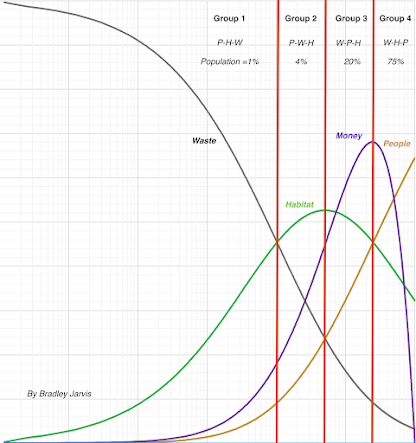
There are four identifiable groups that remain constant in their fractions of the population until too little habitat remains to support each person and members of the species that maintain it. The ranks of value placed on waste (artificial environments), habitat (natural environments), and people are unique to each group, as shown below. Note that the two middle groups could also be considered one group, as mentioned in Distributions.

Waste is valued most by the smallest group and people are valued most by the largest group. Habitat is valued most by the two middle groups, with one valuing waste second and the other valuing people second. No one in one group places the same amount of value on people or waste as anyone in another group. Members of either of the middle two groups can value habitat the same as members of the other group, but not members of either of the two remaining groups. Some members of the smallest and largest groups can value habitat the same, but no one can value habitat the same as members of the two middle groups.

If the value placed on each of the resources is exclusive of the others across the whole population, the fraction of the population valuing waste is 9%, the fraction valuing habitat is 40%, and fraction valuing people is 51%. Note that even for these groups, the fraction valuing people is much larger than the fraction valuing waste.

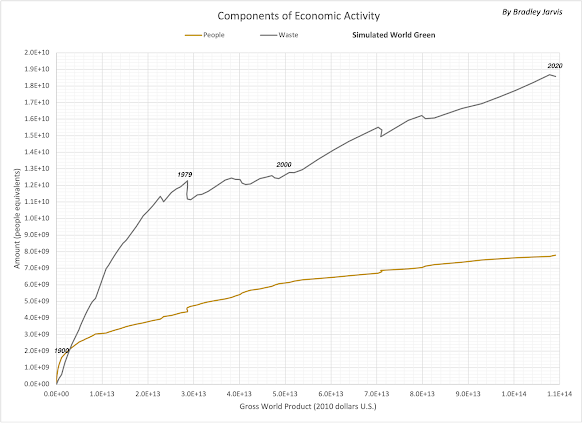
Money as a resource indicating relative economic activity (as indicated in the diagram for small populations and discussed in Economic Distribution) have favored equal value placed on people and habitat (corresponding to half the total habitat available to the population) while promoting increased waste by those who value it most. As shown in the following graph, waste production by a simulated world like ours has outstripped population growth (driving human transactions) as a component of economic activity and remains strongly associated with it. The “rich,” those benefiting most from that activity, and everyone else, represent another set of groups - defined by the value placed on money.

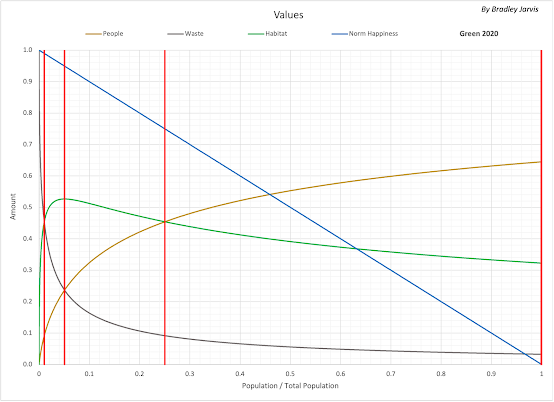
Implicit in this approach to quantifying what someone considers good and bad is the debatable assumption that their current conditions represent what they prefer, and that others they compare themselves to are likewise in preferred conditions. Even using change over time might not be a reliable indicator of preferences; the change could be so far beyond the person’s control and the destination is opposite to their preference. Referenced to groups, a person could move from one group to another due to the actions of others or environmental effects that force change in availability and consumption of resources. This appears to necessitate an additional variable for consideration: choice. Based on national statistics from 1800-2017, happiness varies as shown below, as does life expectancy, where the red lines mark the limits of each the four groups we started with; this suggests that members of a population will tend to prefer a higher value of waste.


As waste effectively decreases habitat, the ability of nature to provide basic biological needs decreases to a point where more people die than are born, beyond which the population crashes. Thus, increased waste decreases how long the population can exist (its longevity). Another set of groups could therefore consist of a group that cares about longevity being longer and the other that doesn’t. The group that cares about longevity would likely value habitat more than anything and waste less than people; the other group would consist of everyone else.


Saturday, July 15, 2023

Distributions

People are organized into communities that enable the acquisition, movement, manipulation, and use of resources in order to maximize the quantity and quality of what they value. Each community has its own strategy for doing so based on its values, its abilities and the composition of its environment.


Averaged over the world population for more than 70 years, my simulations show that the annual distributions among people of biologically useful resources have maintained a common pattern, with communities changing what parts of the pattern they occupy and the parts they interact with. The primary distributions are people, habitat (resources composed of, and used by, other species), and waste (resources converted by humans into forms that are not biologically useful). 

Processed to display how their amounts change relative each other, the distributions can be used to indicate how much different parts of the world’s population value people, natural environments (habitat), and created environments (waste). As the number of people is added up in order of increasing habitat density (people per unit of habitat), the value of people rises; the value of created environments drops; and the value of natural environments climbs to a peak and then falls. This is shown below.


There are three distinct groups defined by the intersections of the trends. The smallest, amounting to 1% of the population, is dominated by the value of waste over habitat and people. The second, amounting to 24%, is dominated by the value of habitat over the rest. The third and largest group, 75% of the population, is dominated by the value of people. Based upon my simulations, any isolated population with limited resources (embodied by habitat), that is not consuming more than a critical amount of them, will have these characteristics. 

Consuming more than two-thirds (67%) of total resources results in the first group growing at the expense of the other two until the amount of remaining resources is less than the total number of people - who will be in just one group that values everything equally. My simulation that best matches history shows that this year humanity will be consuming more than the critical amount, as shown below, and will reach the end point bordering on extinction by 2040.


Monday, November 9, 2020

Habitat Loss


As our species dominated and the world’s ecosystems, we made them part of our own habitat. The tools we used to do so were simultaneously used to create artificial environments that removed or spoiled resources that could be used to meet the basic biological needs of species we directly or indirectly depended upon for our survival, threatening to exterminate them and - in much the same way - us. This is a story told by statistical simulation of our history by my Timelines model and ecological observation of how extinctions occur.


According to my simulations, resources available for meeting human needs (what I’ve called “ecological resources”) are now only double the amount consumed for needs. This allows for consumption of only 15% more needs before population reaches a peak and then collapses. Most likely, collapse occurs because the populations of species (counted as resources) that supply the resources we directly consume themselves collapse. Our population peak is projected to occur no later than 2024, after which casualties are unavoidable.


ABOVE: Current summary of global variables and their projected trajectories. 


The COVID-19 virus is already exacting a toll on our population. It can be thought of as a consequence of habitat loss, because the other species in our habitat are likewise experiencing habitat loss, being forced to share more of their space with us and enabling those that prey on them to prey on us. Critically shrinking habitat is making this situation catastrophically worse even as our temporarily restrained consumption slows the rate of the shrinking. 


Meanwhile, climate change is becoming a self-sustained feedback of our pollution that is destroying habitat and creating conditions such as melting ice that will drive it further on its own. Our collectively growing obsession with reducing greenhouse gas emissions (climate-altering pollution) might slow the destruction, but more is necessary because we are too close to the critical point where species including ours might not avoid collapse in time to recover. 


As I’ve suggested before, the best option is to radically increase the total amount of habitat by reducing what we are currently consuming (in needs and waste). This will buy time for us and the other species we save to create barriers to further loss, including cleanup of waste such as that threatens to increase global warming. My simulations of such an approach provide insight into the attendant physical and social consequences that be used to craft a strategy for making them a reality and monitoring the results.


ABOVE: Summary of global variables after a reduction in consumption from 2021 to 2030. Reducing the amount of greenhouse of gases in the atmosphere to avoid more dangerous temperatures would need to occur soon.