Showing posts with label economy. Show all posts

Saturday, August 26, 2023

Groups of Value

The term “values” can be reduced to what someone uses to define “good” and “bad.” In my attempts to quantify it and relate it to behavior and global outcomes, I’ve identified a set of resources and amounts of them that everyone has and uses to some extent. Fractions of the totals of each per person throughout a population, representing how much each resource is valued, are ranked based on calculated distributions of each using historical projections of the totals over time that are embodied in simulations.

There are four identifiable groups that remain constant in their fractions of the population until too little habitat remains to support each person and members of the species that maintain it. The ranks of value placed on waste (artificial environments), habitat (natural environments), and people are unique to each group, as shown below. Note that the two middle groups could also be considered one group, as mentioned in Distributions.
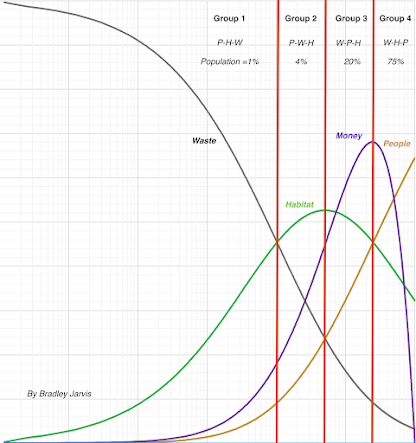
Waste is valued most by the smallest group and people are valued most by the largest group. Habitat is valued most by the two middle groups, with one valuing waste second and the other valuing people second. No one in one group places the same amount of value on people or waste as anyone in another group. Members of either of the middle two groups can value habitat the same as members of the other group, but not members of either of the two remaining groups. Some members of the smallest and largest groups can value habitat the same, but no one can value habitat the same as members of the two middle groups.

If the value placed on each of the resources is exclusive of the others across the whole population, the fraction of the population valuing waste is 9%, the fraction valuing habitat is 40%, and fraction valuing people is 51%. Note that even for these groups, the fraction valuing people is much larger than the fraction valuing waste.

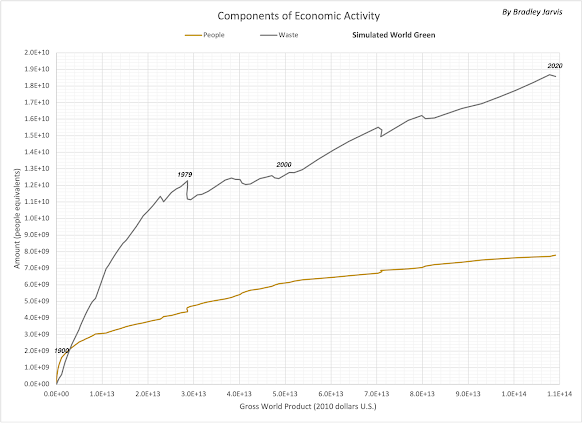
Money as a resource indicating relative economic activity (as indicated in the diagram for small populations and discussed in Economic Distribution) have favored equal value placed on people and habitat (corresponding to half the total habitat available to the population) while promoting increased waste by those who value it most. As shown in the following graph, waste production by a simulated world like ours has outstripped population growth (driving human transactions) as a component of economic activity and remains strongly associated with it. The “rich,” those benefiting most from that activity, and everyone else, represent another set of groups - defined by the value placed on money.
Implicit in this approach to quantifying what someone considers good and bad is the debatable assumption that their current conditions represent what they prefer, and that others they compare themselves to are likewise in preferred conditions. Even using change over time might not be a reliable indicator of preferences; the change could be so far beyond the person’s control and the destination is opposite to their preference. Referenced to groups, a person could move from one group to another due to the actions of others or environmental effects that force change in availability and consumption of resources. This appears to necessitate an additional variable for consideration: choice. Based on national statistics from 1800-2017, happiness varies as shown below, as does life expectancy, where the red lines mark the limits of each the four groups we started with; this suggests that members of a population will tend to prefer a higher value of waste.
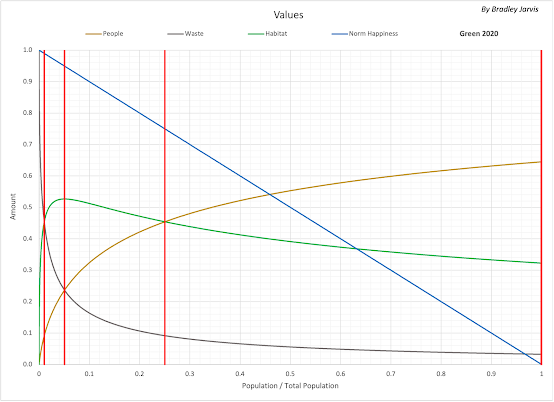

As waste effectively decreases habitat, the ability of nature to provide basic biological needs decreases to a point where more people die than are born, beyond which the population crashes. Thus, increased waste decreases how long the population can exist (its longevity). Another set of groups could therefore consist of a group that cares about longevity being longer and the other that doesn’t. The group that cares about longevity would likely value habitat more than anything and waste less than people; the other group would consist of everyone else.


Saturday, October 8, 2022

Upgrades


For much of this year I nursed a slowing computer while attempting to further my research and to do some writing within time limited by working a full-time job (luckily at home). As has happened in similar experiences, I built up a cache of insights that I could share when conditions permitted while sharing tidbits of related wisdom and information on social media platforms, most notably Twitter (@bradjarvis), which also served as a tool for collecting relevant source information. Just when my computer became unusable due to “upgrades” in the operating system and software that its speed could not handle, I capitulated to the need for a hardware upgrade (a new computer) to keep up with them and maintain the most basic functionality.

My new insights, as the most useful have, came from taking a fresh look at the essence of the mathematical modeling of historical data that has dominated my decades-long research into how basic values and resource availability are coupled to affect how long and how large a population can survive. This phase of the research focused more on what happens to groups within a global population than on projections of what happens to the entire population, requiring many more calculations to provide meaningful results. I had enough results by the time my computer became unusable to begin drawing conclusions that could be tested and used to extract a simple set of rules that embody their derivation.

The most fundamental insight of the model has been that human consumption of ecological resources (provided for sustenance of life in ecosystems) varies predictably with habitat density; where habitat density is the ratio of consumption for needs to the number of resources that remain (which are available to members of other species to meet their needs). One of my new insights is how consumption for needs (which is proportional to the number of people) increases with habitat density, and how the amount not consumed for needs (what I call waste) decreases with habitat density. 

Economic activity, measured globally as Gross World Product (GWP) and on a national level as Gross Domestic Product (GDP), is a function of the number of potential exchanges of resources, which varies with the number of people and the resources they consume. The distribution of people and resources derived from their relationships to habitat density can therefore be used to estimate the range of habitat densities occupied by an economically active group like a nation for which that activity is measured. Related aspects of people’s lives such as life expectancy and happiness show looser correlations with habitat density that can therefore be used on a society level to infer the dominant values associated with those aspects along with the more direct ones: population size and longevity (how long the society can survive with its resource base).

The upgrades to the underlying historical data and its analysis showed that, in general, nations have kept their minimum habitat density the same as the world’s while varying their maximum habitat density. This maintains a link to the people in the society with the most access to resources that can be used to meet needs and are paid handsomely for it. In the extremely rare exceptions where that link has been severed, it appears to have been accompanied by rapid demographic transition or government collapse. If, as most of my simulations of the world’s future show, the minimum habitat density climbs in response to critically depleted resources, what triggered those exceptions may also become outcomes in a self-sustaining feedback loop that accelerates the process, enhanced by environmental feedbacks that further reduce available resources.

For now, my new computer is performing as well as I hoped, apparently matching what my not-too-old computer was able to do. Like humanity’s instinctive drive to increase the number of people in the world, which seems to be our dominant value, my hard drive is filling up with the inevitable upgrades to my software and the files (and increases in file size) that I am generating with each new increment of my research and writing. Some time when I least expect it, a critical amount will be used and a new set of upgrades will threaten to make this computer inoperable, just as our planet is on the verge of becoming unable to sustain life as we know it, forcing us to quickly (and impossibly) find and move to another one or die. Refusing that next upgrade is still an option, as is reducing what we’re already doing with it so we can use fewer resources. Unfortunately, our planet – like my last computer – may be doing the ecological equivalent of changing the operating system so that functions we need can no longer be done without a lot of adaptation. Time is running out to find and implement a solution to this conundrum, and I’ll keep doing what I can to help that process.


Wednesday, April 15, 2020

A Pandemic-Altered Future


I have continued refining my simulations to account for the progress of the COVID-19 pandemic and the potential futures that might result from it. The strong correlation of carbon emissions and total consumption suggested that atmospheric carbon dioxide concentration could be used to estimate total consumption; I would then project total consumption along with the ratio of needs to remaining resources based on population projections made from pandemic global death statistics and my simulation (Green Prime) of population without the pandemic.

A curve fit of carbon dioxide concentration and total consumption automatically factored in the effects of natural contributors and the cumulative aspect of consumption and extracted the resulting consumption, as shown below.


I updated projections using weekly mean concentration and the average difference between Green Prime population and total deaths from COVID-19. The current projections are shown below.


Despite the apparent convergence of deaths toward a maximum beginning in May, the projected population (“R Projected”) suggested a much different situation. This was perhaps due to an excess of deaths by people who couldn’t be treated for life-threatening conditions other than the virus, or it was due to underlying growth in the virus-related deaths, or both, but it convinced me to continue allowing the possibility of greater growth in deaths as shown in today’s population projections below.


Projecting global variables into the future based on current data shows that the virus would result in one year less of survival for our species, as shown below.


Reducing per-capita consumption (ecological footprint) would still extend our remaining time, although temperature would continue to rise. The following graph shows one such scenario: a 2% annual drop until just needs are being met.

Another option is to freeze consumption at peak happiness and life expectancy as shown below. This would result in temperature exceeded the 2-degree Celsius threshold earlier, which would likely force a decrease in population.


Tuesday, March 31, 2020

Bridging the Future


Shortly after discovering that constant capacity (total ecological resources) provided a better fit to historical data by my Timelines model than my baseline simulation (“Green”) that decreased it, the COVID-19 pandemic threatened to significantly change the world’s population-consumption trajectory on its own. 

The model has two main purposes: to help people judge how to live their values and understand the effects of doing so; and to identify ways to avoid humanity’s extinction. Simple curve-fits to world deaths from the pandemic suggested that, left unchecked, it could result in extinction by August of next year. I knew enough biology to dismiss that as highly unlikely, but it would almost certainly result in a population peak, and close to the time that my new simulation (Green’) was indicating.

  
ABOVE: Projections of population for simulation Green’ and with projected COVID-19 deaths (as of March 31, 2020). Unchecked deaths would result in extinction, a population of zero, by day 560 (August 3, 2021).

If the new population reached its peak on schedule around September 1, 2020, and then synchronized with the Green’ population projection, the net deaths would be the difference between the values of the two peaks. The virus would essentially wipe out the gain in population since mid-2019 that appears at the resolution of weeks instead of years.


ABOVE: Global variables projected for simulation Green’ at mid-year 2000-2050.

If the average population and per-capita consumption stay at the 2019 values from 2020-2021 (to crudely account for reduced activity as well as population), the model projects that extinction will occur one year earlier than otherwise, as shown below.


Looking ahead toward how to achieve the primary goal of avoiding extinction, the prescription remains the same as before: reduce per-capita consumption as soon as possible while maintaining constant population. A 2% annual reduction from 2021-2062 would keep the global temperature anomaly below the catastrophic level until 2100, as shown below.


Doubling the decrease in per-capita consumption until only basic needs are met, as shown below, adds another 50 years to the time when the maximum temperature is reached.


Note that these projections reflect my personal valuing of human life. Letting population decrease instead would keep per-capita consumption at an arbitrarily higher level, even though the economy would likely drop more (because it depends strongly on the number of transactions, which varies with the square of population).

Thursday, August 22, 2019

A Brief History of Simulated Wealth

About sixteen hundred years ago, people on average began consuming more than what nature had allocated to meet their basic needs. At that point, personal wealth switched from depending on access to people to depending on access to resources. This enabled wealth to flow to fewer people who could trade and consume more resources. Extraction of resources increased environmental degradation which made fewer resources available for trade (the difference being "waste"). Perhaps as soon as 2025 there will be more waste than what people consume for basic needs, and more people will die than are being born. With fewer resources and fewer people, wealth will become more evenly distributed until everyone is dead. 

That scenario is based on a simulation of civilization, with a likely future where people do not work to reduce waste that is increasing faster than they are creating it (such as greenhouse gases that by amplifying climate extremes and chaos are making more of the world uninhabitable). In an alternative future projected by the fictional denizens of the simulated world "Hikeyay" featured in my Simulated News blog, total consumption is humanely forced down until 2040 so natural ecosystems can assist fighting climate change, resulting in wealth being cut to 1/6 of its starting value this year and wealth inequality dropping by more than half while waste is totally removed. Waste could come back with a vengeance if its external sources aren't disabled, but the means of stopping it cannot be done with wealth compensation if additional consumption is to be avoided.

The inherent dependency of wealth on per-capita consumption and transactions (proportional to the square of population) is also true of economic activity (embodied in gross domestic product) both as an observation and as a fundamental aspect of any economy. If everyone is consuming the same amount, such as meeting their basic needs, people's economic activity and wealth (the amount of resources being exclusively used) will vary with differences in population between groups. If people are consuming different amounts of resources (such as when consumption exceeds basic needs), then those who have the most resources (as wealth) will be at the focus of the most activity.

Performing functions such as removing waste would undoubtedly require some consumption of resources to create, deploy, and maintain any technologies involved. Offsetting existing consumption is one way to avoid this problem, which governments traditionally accomplish by collecting taxes and ensconcing wealth as capital "owned" by its citizens that cannot be traded by them. Other species (as our species once did) perform many such functions as part of meeting their basic needs, and as "resources" meeting the basic needs of others, therefore making that work and its results essentially free. Using other species in this way is ideal if we are to limit our consumption, while using institutions such as government is justifiable only until existing consumption can no longer be offset, such as when taxes keep citizens from meeting their basic needs. 

In the admittedly unlikely future of Hikeyay, people will work together to improve the scope and health of natural ecosystems while reducing their personal consumption and population to what can be maintained with the amount of available resources projected for 2040 by a coordinating institution that collects and processes observations from around the world. In the worst case, externally increasing waste is unstoppable and people end up barely meeting their basic needs until diminishing resources crash the population. In the best case, a stable population consumes the same amount per person as the world did around 1920. This is what I see as the best case for us too.


BELOW: L = life expectancy, h = happiness, Fert = fertility, Cum P = cumulative population, World P = world population, R = total consumption, Cap = capacity, C = per-capita consumption. Year of plot indicates associated phase with dark triangle below x-axis.


Tuesday, June 19, 2018

Fix


Beginning in the 1960s, a growing number of people felt that something ominous was approaching. Scientists began warning that the global natural environment was degrading to unsafe levels, and that critical resources were at risk of overconsumption. Use of tools designed to model complex systems revealed that this jeopardized the survival of civilization and even the entire human species. While a majority of proposed solutions focused on acquiring more resources (especially energy) in less damaging ways while accelerating economic growth, a minority argued for reducing overall consumption – even at the expense of economic growth. 

After 1990, economic growth in Timeline 2 generated noticeably less wellbeing than people expected based on previous decades, despite acceleration of economic activity that reached a peak in 2006. Attempts to increase that acceleration by promoting consumption had the opposite effect because of its newly significant slowing effect on population growth, and in 2017 the rate of economic growth began dropping for the last time.

A third timeline was born of this last event. Its inhabitants had a better chance of surviving because a critical number of them simultaneously came to understand that an alarming degradation of social order in recent years was inextricably linked to the degradation of their world's natural environment, of which pollution-linked global climate change was only the most obvious manifestation. Their number was critical because radical change on a world-wide scale was needed immediately, and they had just enough influence to pull it off.

With only two years left before population reached its own peak and more people started dying than being born, stopping the growth of global consumption was the most effective strategy to use. This artificial peak in consumption would similarly require a decrease in consumption by some people that was equal to any increase in consumption by the rest. Ideally, to reduce pain and suffering (as well as social tension that could result in violence and death), the difference between the two would have to be small, and could be aided by avoiding replacement of people who died of old age. But since the passing of several geophysical tipping points had all but ensured that the amount of available resources would diminish without any additional consumption, everyone would still need to learn how to – and agree to – decrease their consumption to match the supply.

Without voluntary initiation of the strategy, the practical difficulty of social engineering required in its absence was too much for Timeline 2 to avoid catastrophe, and humans there would be effectively extinct by 2038. Immediately following the trigger that started the "Fix" timeline, current Gross World Product grew at a rate one-twelfth of what it did in Timeline 2, and within ten years fell to an annual increase of only half a percent.

Facing the threat of a rapidly uninhabitable planet if they kept living the way they had, more and more of the people in the Fix timeline split their newly "free" time between finding ways to survive that had lower impact on natural systems and removing or rendering harmless as much toxic material as possible. Those who insisted on doing otherwise were steadily deprived of the resources that enabled that behavior, isolated themselves, and then died off.

As natural disasters multiplied and people in the Fix timeline became more familiar with their artificial and natural environments, it became clear that most of the built infrastructure existing until 2018 could no longer serve its intended purposes. Useful and safe material was salvaged for use in new structures resembling Earthships, while the rest was rendered as harmless as possible before being abandoned. Various "hot zones" remained, such as nuclear power plants and weapons stockpiles, which were staffed by volunteers who worked on decommissioning them at high personal risk using what technology was necessary and could itself be rendered safe in the process.

Several fundamental shifts occurred organically as the population of the Fix timeline learned to survive in the long term. One was decoupling the economy from ecological impact. Historically, economic activity was a function of the number of transactions of resources, which depended on both the number of people and what was traded between them; all such activity was measured the same way, without regard to its individual qualities. As restricting both individual consumption and the number of people became more intrinsically valuable, this measure became useless. As people learned to reduce their experience to its essentials as a price for survival, they came to treat interactions with others as part of an almost artistic collaboration whose value was in the result rather than their individual contributions. Like their replacement of largely useless physical infrastructure from the past, they developed new ways to efficiently coordinate their activities based on net benefit, maximizing prioritized qualities over time at all conceivable scales, with survival having the highest priority.

Another fundamental shift was a reshaping of group identity. Taken globally, the world's many nations, cities, and smaller groups behaved as one composite population. The global environment was likewise a composite of ecosystems with their own subpopulations of myriad species with functional elements common to the rest. As physics inexorably moved energy and matter around the planet to create temporarily stable states independent of artificially defined boundaries, members of all species – including humans – had to be able to move to regions that improved their chances of survival, and then interact with others in those regions to get what they needed. If a small group of individuals or species attempted to dominate a region, it took the risk of being unable to adapt to specific conditions within the region that others could, and might otherwise assist them to do the same. The people of the Fix timeline were aware of these facts, and organized their groups to improve their chances of survival by maximizing adaptability. This meant that most groups would need a mix of knowledge, abilities, and environmental affinities that could be applied to a variety of places they might need to go. Emphasizing respect within those groups, and applied to other groups of people and species, would reduce the possibility of local population collapse in any given environment.

At the moment, we have the most in common with Timeline 2, and still barely have the option of branching onto the Fix timeline. To the extent that we can apply insights that come from imagining that timeline, we might gain more time for ourselves.


Friday, February 23, 2018

Timelines


Since November I have continued to struggle with the "Rabbit Hole," with a little more success. That success is, in part, due to a decision to give in to my troubleshooting instincts and follow a process that served me well as a test engineer: simulating the system under test, and then using that simulation to reproduce a problem in order to identify its cause and potential solutions. The fact that there are multiple problems made this approach even more attractive. Having done so, I am ready to share what I learned.

The main problem, as it's always been, is the limitation of humanity's population growth and collective lifetime due to unavailability of resources critical to survival. The other problems have to do with limitations to maintenance and growth of the quality of life for the people in that population, not to mention the ultimate consequence of our definition of members of other species as "resources": their dying to the point of extinction. Evidence for these problems is found in the news, results of scientific research, and personal experience that people share (as well as my own). One of the most obvious consequences is stress from growing uncertainty about our own fate and the fate of those we care about, and lack of trust in the people and institutions that we've counted on to reduce that uncertainty.

For me, understanding is a remedy for uncertainty, even if that uncertainty can only be measured. I already had a good start on addressing that. The "population-consumption model" I've been working on for more than a decade has yielded some interesting insights, which have been the basis of much of my writing over that period. To be useful as a troubleshooting tool, though, it needed a lot more refinement. It especially had to be able to address specific behaviors of people, which I considered one of its main deficiencies. It also had to better match the historical data, which was helped by the addition of more data about ecological impact as a proxy for consumption, along with economic activity.

The most basic output of the model was a presentation of the past and most likely future of global population and consumption, similar to what I generated with previous versions. This time, though, I chose to focus on types of consumption, needs and wants, and a new type of impact – waste. Needs are the resources consumed to maintain the most basic survival, while wants are additional resources directly used by people, and waste is everything else that was part of overall impact. I also tracked what is left to consume – mainly members of other species (nature) and what they produce.

Unlike previous attempts, though, I left open the possibility of simulating timelines of history that didn't necessarily match with real experience: thought experiments describing what might be in other universes whose past, present, and future look significantly different from our own. This appealed to me because it could provide valuable context what we observe in our daily lives; and it could suggest actions we might not have anticipated by sticking strictly to reality. It also would inherently reduce confusion between real history and simulated history in my discussions, as I referred to timelines rather than actual events.

The first timeline I simulated, arbitrarily called "Timeline 1," was my best match to reality based on personal judgement about the variables and methods used, as well as tracking of differences between my source data and the outputs. By contrast, the source data represents "Timeline 0," which is essentially reality, though subject to change as more data is added – especially about future events. In Timeline 1, humanity is producing vastly more waste than wants, leading to peak population in 2020, peak economic activity in 2025, and extinction by 2037 as nature is depleted to a point where needs can no longer be met. This is accompanied by, and facilitated by, individual economic reward for waste that is equivalent to reward for meeting needs and wants, along with what the model shows is an inevitable and increasing unequal trade of waste for wants.

I will be adding more detail later, but the main points I just outlined for Timeline 1 are very consistent with the lessons I've learned from the bulk of my research, which is an argument for its usefulness in troubleshooting the real problems the model was created to simulate. Since Timeline 1 is based on human activity and does not include the potential influence of external changes to the environment such as self-sustaining climate feedbacks, it can mainly suggest actions we can take to delay, if not stop, our extinction in the absence of those changes. For example, one such action would be to reduce or remove reward for waste, beginning with calling it out for what it is.

One of the discoveries I made in preparing the new version of the model is a mathematical relationship between ecological impact and economic activity. If it's correct, then the residents of Timeline 1 can't just redefine how economic activity is distributed throughout the population without factoring out the waste they produce. Such a redefinition would, however, alleviate the grossly unequal quality of life that is among the other problems some of them – and some of us – might want to address, and may be a feature of another timeline.


Tuesday, October 27, 2015

Earl's Myth


In the latest installment of a novel I'm writing in parts, a fictional industrialist named Earl recalls a myth he used to finance his nascent company. The myth was based on an ecological interpretation of businesses within an economy which in reality I made up while writing about it:

Economies functioned much like biomes, with companies acting like organisms, industries functioning as populations of species, and economic activity joining them in communities that, together with the physical resources such as people and materials that they collected and processed, functioned as ecosystems.

Of course, economies are artificial, but I wonder if most of us tend to expect similar things from both our artificial and natural environments. Evolution has shaped us to get what we need from natural environments if we follow certain instinctive behaviors, and to penalize us if we don't. Education serves a related function in relating to civilization by priming both our skills and our expectations so we can survive and thrive to the extent that we occupy useful niches within our artificial environment.

For the analogy to work, people must be equivalent to organisms in both types of environment, but there are many indications that it is no longer working. Perhaps the most obvious indication is the huge amount of wealth inequality in the world today, the equivalent of which would, I suspect, never occur in a natural system that wasn't about to include at least one population collapse. Instead, as Earl's myth described, we have organizations that are functioning as organisms, and people have been relegated to the role of "resources."

For the most part, the few people who have mastered control of the artificial organisms, through the acquiescence of their fellows and the illusion of embodied energy in money, still function as organisms themselves, and receive rewards commensurate with their occupation of the new niches demanded by the artificial world. The rest of us are simply used, then discarded, and perhaps recycled eventually (after extended periods of unemployment) while others are "consumed," all the while thinking that the work and personal degradation is an appropriate sacrifice for a better world created by the super-organisms (some of whom are still like us) that will eventually meet our wants and needs too.

Of course, the fact that our artificial organisms are using actual resources, and are crowding out the real organisms whose bodies and work enable our planet's habitability, means that the flesh-and-blood puppeteers of those organizations will also be part of the human population collapse facilitated by their efforts. Barring the success of fantastical efforts like that described in my book (a success we may not end up wanting), humanity will have to dispense with dangerous myths like Earl's and become reacquainted with Nature's reality just to survive.


Monday, August 24, 2015

Shutdown Economics

The recent stock market nosedive was a reminder that future economic growth is far from a sure thing. It, and an immediate need for personal financial planning, led me to explore the economic dimension of my shutdown scenarios, which not surprisingly reflects trends seen in the variables I've already studied.

I focused on Gross World Product (GWP), which according to my population-consumption model is proportional to the square of the number of "happy environments" that exist. The two cases (projected and worst) bracketing business-as-usual both result in a total crash; and the two cases that involve holding population constant (best and hybrid) end with a smaller but sustainable GWP (29% below the 2014 level). The projected case has the largest increase in GWP after 2016 (about 12% above the level in 2014), which is bounce-back from the population loss that occurs over the rest of this decade, but it is also the last peak before GWP crashes.

The best case is of course the least-disruptive of the scenarios, with a shallow decrease toward its final value. This is due mostly to the unchanging population size while personal ecological impact glides toward sustainability by effectively enabling other species to use the resources in one-in-six of the number of happy environments that existed in 2014.

Businesses and governments appear to pay more attention to the rate of change than the total of economic activity. By this measure, 2020-2022 will be the best period of any scenario, but all years after 2016 will be zero or negative in annual change, with 2028-2031 being the worst years. Even the best case will see its worst year in 2029, with what now seems a disastrous 12% drop in GWP, but which is actually the smallest drop for any scenario's worst year.

I've neglected the unlimited case in this discussion, which unfortunately is also the likely reference scenario for economic planning. Comparing the other scenarios to this one, which averages more than 2% annual growth over the next 20 years, the future is an even uglier picture than the one drawn in absolute terms above.

Finally, it is useful to describe the result of fusing all scenarios into a combined case. In this scenario, GWP is currently growing at a measly 0.4% compared to 2.4% over the last year. In other words, today's investors are rightly worried about a slowdown. By mid-2017, the economy will be clearly contracting along with population, which will last another two years. The following two years will have a sharp spike in growth, and then GWP will begin a long fall that stops finally by 2032 when the population is only 801 million people (11% of its value in 2014). At that leveling off, the money spent by an average person measured as GWP per person will be 8% of its 2014 value, and the much-diminished civilization will barely be able to function.

This coming year is when all of us should be trying to ensure that the contraction only results in a decrease in consumption below the critical level, setting the stage for the gradual decline in consumption that marks the best case scenario. From an economic standpoint this might manifest as a distribution of wealth to the most vulnerable people, and perhaps most important, a focus on paying for reclamation of habitat and other resources for use by other species rather than using money to build more artificial environments. As personal income and expense falls, more natural means for meeting needs would be developed so the money does not have to be replaced.


Monday, January 26, 2015

Spaceship Finance


In its simplest form, personal financial planning is governed by one inescapable requirement: Total income over remaining lifetime must be greater than or equal to expenses over remaining lifetime. If you're lucky, "remaining lifetime" is the sum of working years and retirement years, where you are not physically working during retirement.

In practice, planning gets complicated by the many forms of income and expense, but even they can be simplified when you realize that there are basically only two types of each: constant and exponential. The exponential types, in particular, can get pretty tricky, since they depend on the ability to accelerate growth of money without limits, and that money can represent both physical things and non-physical things. As the constant types have been increasingly linked to the exponential types (for example, your "constant" salary is likely paid by an employer who relies on exponential growth in profits), they too have become harder to plan for.

Now that we face hard limits to the availability of quality ecological resources, upon which our economy and our physical survival is based, basic assumptions built into our economy are beginning to lose their usefulness, which is making successful planning by most individuals and many organizations even more difficult. In addition to reducing room for growth, which has been assumed to be infinite, we are degrading the ability of social and physical ecosystems to absorb or nullify the negative effects of our actions within a period of time that is meaningful to people. This results in decreasing exponential income and increasing exponential expense, as an average, for our whole population, which reduces our effective lifetime.

One positive aspect of our situation is that we are collectively becoming a global village, re-creating some important dynamics of near-isolated communities of the past. In an idealized version of such a community, the social and environmental impacts of economic activity were felt directly by both businesses and their customers. Since the number of prospective customers was practically limited, businesses had to focus on keeping them satisfied; and since resources were limited, their consumption had to be kept below the regeneration rate (such as the growth of new trees for wood) if the business along with the community was to survive over a long period of time. Businesses were rewarded with enough profit to create new products or services only if they could find more resources or efficiencies in the use of existing resources, and if it didn't result in harming the community. Exponential growth became possible as a community's territory expanded and its population grew to take advantage of the newly available resources. Combining of multiple communities also contributed to that growth, leading to our present situation. Enabled by multiple technologies that have also grown exponentially, we have turned much of our planet-sized spaceship into a giant community of communities, subject to rules of survival similar to the ones those early communities had to live with, but without most of the self-replenishing resources they had.

Our new community and the environment it occupies is much more complex than the ones we were naturally evolved to maintain, which is a big reason for our heavy dependence on technology. Our computers and communications enable us to share and mentally process experiences around our community, translating its complexity into much simpler forms we can comprehend, thus keeping us from being aware of all but the largest of the consequences of our actions, and, even then, not with the gut-level feedback we naturally depend upon for knowing and acting to change the status of our environment. Put another way: We have taken over Spaceship Earth by cannibalizing its parts for our pleasure and thereby sabotaging its life support systems, while knowing a lot about the small part we were supposed to operate before we went rogue, and knowing very little about the rest of it.

One thing we do know is that life tends to maintain habitability for itself, and there is still a chance that species we haven't destroyed could fix enough of the damage we've inflicted to keep our planet habitable (if still uncomfortable) for at least a few decades more than if we don't let them. To give them that chance, we will need to let them have more resources. From a personal finance point of view, I estimate will all need to learn to limit our individual expenses to under $12,000 per year, which, not surprisingly, is most easily done by reinforcing the necessary regrowth of natural ecosystems and their denizens so they can provide more replenishing resources like what we evolved to consume (of which we should use less than half). This should also help reduce our greenhouse gas emissions, one of our largest negative impacts on ecosystems both directly and indirectly (through climate change).

Ideally, the world community would eventually function like an isolated sustainable community, utilizing exponential income and expense only as necessary to deal with conditions that require swift growth or contraction to maintain survivability, instead of an ongoing expectation for personal gain. For most of us, our life focus would shift to favoring quality over quantity. The inevitable fraction of the population that found this impossible to live with would have the option, like generations of the past, to explore new environments – this time in space – and make them habitable for people, so long as those efforts did not degrade the lives of existing communities.

Friday, January 16, 2015

Year Of Validation

It is now a year since I made the first projections into the future using my population-consumption model. At that time, I had identified three representative scenarios of what would happen after 2008, when the model showed humanity using up all of the valuable ecological resources that weren't already enlisted in maintaining civilization (technically, the number of "environments" people had created equaled the number of possible environments using available resources). A newly published academic study indicates that consumption of major resources other than energy reached a peak around 2006, apparently corroborating this critical point in the model's projection (which was later refined to 2009).

A few months ago, the WWF's latest Living Planet Report famously highlighted the fact that animal populations dropped by little more than half between 1970 and 2010. This too is consistent with my model, which in its last iteration showed a 55% drop in the Living Planet Index (LPI) over the same period. The model uses the LPI as a proxy for the amount of available ecological resources, and the amount of resources we are using as proportional to the global ecological footprint, so this and the consumption study are significant data points in validation of the model.

One other aspect of the model appears to have been partly validated over the past year, which I referred to in a previous blog post. As happiness increases, it takes more resources to become happier; and above a certain threshold (82%), consumption (of ecological resources) becomes negative, which I interpret as the consumption of virtual resources. My model includes the observation that our economy is based on the valuation of environments that theoretically would provide maximum happiness, and in one of its first validation exercises, reproduced our unequal distribution of wealth as a result of the economy's positive valuation of the excessive happiness of a few people. Since money is used to trade real things, that money is expected to represent real resources (even though they are in fact virtual) and therefore it appears that the rich are hoarding a lot of resources and effectively stealing from everyone else. It is logical to assume that the excessive happiness is likely met by using other people rather than other parts of Nature, and this would manifest as what the rest of us would consider antisocial behavior, with an associated reduction in conscience and empathy that enables people to be treated as things to be used for gratification (what I've called the root of all evil). The studies I learned about seem to verify this assessment. For me, the scariest part of this analysis has been the capacity of a few people to own everything, especially given the complexity of the systems we all operate under and the physical limitations we all have in comprehending, much less managing, what's around us; that they would become sociopaths makes it even worse.

The three projection scenarios I started with a year ago were based on simple extrapolations of happiness over time, and its effects on population and consumption. Those with the most physical credibility resulted in a catastrophic decrease in population, starting soon. I followed those projections with a series of simulations, producing theoretical versions of the world using random values of variables my model had identified based on research into the past, and then generalized the results which I have since considered more reliable and used as the basis for the projections and recommendations that I've presented since then. Given how sensitive the projections are over the next two to five years, we should know soon whether the model is truly valid. As a scientist, I can't wait. As a person, I wish I could wait forever.

Friday, December 5, 2014

Requirements For Another Ideal World

In "Money and Responsibility" I mentioned my latest vision of an ideal world, whose focus is on preserving and proliferating life, especially ours, through commonly held values, understanding, and management of resources. It can be described, with some refinement, by a set of requirements that would apply wherever humans are (on Earth and in space):

  • V: All of us agree to a common set of basic values and standards for developing them
    • The main value, which dominates all others, is the preservation and proliferation of life for as long as physically possible
  • U: All of us agree to a common understanding of reality and standards for developing it
    • That understanding will be based on observation, logic, and verifiable predictions
  • M: None of us can take, or render useless, the means of basic survival ("the commons") used by anyone else, including members of other species critical to maintaining those means, beyond the constraints of natural predator-prey relationships
  • E: Everything not in the commons may be distributed among people in a socially acceptable way, such as in an economy
    • This includes rewards for risks incurred in expanding the commons, which may be kept for a fixed time (not to exceed one lifetime)
  • R: We are all responsible for maintaining the commons

For convenience, I'll refer to these requirements by the acronym VUMER, and its implementation "VUMER World." The main value is the driver for all of the requirements; and an accurate and commonly-held understanding of reality is critical for taking appropriate and effective action in implementing values, especially those involving survival, and well as maintaining a cohesive society. Values "V" and understanding "U" therefore take precedence over the other requirements, which deal with implementation.

It is of course possible that an actual global agreement about values and understanding (which itself is pretty "ideal," and would involve everyone, rather than just officials of dominant political entities) would preclude my preferences for them and everything that follows from them. I wouldn't be surprised if such an outcome represents a compromise between VUMER World and the "Dead World" we are currently creating, which might delay our demise by a few more years, but at least we would all be invested in the outcome rather than, as many of us are, going along for the ride.

Tuesday, February 11, 2014

Happy Environments


My mathematical model of population and consumption now has an economic component that projects Gross World Product (GWP), global wealth, and wealth distribution backward and forward in time. The latter was aided by the lucky release of a new report on global wealth.

As people pursue happiness as defined in the model, they must seek and manipulate sets of conditions (what I call "environments") that maximize it. Economies are cultural tools for enabling this, so it's not surprising that they can be described in the same terms. One such term dominates this new view of economics: "happy environment."

People who have total life satisfaction occupy environments that are matched to all of their needs and wants. Such matches are uncommon, just like finding the perfect house. But if we could disassemble, move, and assemble all the environments we collectively have access to ("inhabited environments") to make environments that match as many people's wants and needs as possible, each of those environments would be a happy environment.

Our world economy doesn't explicitly traffic in happy environments (to my knowledge, this is a concept that I just invented), but it appears to do the equivalent. From what I can tell, it defines one set of happy environments for actual, physical conditions. It defines another set for all the ways those environments can be manipulated. Then it defines a third set for all the ways the environments and manipulations can be manipulated as abstract entities that embody their value. Mathematically, economic activity (such as that measured by GWP) is proportional to the square of the number of happy environments; and wealth is proportional to the cube of the number of happy environments.

One of the most controversial issues facing people today is the tremendous inequality in the distribution of wealth. If it was distributed purely on the basis of happy environments, this wouldn't be nearly as much of an issue as it is (though it certainly isn't issue for the few people who benefit from it). However, as I discovered while trying to find out how the model could reproduce the actual distribution, our economy apparently uses both happy environments and consumption to determine who has how much wealth, dominated by the latter. Our exhaustion of sources of new environments (and associated resources) has an already focusing effect on wealth distribution, which I plan to elaborate upon later, but this dependency on consumption makes it extreme.

Projections of our economic future follow the same trajectories as happiness and population, which are the factors that define the number of happy environments. Thus, we are probably at the peak of everything, and can expect it all to drop to zero by early in the next century (at the latest). I'm continuing to explore the alternative "best" case, which unrealistically relies on finding and using millions of Earth-equivalent biospheres over the next 800 or so years, which is what it would take to follow our preferred trajectory. If the model's assumptions are accurate that far into the future, then we will once again be at a peak, but it will be an ultimate one.