Showing posts with label values. Show all posts

Saturday, October 19, 2024

Limits to Superiority


We are animals. Each of us has only been on the world for a few decades at most. We are not the sum of all of the people who have lived before us. We are not the sum of even the people who are around us.

It doesn't matter who we are, we all have the same limits. No matter how smart we are, no matter how innately capable we are, we all must use several hours a day for sleep. Admittedly there’s a lot more of other people's experience shared in many different ways; but we have about the same amount of time to take in information.

We are not better than anyone around us, or anyone who has come before us, because we have the same fundamental limitations. We might shine in certain circumstances that other people don't, but there almost certainly are other circumstances where we are as much of a failure as somebody else in either similar or other circumstances.

We are not superior because of our culture, because cultures are products of people. They are subject to the same limitations: their physical environment; their access to resources; the collective knowledge that they can pass along to each of their fundamentally limited members; and, of course, time.

What is superiority anyway? Each creature has its own limitations in many ways shaped by their environment, by their experiences, and their genetics, which are themselves products of a process of trial and error in a variety of different environments that enable them to survive and sometimes thrive in some places (in others, not so much).

Once we accept that we have limitations, that we are not fundamentally superior to anybody or anything else, that we are a product of environment and events that brought us into being, whether they be biological or circumstantial, then we can go about living our lives with judgment based in reality. 

We might invent values and use them to guide our actions and the actions of others who adopt them voluntarily or otherwise. Values are inherently arbitrary, limited by the imagination, experience, and intelligence of their sources; they should themselves be judged accordingly. 

One value is common to all, whether explicit or not: survival. Without those who hold values, the values themselves cease to exist, though the consequences of actions based on those values will continue into the future whether or not anyone can judge them. 

This value highlights a fundamental aspect of existence that can be seen as the ultimate meaning of our lives: we are part of the universe, and the universe is part of us. We are not superior because we are not separate; we are a part, not apart.

As I worry about the future existence of life on Earth, I accept that whatever contribution I make to extending it will be limited. The influence of actions taken based on the values I choose is going to be beyond my control, beyond my limited ability to anticipate what it is. The stress I feel about not living up to those values is as much a consequence of my expectations and understanding as it is about what I accomplish.


Saturday, April 6, 2024

Value Statement

“Exploring new ways of thinking, for fun and optimization of the amount, longevity, and quality of life.” – Bradley Jarvis profile, X (formerly Twitter) @bradjarvis

That introduction is a succinct statement of my values and how I most prefer to serve them. The term “life” is more general than I’ve typically used it elsewhere, applying to both humanity and other species. 

By my calculations, collapse of both populations is avoided where natural habitat that includes other species accounts for more than 63% of the sum of habitat and what people are consuming to survive. Put another way: The habitat that supports humans requires about the same amount of additional habitat to support it; less than that and it decreases, unable to support as many of us. If we were like other species and did not generate waste, our population would decrease to a level that could be supported by the remaining habitat which is supported by what it needs that grows back; but with increasing waste, that can’t happen, and we all die together.

What I just described accounts for the amount of life. How long both populations can survive is the longevity. Quality of life is how well members are matched to their environments, receiving benefits commensurate with what they contribute to the health of others. Humanity’s creation of waste, whose function as the essence of artificial environments is to provide benefits without requiring the giving of benefits, has enabled increasing quality of life for some at the expense of life itself for others – nonhuman and human.

One of my “new ways of thinking” is to tie amount, longevity, and quality as aspects of life to the values of people, habitat, and waste that I’ve identified in my other writing and described briefly above. How the aspects of life are to be optimized depends on the relative priorities of the values; and those priorities will be different for different people. For that reason, my recent research has been focused on deriving what those priorities might be (and how they might change) within given populations of people; and presenting the results as aspects of life within simulated “worlds” with similar pasts and different futures – one of which might be our own.

My greatest interest has been how to increase human longevity since our extinction would be the end of all our lives and our values along with them. The dependency of longevity on the amount of available habitat over time and the number of people consuming it to meet basic needs is a good reason to give habitat at least as high a priority as people. Waste would be the lowest priority, though it can serve longevity if a fixed amount of it is used as protection from threats to it that can’t be dealt with otherwise. Waste also can be, and has been, used to access more habitat if habitat is diminishing or population is growing beyond what existing habitat can support.

 From the perspective of other species, my guess based on extensive reading about biology and specifically ecology is that, for many, the value of population size (as procreation) would be the highest priority. Habitat (food supply and shelter) would be second. Waste wouldn’t even occur to them unless it was mistaken to be part of their habitat. Generally speaking, enabling development and maintenance of healthy, diverse ecosystems is the best way to optimize non-human life. This would, as a minimum, involve getting rid of waste and making the rest as harmless as possible.

As for the fun part of creative thinking, it’s a natural reward that draws me to do more of it no matter what circumstances I’m in.


Saturday, August 26, 2023

Groups of Value

The term “values” can be reduced to what someone uses to define “good” and “bad.” In my attempts to quantify it and relate it to behavior and global outcomes, I’ve identified a set of resources and amounts of them that everyone has and uses to some extent. Fractions of the totals of each per person throughout a population, representing how much each resource is valued, are ranked based on calculated distributions of each using historical projections of the totals over time that are embodied in simulations.

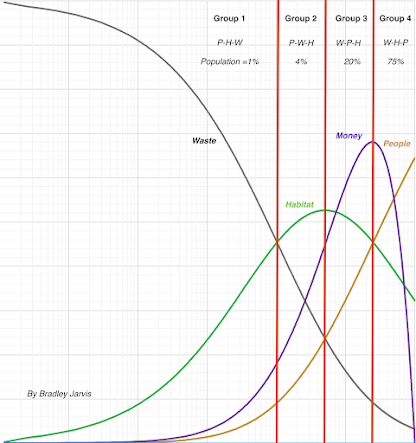
There are four identifiable groups that remain constant in their fractions of the population until too little habitat remains to support each person and members of the species that maintain it. The ranks of value placed on waste (artificial environments), habitat (natural environments), and people are unique to each group, as shown below. Note that the two middle groups could also be considered one group, as mentioned in Distributions.

Waste is valued most by the smallest group and people are valued most by the largest group. Habitat is valued most by the two middle groups, with one valuing waste second and the other valuing people second. No one in one group places the same amount of value on people or waste as anyone in another group. Members of either of the middle two groups can value habitat the same as members of the other group, but not members of either of the two remaining groups. Some members of the smallest and largest groups can value habitat the same, but no one can value habitat the same as members of the two middle groups.

If the value placed on each of the resources is exclusive of the others across the whole population, the fraction of the population valuing waste is 9%, the fraction valuing habitat is 40%, and fraction valuing people is 51%. Note that even for these groups, the fraction valuing people is much larger than the fraction valuing waste.

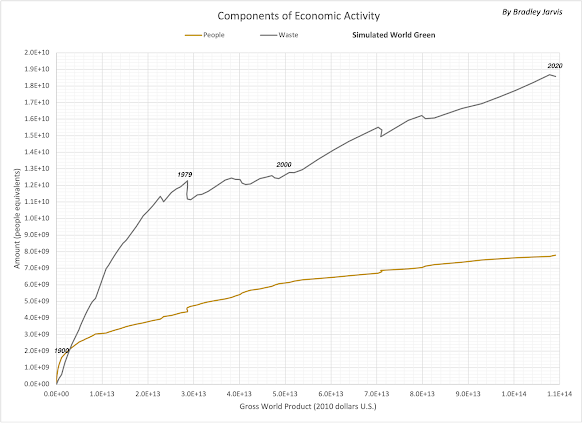
Money as a resource indicating relative economic activity (as indicated in the diagram for small populations and discussed in Economic Distribution) have favored equal value placed on people and habitat (corresponding to half the total habitat available to the population) while promoting increased waste by those who value it most. As shown in the following graph, waste production by a simulated world like ours has outstripped population growth (driving human transactions) as a component of economic activity and remains strongly associated with it. The “rich,” those benefiting most from that activity, and everyone else, represent another set of groups - defined by the value placed on money.

Implicit in this approach to quantifying what someone considers good and bad is the debatable assumption that their current conditions represent what they prefer, and that others they compare themselves to are likewise in preferred conditions. Even using change over time might not be a reliable indicator of preferences; the change could be so far beyond the person’s control and the destination is opposite to their preference. Referenced to groups, a person could move from one group to another due to the actions of others or environmental effects that force change in availability and consumption of resources. This appears to necessitate an additional variable for consideration: choice. Based on national statistics from 1800-2017, happiness varies as shown below, as does life expectancy, where the red lines mark the limits of each the four groups we started with; this suggests that members of a population will tend to prefer a higher value of waste.


As waste effectively decreases habitat, the ability of nature to provide basic biological needs decreases to a point where more people die than are born, beyond which the population crashes. Thus, increased waste decreases how long the population can exist (its longevity). Another set of groups could therefore consist of a group that cares about longevity being longer and the other that doesn’t. The group that cares about longevity would likely value habitat more than anything and waste less than people; the other group would consist of everyone else.


Saturday, August 12, 2023

Economic Distribution

 Distributions of people, waste, and habitat throughout a population are, in part, maintained by economic activity that is reflected by the money people exchange with each other. Like those resources, that money can be treated as a resource and translated into a value relative to the others.

Because it depends upon total quantities of people and waste, exchanged money varies as those quantities change over time. Measured as Gross World Product (GWP), the total has generally increased. How much it is valued throughout the population is determined by the distributions of people and waste.

In simulated world “Green,” whose history is a close match to ours, economic activity until the 1920s was most valued by those who valued both people and waste equally while placing the highest value on habitat. As more waste has been created by economic activity, a small fraction of the population, who values waste more than anything, has increasingly valued money that represents that creation. By the 1950s, the value of money to that group had risen to exceed the maximum value that any other group placed on people.

The focus of economic activity on the growth of waste has continued to the present. For most of Green’s history, 2% of the population has been responsible for 80% of the world’s waste. In 1960, that group was also responsible for 54% of the GWP. By 2020, it was responsible for 68% of the GWP. Increasing waste is largely responsible for decreasing habitat, which includes other species that maintain the habitability of any world; and starting this year, a growing number of people are projected to consume all the habitat available for their survival (a “density” of 1), altering every distribution. Waste, habitat, and people will approach equal value as the death rate increases, and money will be valued more than anything right before all are dead, which is projected to be in 2041.


Saturday, July 15, 2023

Distributions

People are organized into communities that enable the acquisition, movement, manipulation, and use of resources in order to maximize the quantity and quality of what they value. Each community has its own strategy for doing so based on its values, its abilities and the composition of its environment.


Averaged over the world population for more than 70 years, my simulations show that the annual distributions among people of biologically useful resources have maintained a common pattern, with communities changing what parts of the pattern they occupy and the parts they interact with. The primary distributions are people, habitat (resources composed of, and used by, other species), and waste (resources converted by humans into forms that are not biologically useful). 

Processed to display how their amounts change relative each other, the distributions can be used to indicate how much different parts of the world’s population value people, natural environments (habitat), and created environments (waste). As the number of people is added up in order of increasing habitat density (people per unit of habitat), the value of people rises; the value of created environments drops; and the value of natural environments climbs to a peak and then falls. This is shown below.


There are three distinct groups defined by the intersections of the trends. The smallest, amounting to 1% of the population, is dominated by the value of waste over habitat and people. The second, amounting to 24%, is dominated by the value of habitat over the rest. The third and largest group, 75% of the population, is dominated by the value of people. Based upon my simulations, any isolated population with limited resources (embodied by habitat), that is not consuming more than a critical amount of them, will have these characteristics. 

Consuming more than two-thirds (67%) of total resources results in the first group growing at the expense of the other two until the amount of remaining resources is less than the total number of people - who will be in just one group that values everything equally. My simulation that best matches history shows that this year humanity will be consuming more than the critical amount, as shown below, and will reach the end point bordering on extinction by 2040.


Tuesday, July 10, 2018

Values Realized


What we want out of life comes at the expense of Nature. This fact drives our relationships with each other and the other species we share the planet with, as well as how long and how many of us can survive.

No matter what group or groups we might be part of, we are all part of one group: the human species. The number of people in that largest group, its population, has been growing since the beginning of civilization, reflecting the value we collectively place on people. Like other animals, each of us requires a minimum amount of resources to survive, so the amount of resources we consume increases with how many of us there are. Since the populations of other species use or embody much of those same resources, the resources must be shared over time for the system of life to last as long as possible.

Most of us would prefer to live long and healthy lives. Because sharing resources is so critical, and we embody resources that other species can use for food, extending our lifetimes reduces the amount of resources available to other life during the time they are needed by those other species. Thanks in large part to our ability to develop and share knowledge and skills, and translate those things into material objects that can accelerate the process, we have enabled more people to live past birth and to thwart more of other species' attempts to consume us. As a result, we have increased consumption and more than tripled the average amount of time people can expect to live from birth (life expectancy) since the beginning of civilization.

We would all like to have satisfying lives. Happiness means different things to different people, but statistically it tends to increase with consumption in much the same way as life expectancy. This can be interpreted to mean that it is an expression of how well people are able to match their lifestyles to their personal preferences, which is enabled by economies that distribute resources among people through trade. Economic activity, which is easier to measure than happiness and tied more directly to consumption, is therefore often used as a proxy for happiness.

The Timelines model projects that, if we live like people in the simulated scenario Timeline 2, then global population, life expectancy, and happiness will reach their maximum average values between 2020 and 2022. The good news is that most people will get to see the pinnacle of human achievement, even though it won't feel good for half of them. The bad news is that life expectancy and happiness will reach zero for everyone between 2029 and 2030, and no one will be left alive by 2038.

Since Timeline 2 has 82% of its recent history in common with ours, it makes sense to use it as a baseline for discussion of the future. The values of population, life expectancy, and happiness are all dependent on what fraction of remaining resources people minimally consume: as the fraction grows, the values grow until the fraction reaches about 57%, falling to zero for fractions larger than that. 

If we don't want the values to drop (especially for population), then it makes sense to keep the population below its peak (affecting minimal consumption) and our additional consumption from growing (affecting the remaining resources). This is the logic behind the Fix timeline. We could alternatively let events unfold without intervention and hope that people will not overshoot the peaks; but if they do, that the apparent desire to consume more will be overcome by a desire to seek out the peaks, and they will voluntarily reduce their consumption to reach the peaks again.

The Fix and the "wait-and-seek" strategies include an implicit assumption that depletion of remaining resources is totally within people's control. The depletion beyond the economic equivalent of renewable products and services provided by other species is largely due to harm and killing of the species that provide them, and harm to species that those species depend on for survival. Those effects are caused by the same drivers as extinction: habitat loss, alteration of ecosystems by invasive species, pollution, use of common resources by the human population, and direct killing due to hunting and over-harvesting. Pollution in particular is having a greater role by changing the climate, whose predictability all species (including us) depend on for a variety of deep biological reasons, not the least of which being growth of plant life needed for food and oxygen production. When changes people make to the environment lead to cascades of changes that are self-reinforcing (positive feedback), then depletion multiplies beyond control.

In Timeline 2, the "waste" component of consumption (consumption in addition to basic needs and wants) accelerates its increase while population drops after the population peak. This may indicate that during that period it will be self-sustaining. If so, perhaps the significance of the population peak – and maybe the others – is that humans in Timeline 2 have a biological self-destruct trigger that activates when their actions initiate uncontrolled collapse of the biosphere they depend on for survival. The Fix timeline would therefore be impossible without some extremely powerful, and as-yet nonexistent, technology that could repair the damage as it occurs.

Another timeline diverged from ours and Timeline 2 in 1939. World War II was averted there, resulting in slower development of technology and science. The same desires and constraints existed, however, and the population peak was only delayed another 60 years...


Monday, February 16, 2015

Evaluating Competition

It seems that here in the United States we compete for everything. This is certainly the case with politics (managing government) and business (managing the economy), which arguably have the the largest direct impact on our lives. Most of us are effectively slaves to the economy, where we must constantly convince someone that we are better than other people in order to survive. Lost in this competition are answers to some fundamental questions:
  1. What are we ultimately competing for?
  2. Are the winners really "better" than those they defeat?
  3. Is the competition worth the cost?
Biologists would say that most competition can be best understood in evolutionary terms, as a selection of mates whose offspring have the best chance of surviving long enough to have offspring. In this case, the net result of the competition defines its goal: extending the collective lifetime of our species as long as possible. The term "better" is more than just a verdict of who wins a particular competition; it is a value judgment, assessing who supports a particular value more than others. If the value is "human life," then the better people are those who do the most to maximize the amount of human life over time. The cost of the competition must be weighed against the results to determine if the competition is worth it, which involves an additional value judgment used to identify what constitutes a "cost." We can most simply use the same value (or values) for both costs and benefits; for example, assessing whether the rules and conditions of a competition will lead to a net increase or decrease in human life over most potential outcomes.

From the perspective of an individual person or organization of people, the primary value is personal happiness, which is intimately tied to longevity, physical consumption, and the assistance of related individuals. Individuals can choose to collaborate or compete, a choice that is determined by both personal predilection (some of us are more prone to compete than collaborate) and the availability of resources (when resources fall below a threshold where everyone can meet their needs and wants, people will be forced to compete with the others to get what they need and want, unless collaboration can increase the amount of resources).

Artificial competitions, such as those between businesses, manipulate these variables by imposing goals, rules, and conditions, and often selecting participants with particular inclinations and abilities, with the effect of (at least temporarily) increasing happiness for those who win and those who support the competitions with resources. Little, if any, consideration may be given to the net gain or loss to anyone or anything else because the values embodied in a competition do not extend to them, unless additional values are imposed by an outside entity which acts on their behalf, or are inherently shared by the competition's participants who are part of an impacted group.

Political competition is perhaps the most critical of artificial competitions, because it determines the leadership of government, whose influence is derived from its function to enforce and support values common to a society, especially the the lives of its citizens, by for example acting as the "outside entity" influencing other competitions. For societies such as ours that have global impact through artificial (abstract and technology-driven) means, the natural large-scale value of human life should be explicitly discussed and accepted or rejected by all citizens on a routine basis; and, if accepted, it must be intentionally integrated into the values that underlie all activities contributing to that impact, especially the governance of our society and how we choose our leaders.

Due to the world's complexity and global proximity to natural resource limits, those of us with significant influence can no longer follow our natural proclivity to increase our happiness, with its attendant and excessive consumption requirements. Humanity has arguably passed the point where significant additional resources are available, and some of us are already using technology and wealth to manipulate institutions like government and business, which enabled our growth, to facilitate the opposite: competition (with unfair advantage) for what is already being used by the rest. Together we need to reexamine the competitions we are participating in, and consciously decide whether the values they serve are in line with the future we want, before that future is decided for us.

Thursday, December 11, 2014

Values For An Ideal World

The British-based organization Common Cause provides an excellent, formal discussion of current research into world values, and how it relates to issues of social and environmental health. By comparison, I have tended to be pretty loose in my treatment of the subject of values, citing specific applications interchangeably with their deeper motivations. For example, my valuing the maximum amount and thriving of life over time and space is a special consequence of action based upon the formal "self-transcendence" group of values; it is also closely related to what I have been calling "global responsibility." Not surprisingly, the opposite group of formal values, "self-enhancement," corresponds to maximizing personal "happiness" and meeting "personal responsibility." There are two other, opposing formal groups of values, "openness to change" and "conservation," which in my world-view are more aligned with the "openness" dimension of personality that prefers certain "environments" over others (in this case, dynamic vs. static). As Common Cause points out, we all have these values to varying degrees that depend on specific situations, but we also have preferences (much like we have preferred personalities) which will make us more or less inclined to change our circumstances.

In the context of creating a healthier world that approaches the ideal, where humanity doesn't suffer major population loss and it gives other species more power so they can reduce the threat of uninhabitability, self-enhancement and conservation can no longer be dominant. More variability in the environment is inescapable whether or not we pursue this course, since a significant amount of climate change is already locked in, so those of us who prefer change will tend to benefit more than those who don't. If we choose to let pursuit of personal power dominate, conditions will only get worse; because people with power will benefit from further limits on resources and therefore promote more, until they can't, and we will all fight to the death for the remaining scraps.

The requisite change in dominant values can occur voluntarily or not. In my concept of an ideal world, the change is voluntary, proceeding from a fact-based civil discussion of what our dominant values will be and the preferred consequences of living by those values. Reality is likely to be a lot messier, even if we do readjust our values in time to avoid calamity, which I consider a long shot worth taking.

Friday, December 5, 2014

Requirements For Another Ideal World

In "Money and Responsibility" I mentioned my latest vision of an ideal world, whose focus is on preserving and proliferating life, especially ours, through commonly held values, understanding, and management of resources. It can be described, with some refinement, by a set of requirements that would apply wherever humans are (on Earth and in space):

  • V: All of us agree to a common set of basic values and standards for developing them
    • The main value, which dominates all others, is the preservation and proliferation of life for as long as physically possible
  • U: All of us agree to a common understanding of reality and standards for developing it
    • That understanding will be based on observation, logic, and verifiable predictions
  • M: None of us can take, or render useless, the means of basic survival ("the commons") used by anyone else, including members of other species critical to maintaining those means, beyond the constraints of natural predator-prey relationships
  • E: Everything not in the commons may be distributed among people in a socially acceptable way, such as in an economy
    • This includes rewards for risks incurred in expanding the commons, which may be kept for a fixed time (not to exceed one lifetime)
  • R: We are all responsible for maintaining the commons

For convenience, I'll refer to these requirements by the acronym VUMER, and its implementation "VUMER World." The main value is the driver for all of the requirements; and an accurate and commonly-held understanding of reality is critical for taking appropriate and effective action in implementing values, especially those involving survival, and well as maintaining a cohesive society. Values "V" and understanding "U" therefore take precedence over the other requirements, which deal with implementation.

It is of course possible that an actual global agreement about values and understanding (which itself is pretty "ideal," and would involve everyone, rather than just officials of dominant political entities) would preclude my preferences for them and everything that follows from them. I wouldn't be surprised if such an outcome represents a compromise between VUMER World and the "Dead World" we are currently creating, which might delay our demise by a few more years, but at least we would all be invested in the outcome rather than, as many of us are, going along for the ride.

Saturday, March 10, 2012

Changing Values

A community is held together by shared values, beginning with the lives of its members, and extending to what makes those members happiest. Happiness (and survival) requires resources, which, while being consumed, are not available to anyone – or anything – else.

If the definition of the community is extended to include more members, the community must either make more resources available (such as acquiring the resources already used by the new members), get more use out of the resources already consumed (increase efficiency), or settle for a lower level of happiness. If the amount of happiness is increased, statistical trends indicate that consumption – and the amount of available resources – will need to increase exponentially to compensate.

If the community defines itself more restrictively, then it may view former members as competitors or even resources to be "consumed." This could result in an increase in happiness, an increase in longevity (the amount of time that resources can last), or both, by decreasing the happiness and longevity of the members it shed. A more humane way to shed members is to send them to other areas, voluntarily or otherwise, which has the potential benefit of providing access to additional resources.

Changing values is especially costly if a community reclassifies someone or something it typically consumes (uses and throws away) as a member. Slaves and species used for food are obvious examples. The community's resource base must be redefined in fundamental ways that can fundamentally change how the community deals with itself and its environment. What was good is now evil, and what could be counted on to enhance happiness must either be replaced or happiness must be reduced. Understandably, a reduction in happiness (which is proportional to life expectancy) would be considered unacceptable by many people, so we could expect a lot of resistance to a such a change in values.

With humanity's ecological impact rising so high that it threatens the habitability of our planet, our values must change in such a way as to reduce that impact to a safe level, and this must happen soon – in much less than 20 years. Arguably, all of the alternatives are already being tried. Environmentalists are promoting the redefinition of community to include more of the biosphere (other species), while limiting population growth as a multiplier on individual impact/consumption; this potentially has the additional benefit of growing the resource base, especially when combined with efficiency-increasing measures. Those who favor restricting communities are promoting the "shedding" of members of the population, most without acknowledging the threat, by favoring perpetual warfare and declining working conditions as "others" either become slaves or die. Space enthusiasts are pushing for the settlement of other planets, which is the equivalent of humane population-shedding – though most of the places people might go are uninhabitable wastelands, just as the Earth is in danger of becoming.

Given the urgency of the task of reducing our ecological impact, the first two options have the best chance of working, while the third (space settlement) is at best a desperate insurance policy against total extinction. If all human life is valued, the second option must be ruled out, though it is arguably built into human nature (and some humans more than others). Unfortunately, the environmentalist's approach requires the most change, and is therefore prone to facing the most resistance – which it is getting.

For those of us who favor an emphasis on the environmentalist's approach, reducing resistance to it is critical. Based on this discussion, it should be clear that attempting to counter the resistance without addressing the associated values is likely doomed to failure.

Wednesday, March 23, 2011

Delta World

In the language of mathematics, the Greek letter delta (∆) is often used to denote a change in a variable. For example, “X = 5” means “the change in X is 5.” In comparing the world we have with the world we want, the difference can be thought of as “delta world” (∆W).

The world I want starts with a definition of “good” as anything that maximizes the amount (“A”), variety (“V”), and longevity (“L”) of life in the universe; that is, the product of all three (W = A*V*L). There is almost certainly some physical limit to this (Wmax = Amax*Vmax*Lmax), but since we are only responsible for what we know and can change, the best we can do is to approach that limit and try to develop more capabilities through learning and creating tools. Put another way, we should try to minimize W = Wmax – W.

This approach to definition helps clarify differences between people's values. For example, there are some people who primarily value only people like them, or themselves and a very specific set of species that are useful to them (V and A are very small); until very recently I was one of them. The amount of disagreement two people might have on the aggregate of all issues might even be proportional to the difference between their ideal values of W, which would explain why education (affecting their ability to estimate Wmax) can only go so far in getting them to agree.

Even if we all agree on a definition of good, our individual knowledge, skills, and experience will create differences in our perception of the best course to take in achieving it. Because we are individually limited, it is critical that we communicate and collaborate so we can approximate a solution that has the best chance of success. This is the logic behind my insistence on cooperation over competition, where competition is limited to testing solutions rather than dominating the entire process. It is important to keep in mind that because agreement on values is a prerequisite for success, competition has the additional role of determining what those shared values are, and should be completed as soon as possible.

Much of the aggravation I personally feel about the course of our global society comes from the ongoing dispute about values which has increased the probability to near-certainty that we will reach the simplest configuration of the world, with a minimal amount, variety, and longevity of life. This is why I have focused so much time and effort on ideas rather than practical solutions; most of the knowledge is already available, but it will be irrelevant to most people, and the other species we share this planet with, if we're not all working toward a goal closer to the one I subscribe to.

Friday, December 31, 2010

Common Knowledge

Communities depend on a common base of knowledge and values to maintain cohesion. To use just two examples of why: common knowledge enables its members to communicate, and common values keep them from killing each other. This is true regardless of the community's size. The community's environment (in the general sense) determines to a large extent the kind of knowledge that's useful, both in form and content, especially in those aspects on which the community depends for survival. I offer these observations without proof, though I believe I can make a convincing case for each of them.

There are likely no effectively isolated communities left. This is mostly due to technology informed by science (a form of common knowledge), and the dominant value system's stated goal of subduing the Earth, which has been very successful. To the extent that the resources that drive that technology are becoming more scarce, our global community will become less viable. Anticipating that, the Transition movement is getting (barely) ahead of the curve, so-to-speak, and attempting to create smaller communities that can thrive on local resources, making the inevitable disintegration more controlled and, as a result, less painful.

Contrary to the view of conspiracy theorists on the “right” side of the political spectrum (in the U.S.), those who identify themselves as environmentalists are not driving this transition in the pursuit of power. They are trying to confront perhaps the greatest existential threat to humanity, caused by the systematic plundering of the biosphere which the dominant value system promotes, and avoidance of basic knowledge about the world exacerbates by keeping people ignorant of its consequences. This clearly significant problem with the quality and pervasiveness of our community knowledge and values needs to be fixed, even if we do splinter into smaller groups, because those groups will likely still need to interact, if for no other reason than to share and help develop resources critical to survival.

As smaller communities become more viable, their common knowledge and values will likely evolve to adapt to their local conditions. Ideally, they will maintain, intact, parts that enable them to contribute to a healthy planet (and keep from harming other such communities).