Showing posts with label Happiness. Show all posts

Saturday, August 26, 2023

Groups of Value

The term “values” can be reduced to what someone uses to define “good” and “bad.” In my attempts to quantify it and relate it to behavior and global outcomes, I’ve identified a set of resources and amounts of them that everyone has and uses to some extent. Fractions of the totals of each per person throughout a population, representing how much each resource is valued, are ranked based on calculated distributions of each using historical projections of the totals over time that are embodied in simulations.

There are four identifiable groups that remain constant in their fractions of the population until too little habitat remains to support each person and members of the species that maintain it. The ranks of value placed on waste (artificial environments), habitat (natural environments), and people are unique to each group, as shown below. Note that the two middle groups could also be considered one group, as mentioned in Distributions.
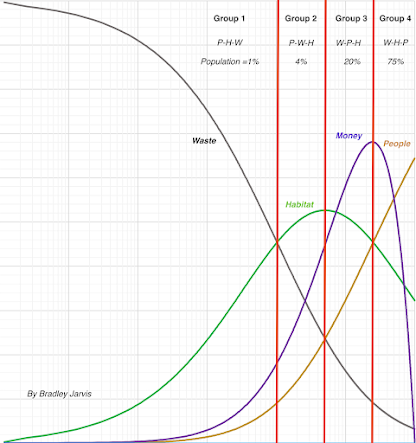
Waste is valued most by the smallest group and people are valued most by the largest group. Habitat is valued most by the two middle groups, with one valuing waste second and the other valuing people second. No one in one group places the same amount of value on people or waste as anyone in another group. Members of either of the middle two groups can value habitat the same as members of the other group, but not members of either of the two remaining groups. Some members of the smallest and largest groups can value habitat the same, but no one can value habitat the same as members of the two middle groups.

If the value placed on each of the resources is exclusive of the others across the whole population, the fraction of the population valuing waste is 9%, the fraction valuing habitat is 40%, and fraction valuing people is 51%. Note that even for these groups, the fraction valuing people is much larger than the fraction valuing waste.

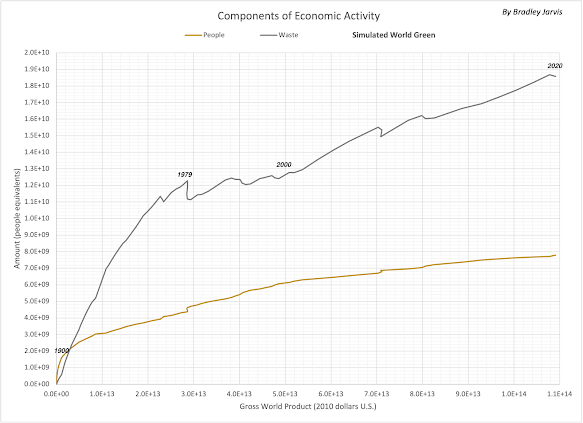
Money as a resource indicating relative economic activity (as indicated in the diagram for small populations and discussed in Economic Distribution) have favored equal value placed on people and habitat (corresponding to half the total habitat available to the population) while promoting increased waste by those who value it most. As shown in the following graph, waste production by a simulated world like ours has outstripped population growth (driving human transactions) as a component of economic activity and remains strongly associated with it. The “rich,” those benefiting most from that activity, and everyone else, represent another set of groups - defined by the value placed on money.
Implicit in this approach to quantifying what someone considers good and bad is the debatable assumption that their current conditions represent what they prefer, and that others they compare themselves to are likewise in preferred conditions. Even using change over time might not be a reliable indicator of preferences; the change could be so far beyond the person’s control and the destination is opposite to their preference. Referenced to groups, a person could move from one group to another due to the actions of others or environmental effects that force change in availability and consumption of resources. This appears to necessitate an additional variable for consideration: choice. Based on national statistics from 1800-2017, happiness varies as shown below, as does life expectancy, where the red lines mark the limits of each the four groups we started with; this suggests that members of a population will tend to prefer a higher value of waste.
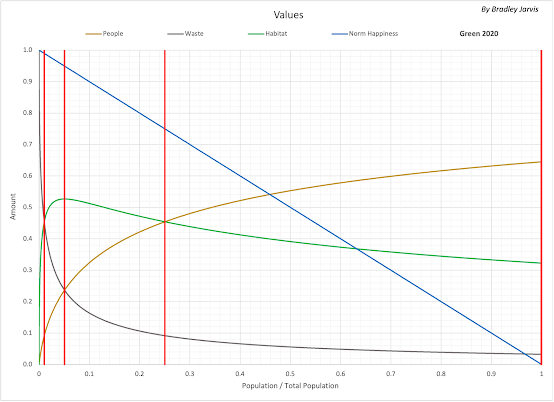

As waste effectively decreases habitat, the ability of nature to provide basic biological needs decreases to a point where more people die than are born, beyond which the population crashes. Thus, increased waste decreases how long the population can exist (its longevity). Another set of groups could therefore consist of a group that cares about longevity being longer and the other that doesn’t. The group that cares about longevity would likely value habitat more than anything and waste less than people; the other group would consist of everyone else.


Wednesday, April 15, 2020

A Pandemic-Altered Future


I have continued refining my simulations to account for the progress of the COVID-19 pandemic and the potential futures that might result from it. The strong correlation of carbon emissions and total consumption suggested that atmospheric carbon dioxide concentration could be used to estimate total consumption; I would then project total consumption along with the ratio of needs to remaining resources based on population projections made from pandemic global death statistics and my simulation (Green Prime) of population without the pandemic.

A curve fit of carbon dioxide concentration and total consumption automatically factored in the effects of natural contributors and the cumulative aspect of consumption and extracted the resulting consumption, as shown below.


I updated projections using weekly mean concentration and the average difference between Green Prime population and total deaths from COVID-19. The current projections are shown below.


Despite the apparent convergence of deaths toward a maximum beginning in May, the projected population (“R Projected”) suggested a much different situation. This was perhaps due to an excess of deaths by people who couldn’t be treated for life-threatening conditions other than the virus, or it was due to underlying growth in the virus-related deaths, or both, but it convinced me to continue allowing the possibility of greater growth in deaths as shown in today’s population projections below.


Projecting global variables into the future based on current data shows that the virus would result in one year less of survival for our species, as shown below.


Reducing per-capita consumption (ecological footprint) would still extend our remaining time, although temperature would continue to rise. The following graph shows one such scenario: a 2% annual drop until just needs are being met.

Another option is to freeze consumption at peak happiness and life expectancy as shown below. This would result in temperature exceeded the 2-degree Celsius threshold earlier, which would likely force a decrease in population.


Wednesday, February 5, 2020

Drop Ratios


After 2001, some people began experiencing falling happiness and life expectancy in my Timelines simulation (“Green”) that best matches our history. Starting in 2012, both of those variables were zero for a growing number of people whose part of the population was essentially living the rest of their lives without being replaced by children. The rest were still growing toward the peak that they had left. These conditions are identified in the following example as ranges of “action phases” that are derived from the ratio of unused resources to resources used to meet people’s basic needs.


ABOVE: Distributions of population, happiness, and life expectancy as functions of action phase at the beginning of 2020. Three ranges of phase identify trends in happiness and life expectancy: Growing (phases 1-5), Falling (phase 6), and Dying (phase 7). In this example, 16% of the population is growing, 35% (51% minus 16%) is falling, and 49% (100% minus 51%) is dying.

The conditions can be further reduced to “drop ratios” that compare the amount of people falling and dying to the amount of people growing. These are defined in the following graph, which projects how they change over time. Note that historical data is used for years through 2014 (where a “year” corresponds to the middle of the calendar year), and every year after that is a projection.


Drop Ratio 1 is the raw drop ratio, is now more than five, and is projected reach nearly eight before the total population is projected to peak and then decrease. It notably decreased just once, in 2009, corresponding to the global recession in that year, but has increased every year since then.

To the extent that people’s motivations might track with their membership in these phase ranges, it is conceivable that the people in the falling range might be split between siding with those who are growing and those who are dying. Drop Ratio 2 assumes an even split between the two.  

The following graph shows the drop ratios as functions of world phase (the phase for the world as a whole). Also shown is the fraction of the population that is falling and dying, which begins at phase 5. For reference, the world phase at the end of this month will be 5.8. 


Monday, February 3, 2020

Social Cohesiveness

The differences in experiences between people in a group can provide some insight into the cohesiveness of the group as a society, which recently has appeared to be decreasing. Action phases provide a measure of those differences, which correspond to different ranges of global variables that can be loosely associated with roles and experiences in the manipulation and distribution of resources throughout the population. The total range of phases has tended to expand throughout history, as shown below for the simulation “Green.” 


If the world of this simulation as a whole was experienced by a single person, that person would follow the World phase trajectory in the graphs. This is considerably different from the average person (the green line marking the 50% trajectory) and the person with the highest phase (the red line). Those people in the 10% with the lowest phases are the most different from the rest of the population, now occupying five of the seven phases where people can be found.

Global variables projected for the end of this month are shown below for the range of phases as it will exist then. The obvious phases people would want to occupy are 4 and 6 based on life expectancy and happiness, but the expansion of the range of phases caused by the reduction of unconsumed resources is forcing everyone higher - toward the dropping population that follows a maximum phase of 8 and a world phase of 6. The graph shows half the population above phase 7, with no happiness or life expectancy (for children born in that group), which will surely be a major event for the simulated world it inhabits.


To the extent that the simulation coincides with our real world on which it is historically based, the changes in life expectancy and population growth will be observable here on a global scale, although individual nations will vary based on their resources, consumption, and interactions with each other. 

With so much at stake, it would be unsurprising see social fragmentation of the population into three groups: the one-sixth of the population that benefits from increasing consumption; the half that is being driven toward death; and the remaining one-third that is suffering catastrophic loss of happiness and life expectancy. Such fragmentation would have a strong economic component, since the one-sixth that wants more consumption owns four-fifths of the world’s wealth, and that wealth tends to increase with consumption.


Wednesday, December 12, 2018

Future Cases


For several months now I have used Twitter (@bradjarvis) to react in real time to news that impacts the timing and quality of the survival of our species. My Timelines model has been gradually updated and tested in response to what I've learned and decided was worth exploring in more detail. So far, it seems to be very robust, and like any good tool of its kind is generating as many questions as it answers.

The most useful variable for tracking our past and future survival continues to be what I've called the "species ratio"Sratio, which compares the consumption of resources needed for basic survival by humans to that of other life that can be used as resources. Based on extrapolation of historical statistics, I estimate that Sratio is currently 51% (about 1:2, or one-half). Population tracks with Sratio, nearly-symmetrically rising to a peak at 54% and falling back down to zero at 117%. The peak will likely be reached in 2020 and hit zero in 2038 if Sratio continues to increase after that. I have seen no evidence to suggest that the timing of these events will be markedly different from what I expect.

As I've said before, one of the main functions of a model is to identify what it would take to change projected outcomes, and our extinction is an outcome that definitely needs to be changed. One such solution is a "Fix" which would have started six months ago and involved slowing total consumption (population times per-capita consumption) enough to keep Sratio from forcing population past its peak. Not surprisingly, the Fix wasn't implemented, which has made the required changes more drastic but theoretically not impossible – that point will be reached when we actually reach the peak.

Unfortunately the specter of self-perpetuating climate change due to climate feedbacks has grown in both probability and magnitude. This threatens to decrease the amount of resources available for future consumption, with the effect of driving Sratio higher regardless of what we do. Scientists focusing strictly on global warming have concluded that total emissions of greenhouse gases must decrease to have any chance of avoiding such a scenario, which means that a "fix" isn't good enough: we must decrease our consumption rather than keep it from growing. I and others have advocated this in terms of overall ecological impact (which is equivalent to what I call "consumption"), which would have the benefit of enabling other species to enable recovery by reducing the stress on their survival. 

There are at least two problems with the option of reducing consumption. One problem is the risk of increasing global warming and triggering more climate feedbacks as a result of decreasing air pollution because some of it reflects radiation from the Sun. The second problem is that population might decrease in response to people's reduced consumption, especially if it is forced (resulting in violent resistance) and/or today's life-saving technology is not replaced with a less ecologically impactful equivalent. In the first case, Sratio would be driven higher; and in the second, the lower Sratio values would be roughly matched with the historically lower values of population.

In my opinion it would ideal if everyone in the world would be willing to do whatever is necessary for our species to survive, even if it involves valuing the lives of others as much as their own and alllives more than power and property. This is ideal in large part because it would run counter to what it's taken for humanity to dominate the world to the extent it has. Competition practiced by a majority of people has been accompanied by a perception of other people and other creatures as resources – things to be used (consumed) for one's own benefit – and is this is unlikely to change at any time, especially in the short time we have available to adapt to the new world that we and our ancestors created. It is ideal for another reason: humans have a great capacity for self-delusion; this includes faith that something or someone else (new technologies or a parent figure such as a group leader or a hypothetical creator of the Universe who cares about us more than all others) will save us from any major threats to our preferred ways of life.

Because the history and future depends on the actions of individual people, I've refined my model to tease out how people in a population under given circumstances perceive their world and act within it. Intellectually this is just interesting, but it also has the potential for identifying how to influence people to take appropriate action for the survival of their population. Part of this process has been the identification of twelve groups of people within a population who each have basic characteristics and behaviors that can be compared to real people both as a test of the model and as a potentially helpful thought experiment. As I prepare a book that combines the related things I've learned with what I hope to learn, these twelve groups ("samples") are expected to figure prominently as they evolve over time in runs of the model that I think of as alternative universes or timelines. 

On Twitter I have already rolled out some of my thoughts and observations in this effort, including a preliminary approach to identifying expression of personality types among samples in the model's best approximation of our present world ("Timeline 2"). For example, one promising hypothesis is that each sample has a unique viewpoint shaped by the changes of variables as a function of changes in effort (enabled by, and measured as, basic consumption), what I'm calling focus, and that the Big Five personality dimensions find their expression based on that focus. If this hypothesis is correct, then neuroticism varies more than any other dimension with effort, being most affected by the resources available for meeting what people want instead of need in a totally natural environment.

Another example is an exploration of the effects of changes in the distribution of happiness over a population. Since happiness is primarily dependent on Sratio, increasing the population's total consumption creates more variability of happiness within the population which could be an indicator of conflict. As a minimum, it is reasonable to expect that frustration would become widespread as a larger number of people experiencing high neuroticism discover that more effort decreases instead of increases their happiness (the model projects that one-fourth of the world population is currently in that situation).

Cutting per-capita consumption by nearly half to what it was in the 1920s without changing population would restore the happiness distribution to what was in 2002, right before it reached its maximum and started to drop for those expending the most effort. It would have the added benefit of total impact on the planet equivalent to what it was in 1970 when humanity was consuming only what Nature could spare without harm. I have no idea whether these benefits would be sufficient motivation to make such a change (even if my analysis could be proved to everyone's satisfaction), but just the possibility is a valuable insight provided by the model. 

Implementation of this scenario is subject to the concerns about reducing consumption that I mentioned earlier, which implies to me that, if undertaken, it should be done as soon as possible – no more than the 19 years it would take for us to otherwise go extinct - to get the most gain from assistance by other species. In the worst case, it would buy us some time (a rough estimate is 15 years); while in the best case we could avert catastrophe altogether. If the model is right, and my analysis of it is right, then we will soon be forced to make a choice between taking this risky approach and being forced to take even more casualties without hope of recovery.


Tuesday, July 10, 2018

Values Realized


What we want out of life comes at the expense of Nature. This fact drives our relationships with each other and the other species we share the planet with, as well as how long and how many of us can survive.

No matter what group or groups we might be part of, we are all part of one group: the human species. The number of people in that largest group, its population, has been growing since the beginning of civilization, reflecting the value we collectively place on people. Like other animals, each of us requires a minimum amount of resources to survive, so the amount of resources we consume increases with how many of us there are. Since the populations of other species use or embody much of those same resources, the resources must be shared over time for the system of life to last as long as possible.

Most of us would prefer to live long and healthy lives. Because sharing resources is so critical, and we embody resources that other species can use for food, extending our lifetimes reduces the amount of resources available to other life during the time they are needed by those other species. Thanks in large part to our ability to develop and share knowledge and skills, and translate those things into material objects that can accelerate the process, we have enabled more people to live past birth and to thwart more of other species' attempts to consume us. As a result, we have increased consumption and more than tripled the average amount of time people can expect to live from birth (life expectancy) since the beginning of civilization.

We would all like to have satisfying lives. Happiness means different things to different people, but statistically it tends to increase with consumption in much the same way as life expectancy. This can be interpreted to mean that it is an expression of how well people are able to match their lifestyles to their personal preferences, which is enabled by economies that distribute resources among people through trade. Economic activity, which is easier to measure than happiness and tied more directly to consumption, is therefore often used as a proxy for happiness.

The Timelines model projects that, if we live like people in the simulated scenario Timeline 2, then global population, life expectancy, and happiness will reach their maximum average values between 2020 and 2022. The good news is that most people will get to see the pinnacle of human achievement, even though it won't feel good for half of them. The bad news is that life expectancy and happiness will reach zero for everyone between 2029 and 2030, and no one will be left alive by 2038.

Since Timeline 2 has 82% of its recent history in common with ours, it makes sense to use it as a baseline for discussion of the future. The values of population, life expectancy, and happiness are all dependent on what fraction of remaining resources people minimally consume: as the fraction grows, the values grow until the fraction reaches about 57%, falling to zero for fractions larger than that. 

If we don't want the values to drop (especially for population), then it makes sense to keep the population below its peak (affecting minimal consumption) and our additional consumption from growing (affecting the remaining resources). This is the logic behind the Fix timeline. We could alternatively let events unfold without intervention and hope that people will not overshoot the peaks; but if they do, that the apparent desire to consume more will be overcome by a desire to seek out the peaks, and they will voluntarily reduce their consumption to reach the peaks again.

The Fix and the "wait-and-seek" strategies include an implicit assumption that depletion of remaining resources is totally within people's control. The depletion beyond the economic equivalent of renewable products and services provided by other species is largely due to harm and killing of the species that provide them, and harm to species that those species depend on for survival. Those effects are caused by the same drivers as extinction: habitat loss, alteration of ecosystems by invasive species, pollution, use of common resources by the human population, and direct killing due to hunting and over-harvesting. Pollution in particular is having a greater role by changing the climate, whose predictability all species (including us) depend on for a variety of deep biological reasons, not the least of which being growth of plant life needed for food and oxygen production. When changes people make to the environment lead to cascades of changes that are self-reinforcing (positive feedback), then depletion multiplies beyond control.

In Timeline 2, the "waste" component of consumption (consumption in addition to basic needs and wants) accelerates its increase while population drops after the population peak. This may indicate that during that period it will be self-sustaining. If so, perhaps the significance of the population peak – and maybe the others – is that humans in Timeline 2 have a biological self-destruct trigger that activates when their actions initiate uncontrolled collapse of the biosphere they depend on for survival. The Fix timeline would therefore be impossible without some extremely powerful, and as-yet nonexistent, technology that could repair the damage as it occurs.

Another timeline diverged from ours and Timeline 2 in 1939. World War II was averted there, resulting in slower development of technology and science. The same desires and constraints existed, however, and the population peak was only delayed another 60 years...


Friday, April 15, 2016

The Happiness Approximation


One of the cornerstones of my understanding of global population and consumption is the mathematical relationship between happiness and ecological footprint (our individual consumption of ecological resources). While trying to derive real significance from the convenient abstraction, I gained insights into how much of the natural world we can safely use, the purpose and mechanics of the global economy, and how people's values influence the survival of our species. Yet still I didn't fully appreciate why it had the form it did.

In the mean time, I grappled with the dynamics of human behavior and how to derive a means of successfully communicating the lessons I was learning so they could be used to hopefully extend the lifetime of our species, which my research showed is uncomfortably limited. One approach was to focus on complexity and how it influences both comprehension and the completion of basic tasks. I studied the implications of a general relationship I had discovered in my own experience between efficiency and the timing of progress in various activities, including the propagation of error in product development and messages as represented by my writing and that of others.

I suspected that task completion might be related to the pace and nature of global consumption and population growth. While I couldn't find a close correlation, I did discover that our species is attempting to use all of the Earth's resources that don't threaten the planet's ability to meet our basic needs, and we have historically been doing so in at least four different ways at a speed that varies with how much we consume.

A few weeks ago I had the latest of a string of epiphanies that has marked my research since the beginning. I accepted the possibility that the timing of consumption might be independent of the timing of task completion, and sought to generalize how they might fit together to describe how much resources are consumed during a task. In the process, I derived a relationship of the form found between happiness and ecological footprint. I was then able to apply the generalization, which I came to call the "happiness approximation" to how happiness has changed over human history and how it could conceivably change over a person's lifetime.

As I studied the consequences of the happiness approximation, I homed in on the special cases of completion and consumption that involve full use of resources in the completion of a task, which would be optimum where resources are limited. A simple statistical simulation showed that optimum completion averaged out to 76%, and that general completion had an average of 87%. Averaging those two values produced the 82% that the happiness relationship had identified as maximum average happiness for a population (and also happens to be close to the 80% used as a rule of thumb for realistic completion by project managers.

The timing of task completion also rang a bell of familiarity. The minimum amount of time it takes to complete a task (in the simulation) is 19, which is close to the 20 years that is the lowest life expectancy in my historical data (at the earliest year: 10,000 BC). If this correlation is correct, then it is the earliest point in a person's life that they can achieve 100% happiness, which according to the simulation only happens in 14% of cases.

I also modeled a better match to traditional expectations of task completion time, including something close to achievement of historical values of happiness and life expectancy in 2015. It never achieved total or optimum completion, and still took three units of time to reach maximum consumption, which is what I typically use for planning purposes (where one unit of time represents best possible achievement). Only 2% of a general population achieves that or better, which speaks to how selective an organization must be to realistically promise such performance; much less than 1% could be expected to achieve the perfect performance that an organization might optimistically promise in one unit of time.


Tuesday, December 29, 2015

The Longevity Trap


A new set of simulations involving happiness, longevity, and population shows that when different isolated groups join together to form a larger, competitive group, population may be traded for longevity except when growth rate is the only difference.

Recall that longevity is the time it takes for a group to begin disabling the habitability of its environment by consuming species that keep alive the species it directly depends upon for survival, and that my calculations show that humanity recently reached that point. The simulations indicate that world history can be approximated by a lot of isolated groups, which is also equivalent to what would happen if isolated groups came together and allocated resources equally among them. If the world instead had competition among its subgroups for resources, then the average population over history would be smaller (such as 50%), and longevity would be longer by the same fraction (150%); happiness would have dropped only slightly (3%).

In general, any differences between isolated groups in population or per-capital consumption of ecological resources (footprint) will translate into differences in power to acquire resources and convert them into personalized environments. Those power differences will result in a loss of population when the groups are merged and they must compete for resources with too few available for some people to survive when the resources are allocated according to power. Having fewer total people enables those who are left to consume resources for longer at their current rates, thus increasing longevity. This is not the only way to increase longevity, though: by decreasing consumption rates, longevity can be increased without an accompanying drop in population.

Ironically, any growth at all ensures that a group's longevity will eventually reach zero. Pursuing more longevity, while insisting on growth, is therefore a trap. Even if we use the increased longevity to find more resources so we can accommodate more people, we will be forced to adjust and eventually limit the growth rate of consumption based on physical constraints of speed and availability of resources. To pursue more longevity and accept loss of life as its cost is to automatically assume that the casualties have less value than the survivors or their potential replacements.


Tuesday, December 15, 2015

Assessments


I spent the last two weeks immersed in environmental news, much of it associated with news about the COP-21 climate talks that were in progress during that time. The news came so rapidly that I took to Twitter to both track and comment about it. Coincidentally I was attempting to map out what the next ten years might look like in detail so I could do better personal planning and inform my research and writing (blogs and fiction).

The effort left me stressed and depressed, disappointed and exhausted. Despite the generally positive press about precedent set by COP-21, I saw the result as clear evidence that our global socio-economic system is simply incapable of adequately addressing urgent environmental problems that it has created as a function of its existence and values. Civilization needs to be slamming on the brakes of ecological consumption so we don't critically disable the means of maintaining habitability, but instead we're looking for ways to change the direction of our metaphorical train by tapping the brakes on only some of the wheels.

Toward the end of last week I began trying to frame my assessments of news in terms of the three basic values I've identified in my own research: happiness, population, and longevity. I dove back into my research, looking for a simple graphical representation of the relationships of their physical expressions to each other, and ended up creating a simple statistical simulation of probabilities for various combinations of the three variables.

The simulation showed that in September we likely hit the ecological limit I've been most worried about, an event that it calculated has a 28% of occurring. Furthermore, there was less than a one-in-ten-thousand chance that we would be able to increase our happiness, population, and longevity from their values a few months ago – even if the amount of total resources was twice what I expected. Decreasing minimum happiness from 66% to 60% provided a 3% chance of growing longevity and population with expected resources, and 2% for double the resources. Allowing 50% happiness, corresponding to its value in 1850, increased the chance to 11% with expected resources and 4% with double the resources. Allowing global warming to potentially decrease the amount of resources reduced the chances even more than the dismal numbers I mentioned.

If we did already hit the ecological limit, then we are possibly following one of the reference cases I discussed last. Trying to prevent it is no longer an option; we can only deal with what's to come and apply what we've learned in order to maximize the number of survivors over time. Unfortunately, we still have vestiges of our healthier past that support the delusion that growth is still possible; and there may be enough of a delay in the onset of consequences that we won't easily appreciate the causal link between those consequences and the environmental degradation that triggered them.


Monday, November 16, 2015

Group Interaction


Based upon a simple model of interactions between two groups, the people in those groups will choose among six options depending on their relative populations, resources, and how much they value people, happiness, longevity (how long the population can survive), and the carrying capacity of their environment (the maximum number of people that can consume a given amount of resources per person).

The first option (isolation) has each group and its resources effectively isolated from the other group and its resources, and the other five involve one or both groups having access to all of the resources. Both groups can share their resources (sharing), which averages their consumption patterns (amount per person and how fast it grows). Group 1 can kill off Group 2, keeping all resources for itself (extermination 1), or Group 2 can do the same to Group 1 (extermination 2). The last two options involve the groups living together, with one dominating the other by imposing its consumption pattern on the other (dominance 1 or dominance 2).

If the two groups and their resources are roughly the same size and at or near their carrying capacity, then extermination 1 and extermination 2 each have roughly a 50% chance of being chosen, with practically no chance of any other option. If they each have more resources than people to consume them, then isolation, sharing, extermination 1, and extermination 2 will each have a 20% chance of being chosen; and dominance 1 and dominance 2 will each have a 10% chance of being chosen.

Where one group is much larger than the other group, isolation has the same chance (25%) of being chosen as sharing, extermination of the smaller group by the larger group, and dominance of the smaller group by the larger group. This is mostly due to the larger group having overwhelming power compared to the smaller group, and is independent of how close each group is to its carrying capacity.

The probabilities I've quoted are approximate averages of simulated groups, with each group "member" and each simulation varying from the average such that at any given time one option may dominate the others. In reality, I expect that all options will be attempted, perhaps simultaneously. I introduced this model in part 3 of my BIOME novel, and will explore its implications in the remaining books as a critical aspect of the plot. Here and in my other writing, I intend to use it as a tool for exploring real-world events, and to test it in the process.

Two predictions of the model are particularly relevant to current events, particularly those involving conflict and the potential for conflict between a large group and a small group, such as we've seen recently in terrorist attacks. Viewed from the perspective of the smaller group, there is a 25% chance of being physically destroyed by the larger group, and a 75% chance of losing cultural purity (total control over happiness and longevity as determined by consumption). To eliminate these threats, isolation can be re-established (accompanied by adequate resources), or full control over the larger group can be achieved by domination or by killing its members. Each alternative requires a huge increase in power, ideally in excess of the power available to the larger group, and we can realistically expect the acquisition of such power to be an early step in the process of pursuing one or more of these courses of action. Interestingly, the same actions that deal with these threats from the larger group may also be used to pose a threat to the larger group (and would be perceived as such by that group, regardless of the smaller group's motivation, thus making more likely the extermination option being taken by the larger group).

Of the two threats perceived by the smaller group, loss of cultural purity is the largest (by a factor of three). If this wasn't an issue, then the extermination threat might be addressed by improving the chances of sharing or domination. Where it is non-negotiable, then isolation is the most humane option. Isolation has been crudely implemented in the past through establishment of penal colonies; but, since the world is currently close to its resource limits, it is practically impossible. Note that space travel would be an option for isolation if habitable planets were already available and reachable, but any settlements in the foreseeable future would be operating dangerously close to their carrying capacities with additional risks to life that would require new consumption patterns and associated cultural adjustments. Incarceration, an extreme form of domination, is commonly used as an alternative to extermination, but of course it is the embodiment of cultural loss for a group that is markedly different from the dominant group.

As our planet changes its requirements for survival with the ecological disruptions of climate change, raw resource depletion, and species extinctions, I expect we will all perceive ourselves as parts of small groups struggling to adapt while avoiding extermination. We will also need to see other species as something other than other groups that can be exterminated, since they and the services they provide embody the "resources" that we need to survive. Our consumption patterns, which are major components of our cultures, will need to be more flexible than ever in light of these conditions; and above all else, we must adjust our values so that our preferred options are more aligned with extending longevity and minimizing death.


Friday, September 25, 2015

Two Stories


My efforts to explain and project global trends in population and consumption have yielded two competing stories about the past and our potential future. With critical new insight about the second one emerging from work over the past week that may have reconciled the two, this is a good time to summarize them.

The stories are based on several key observations. First, happiness (life satisfaction) varies predictably with the amount of resources people consume, as measured by their ecological footprint, with smaller and smaller increases in happiness as consumption increases, approaching a maximum amount as any one person approaches consumption of the output of Earth's entire biosphere. Second, there is a minimum amount of such resources each person needs to survive. Third, the population of an average other species decreases linearly with the total amount of resources that humanity consumes. Fourth, global economic activity is proportional to the square of the product of population and happiness, which I interpret as transactions of artificial environments that provide happiness. Fifth and finally, in small groups life expectancy increases with consumption much as happiness does, while in large populations it varies with the total resources consumed by the group.

The first story comes from mathematically simulating "worlds" that each represent a point in time with a certain population, ecological footprint, and total amount of resources. A world can only "exist" when: (1) the resources consumed by the population is no greater than the total resources; (2) an average "person" consumes no less than the minimum; and (3) average happiness is less than the maximum. As total resources decrease, the number of worlds decreases, and the remaining worlds are clustered around more restricted combinations of population, ecological footprint, and happiness. Using historical data to identify the worlds occupied by humanity over time, it appears that as our species has consumed more resources, it has targeted the most dense concentrations of remaining worlds, with the objective of occupying as many worlds as possible without decreasing population in the process.

Behind both narratives is a more conventional backstory. All species collect and recycle energy and material, using it to exist as long as possible and to maximize the propagation of their forms over time and space. As the distribution and types of energy and material change, they adapt by changing their behavior and their form (evolving). From the perspective of members of any one species, other species either assist them, impede them, or are merely parts of their background environment that may assist or impede them later. "Assistance" can understood in economic terms as the provision of products and services, collectively considered as "resources" that include food (a primary source of energy and material) and purification of water (processing a resource for use and eliminating threats to survival), and those resources can be provided either on a continuous basis or a one-time basis. "Impeding" includes removal and degrading of resources (or the species that provide them) and, of course, being treated as a resource yourself. Happiness, as experienced by us and possibly other species, is a consequence of the degree that an individual's environment is optimally suited to maximize personal longevity and propagation of the individual's unique characteristics, and increasing it means using as many resources as possible.

The second story begins with two people, each using the minimum amount of basic resources (such as nutritional food, water, and breathable air) needed to live long enough to produce two more people and keep them alive long enough to survive on their own. Those resources are provided by a core set of other species ("supporters") which are doing the same thing and consuming resources supplied by another set of species ("producers"). For the system to last a long time, the supporters and producers must be allowed to reproduce so that their populations remain at least constant, otherwise the amount of resources drops, as do the populations of the creatures that depend on them – especially us.

Consuming the minimum amount of basic resources corresponds to a minimum level of happiness and lifespan, since none is left over for significantly altering an individual's environment beyond providing basic needs. The creation of physical and social technology (such as economics), especially since the beginning of civilization, has enabled the use of more resources as well as other types of resources besides the basic ones. This has translated into increasing happiness, longer lifespans (due to better health care, protection from predators, and a more reliable food supply). It has also supported larger populations, whose labor and ingenuity (higher probability of smarter and more capable people being born) has reinforced technology creation and use.

While we've so far protected the species that provide basic resources, we've consumed more than what other species produce, and have been consuming members of those species themselves. This consumption has included conversion of source material and energy into forms ("waste") that cannot be recycled by other species in a timeframe useful to humans, and may be harmful to them, even to the point of killing them off.

This brings us to the most important aspect of the second story. Humanity is now on the verge of consuming the producers that keep the supporters alive. Keep in mind that only the basic resources keep us alive and healthy; the other resources increase the quality and length of individual lives, and they enable growth in population by getting access to more resources. What will happen next?

In the first story, humanity is forced to retreat to a lower-consumption "world" which allows other species to grow back partially, thus providing resources for more people. We try to occupy this new world and then do the same thing again, resulting in oscillations in population ("popscillations") with a downward trend to a new value dependent on how much the species can bounce back before we overwhelm them again. If, with the second story, historical population and consumption trends are projected forward in time, humanity consumes some of the producers and stops when after our population drops in response to a shortage in basic resources. Then, after some settling, population and consumption both drop to much lower levels, potentially zero.

My new insight came from trying to understand that last drop, which at best seemed like radical overcompensation. After examining my underlying assumptions and being drawn back to the logic of the first story, I realized that humanity must be seeking a particular goal, manifested as reaching a limit in both population and consumption. Historical data showed that the best candidate was a condition where all that remains in the world is us, what we're consuming, and the supporter species. In short, we don't recognize the value of keeping producers around. Incorporating this into the story resulted in popscillation behavior like that in the first story: population drops in response to lack of basic resources, the species providing those resources partially recover, and the cycle starts over and over again, with an overall downward trend in our population. In this case, continuously increasing individual consumption repeatedly causes attempted overshoot of resources that drives down population in response.

As with someone who is banging his head against a wall harder and harder in the hope that it will move out of the way, avoiding further injury is best achieved by stopping the banging. If we're smarter, we'll avoid hitting the wall the first time (immediately stop population and consumption growth). Following this analogy, if the wall starts to move toward us, which is a conceivable consequence of climate change as species start to die off without our help, we should move backward (reduce our consumption) at least as fast as it is moving toward us. If we're lucky, and emphasize reduction of our greenhouse gas waste, the "wall" may slow down or stop before we are forced to reduce our population.


Sunday, August 30, 2015

Groups, Goals, and Actions


Motivated by the threat of global catastrophe that has become more real every day, I recently set about identifying personal goals so that I could determine what actions to take that would best serve my needs and values. That requirement made the scope of the search general and specific, global and local, and incorporated key findings from my research along with thoughts about the essence and physical manifestations of "right" and "wrong."

The result builds on the fact that we are each part of a family (or closely related group of people), which is part of a species, which is one of many species that interact and comprise the totality of life on Earth. It incorporates what I consider the most fundamental value of all: "good" is that which maximizes the quantity and variety of life over all time. Limitations in awareness and power force each individual member of a species, like us, to collaborate with other individuals like us in the transformation of the parts of the world not like us, living and non-living, into environments that enable us to contribute to this good; and for that we are rewarded with an increased sense of life satisfaction (happiness).

Each of three basic goals can be pursued simultaneously, and to varying degrees, by any group: maximizing happiness, maximizing population (the members of the group), and maximizing longevity (how long the group can exist as a group with distinguishable characteristics). I include individuals, or the "self," as a group whose longevity is the same as lifespan and whose maximizing of population is the propagation of his or her genetic uniqueness. Each of these goals will be prioritized by the group on an ongoing basis depending on conditions, history, and success.

A group may even choose to work against one or more of these goals by, for example, serving one or more goals of another group. This may be justified, at least in the short-term, if the other group needs help providing resources that maintain the first group's longevity and population, and if that help can be provided by delaying or postponing growth. If future growth of both groups is impossible, then the population and happiness goals would have been reached and maximizing longevity would be the primary focus by preserving the production of resources. If longevity is threatened as it is for humanity and other species today, then larger groups will need to prioritize the goals of their sub-groups as resources become too scarce to maintain current happiness and, potentially, population.

Goals can only be reached through action. Theoretically, any action will have an impact on each of the goals discussed here, and can be prioritized based on both the relative impacts of other actions and on the priorities of the goals themselves. Other goals may be added and addressed, ideally as supporting sub-goals (if not, then as totally independent of the basic ones). I personally choose to include as my own, at least as placeholders, all basic goals for all groups, and to prioritize them based on my preferences and understanding of their interdependencies.

As I gain more experience with this approach, and because I consider "others" to have a high priority, I will share details and insights in future discussions that can be enhanced by them.