Showing posts with label species. Show all posts

Saturday, July 29, 2017

Diminished Futures


My latest research confirms that humanity remains on track to go extinct within a few decades as the result of our consumption and degradation of the natural environment, both directly and indirectly.

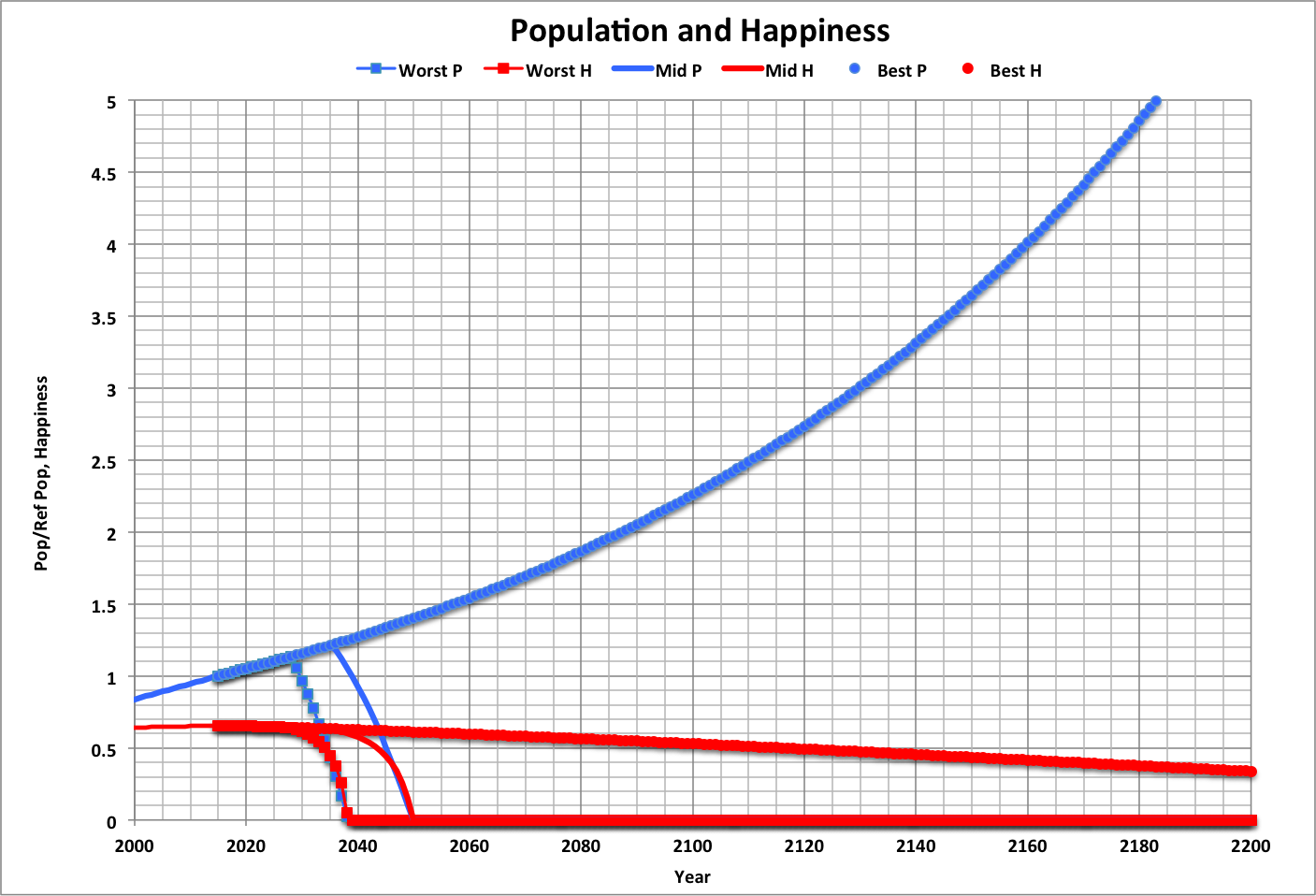
If our survival depends on keeping other species alive (those that directly support us, and those that support them), I now estimate that the combination of our consumption and worst-case global warming impact will drive us extinct by 2032; if not, then we'll have only another seven years. Without global warming impact, I expect humans will be gone by 2124 if killing those critical other species kills people; but if people can survive killing those species, then by 2160 over 29 billion people will be forced to live on fewer resources per person than anyone in history (with that consumption dropping rapidly).

The most reasonable expectation is that global warming will continue to increase for at least several decades, both in magnitude and impact; only how much and how fast is open for debate – until it happens, of course. While much attention has been rightly placed on this particular influence on our future, it is critical to keep in mind that it is a consequence, rather than the cause, of our imminent demise. The cause is humanity's pursuit of total dominance over the world, using its resources (living and not) to create environments suited to people's needs and wants. That pursuit unleashed the greenhouse gases now driving global warming, and it has diminished the ability of natural processes to compensate and keep that warming in check, all the while driving other species extinct at a rate that hasn't been experienced on our planet for many millions of years.

I was reminded recently of the slight chance for extending the lifetime of our species by leaving Earth, with the ultimate limits being the distribution of matter in the Universe and the laws of physics. Meanwhile, my research added a potential clue that humans might have natural limits built into our biology – first suggested by my study of the apparent relationship between happiness and consumption of natural resources – that will effectively cause us to starve ourselves under the most optimistic circumstances.

Use of this clue was behind my latest projections of population and consumption: that annual rates of change in world population and consumption (less so) are correlated with the total amount of those resources that we collectively consume. Those rates reached a peak in the 1960s, when we consumed two-thirds of the production of renewable resources by other species, and the consumption rate would plunge consumption to zero if we ever have the same amount left of total resources – which we won't because of how much we've already consumed, even if global warming spares us. Correlation is course not synonymous with cause, but it does beg for an explanation; and the hypothesis that our speed of growth is based on a basic sensitivity to how much of the world we use is tantalizing, to say the least.

We are still left with a range of stark options in the future of our species, just as each of us individuals must face the many different ways that we could die. The disturbing part now is how much they have in common, including timing, a conclusion I have been unable to shake after years of study and analysis.


Sunday, December 6, 2015

Future Reference


I hope that the next 30 years will be much better than my attempts at projecting the future have indicated. They will almost certainly be different – and interesting. At the very least, I want to be able to look back (assuming I live that long) without regretting the way I spent that time.

My latest projections are now being tested by experience. Interestingly, the latest element of my analysis is the subject of worldwide attention now: the potential progress and impacts of global warming. I have taken time off from writing and modeling to follow the COP-21 negotiations in Paris, and to acquire and process the latest news that pertains to my research. Coincidentally I am facing some personal and professional deadlines that require planning inputs just like the projections I have been working on. As a result, I've decided to use the projections I currently have, for both planning and discussion, with the goal of incorporating the results of those uses into a future update of the model that produced them.

I've created a part of my research Web site that is dedicated to this process, and chosen to focus on two sets of projections which I have discussed previously. The "default" case is the second of two stories that my research has revealed, where humanity begins consuming resources needed to maintain our survival. The "warming case" involves the influence of self-sustaining global warming in combination with our behavior in the default case, which drives our species to extinction by 2165.

Embedded in both of these reference cases is a fundamental assumption about values: that happiness, enabled by using ecological resources (footprint) to customize individual environments, is much more important than people's lives and the lives of the other species whose demise is causing people to die. As total resources decline due to global warming, some surviving people will be still able to consume much more than others, but humanity as a whole won't be able to recover its numbers.

Key to validating, understanding, and possibly mitigating these catastrophic trends is the identification of the critical "producer" species assumed to enable the survival of the "supporter" species that we directly depend upon for our survival. While I don't know what they are, I do have some guesses, chief among them the creatures that enable plants to survive, such as birds with their dispersal of seeds and nutrients, and the fish which keep many of them alive. I have recently been studying the condition of soil, which I expect will reflect our impact on producer species. The fact that one-third of remaining soil is degraded, plus the recently revealed fact that Earth now has two-thirds of the arable land that existed 40 years ago, means that we have less than one-quarter of the healthy soil we had at that time. Interestingly, my calculations show that we now have about one-third of the extra resources (resources not directly consumed by us and supporter species) that we had in 1975.

The first significant decline in our own population is projected to occur in the next few months, with around 200 million deaths due to lack of resources, most likely food. This will be the clearest possible signal that we have begun killing off the last producers alive on Earth; though we may not initially recognize it as such because we will directly be seeing its impact on the supporter species. By 2017 we will have recovered, perhaps due to artificial replacement of what the producers were providing along with some recovery of the producers. We will see a smaller death rate the following year as we attempt to consume more, and probably try a similar fix in 2019. By 2021 the two cases diverge: in the warming case, our recovery will couple with the effects of climate change and we will see the greatest, fastest population drop in history, with more than a half-billion people dead; and, after another recovery, a second drop will occur with almost the same magnitude. The default case, meanwhile, has its greatest population drop in 2023, with more than 300 million people dead, though there will be other, smaller "drops" in the future.

One thing (among many) that I don't account for is the impact of having births make up for drops in population, the most obvious part being the growing fraction of young children over time. That will foreseeably reduce the ability of humanity to maintain its growth in consumption, unless machines grow sophisticated enough to do so without human intervention. A similar argument applies to producer and supporter species, which must grow back, at least partially, and may not grow to be mature enough to provide the products and services expected.

The smartest thing we could do following a population drop is to resist growing the population back and to try lowering per-capita consumption to a sustainable level (at least long enough for other species to recover their numbers and maturity) and then maintain it at that level. If we don't do that on purpose, then perhaps the changing demographics will have the same effect.


Friday, September 25, 2015

Two Stories


My efforts to explain and project global trends in population and consumption have yielded two competing stories about the past and our potential future. With critical new insight about the second one emerging from work over the past week that may have reconciled the two, this is a good time to summarize them.

The stories are based on several key observations. First, happiness (life satisfaction) varies predictably with the amount of resources people consume, as measured by their ecological footprint, with smaller and smaller increases in happiness as consumption increases, approaching a maximum amount as any one person approaches consumption of the output of Earth's entire biosphere. Second, there is a minimum amount of such resources each person needs to survive. Third, the population of an average other species decreases linearly with the total amount of resources that humanity consumes. Fourth, global economic activity is proportional to the square of the product of population and happiness, which I interpret as transactions of artificial environments that provide happiness. Fifth and finally, in small groups life expectancy increases with consumption much as happiness does, while in large populations it varies with the total resources consumed by the group.

The first story comes from mathematically simulating "worlds" that each represent a point in time with a certain population, ecological footprint, and total amount of resources. A world can only "exist" when: (1) the resources consumed by the population is no greater than the total resources; (2) an average "person" consumes no less than the minimum; and (3) average happiness is less than the maximum. As total resources decrease, the number of worlds decreases, and the remaining worlds are clustered around more restricted combinations of population, ecological footprint, and happiness. Using historical data to identify the worlds occupied by humanity over time, it appears that as our species has consumed more resources, it has targeted the most dense concentrations of remaining worlds, with the objective of occupying as many worlds as possible without decreasing population in the process.

Behind both narratives is a more conventional backstory. All species collect and recycle energy and material, using it to exist as long as possible and to maximize the propagation of their forms over time and space. As the distribution and types of energy and material change, they adapt by changing their behavior and their form (evolving). From the perspective of members of any one species, other species either assist them, impede them, or are merely parts of their background environment that may assist or impede them later. "Assistance" can understood in economic terms as the provision of products and services, collectively considered as "resources" that include food (a primary source of energy and material) and purification of water (processing a resource for use and eliminating threats to survival), and those resources can be provided either on a continuous basis or a one-time basis. "Impeding" includes removal and degrading of resources (or the species that provide them) and, of course, being treated as a resource yourself. Happiness, as experienced by us and possibly other species, is a consequence of the degree that an individual's environment is optimally suited to maximize personal longevity and propagation of the individual's unique characteristics, and increasing it means using as many resources as possible.

The second story begins with two people, each using the minimum amount of basic resources (such as nutritional food, water, and breathable air) needed to live long enough to produce two more people and keep them alive long enough to survive on their own. Those resources are provided by a core set of other species ("supporters") which are doing the same thing and consuming resources supplied by another set of species ("producers"). For the system to last a long time, the supporters and producers must be allowed to reproduce so that their populations remain at least constant, otherwise the amount of resources drops, as do the populations of the creatures that depend on them – especially us.

Consuming the minimum amount of basic resources corresponds to a minimum level of happiness and lifespan, since none is left over for significantly altering an individual's environment beyond providing basic needs. The creation of physical and social technology (such as economics), especially since the beginning of civilization, has enabled the use of more resources as well as other types of resources besides the basic ones. This has translated into increasing happiness, longer lifespans (due to better health care, protection from predators, and a more reliable food supply). It has also supported larger populations, whose labor and ingenuity (higher probability of smarter and more capable people being born) has reinforced technology creation and use.

While we've so far protected the species that provide basic resources, we've consumed more than what other species produce, and have been consuming members of those species themselves. This consumption has included conversion of source material and energy into forms ("waste") that cannot be recycled by other species in a timeframe useful to humans, and may be harmful to them, even to the point of killing them off.

This brings us to the most important aspect of the second story. Humanity is now on the verge of consuming the producers that keep the supporters alive. Keep in mind that only the basic resources keep us alive and healthy; the other resources increase the quality and length of individual lives, and they enable growth in population by getting access to more resources. What will happen next?

In the first story, humanity is forced to retreat to a lower-consumption "world" which allows other species to grow back partially, thus providing resources for more people. We try to occupy this new world and then do the same thing again, resulting in oscillations in population ("popscillations") with a downward trend to a new value dependent on how much the species can bounce back before we overwhelm them again. If, with the second story, historical population and consumption trends are projected forward in time, humanity consumes some of the producers and stops when after our population drops in response to a shortage in basic resources. Then, after some settling, population and consumption both drop to much lower levels, potentially zero.

My new insight came from trying to understand that last drop, which at best seemed like radical overcompensation. After examining my underlying assumptions and being drawn back to the logic of the first story, I realized that humanity must be seeking a particular goal, manifested as reaching a limit in both population and consumption. Historical data showed that the best candidate was a condition where all that remains in the world is us, what we're consuming, and the supporter species. In short, we don't recognize the value of keeping producers around. Incorporating this into the story resulted in popscillation behavior like that in the first story: population drops in response to lack of basic resources, the species providing those resources partially recover, and the cycle starts over and over again, with an overall downward trend in our population. In this case, continuously increasing individual consumption repeatedly causes attempted overshoot of resources that drives down population in response.

As with someone who is banging his head against a wall harder and harder in the hope that it will move out of the way, avoiding further injury is best achieved by stopping the banging. If we're smarter, we'll avoid hitting the wall the first time (immediately stop population and consumption growth). Following this analogy, if the wall starts to move toward us, which is a conceivable consequence of climate change as species start to die off without our help, we should move backward (reduce our consumption) at least as fast as it is moving toward us. If we're lucky, and emphasize reduction of our greenhouse gas waste, the "wall" may slow down or stop before we are forced to reduce our population.


Wednesday, May 9, 2012

Arid Despair


Well, I finished reading Merchants of Despair a few days ago, shortly after completing A Great Aridness; and I walked away from both feeling pretty depressed, even though I had a good idea what to expect from them when I started.

A Great Aridness delivered on its close-up look at the likely future of the American Southwest in the face of climate change, drawn within the context of this region's relevant history. Bottom line: it's going to be very hot and very dry, with opportunistic species like bark beetles and mosquitoes making life very much worse. Tales of skeptical professionals in a number of disciplines, including climate science, who have been forced by overwhelming evidence to both accept and help prepare for the effects of climate change are particularly powerful in driving home the harsh reality we're facing.

This stands in stark contrast to the glowing assessment of climate change portrayed in Merchants of Despair, whose author expects natural balance to ultimately be maintained, counter to the claims of environmentalists who want to limit humanity's power out of a mistaken belief that the resources we need are limited relative to population. Indeed, the author portrays environmentalists as the latest members of a worldwide conspiracy dating back to Thomas Malthus that has justified depriving, killing, and forcefully limiting the birth of people deemed by pseudoscientific reasoning to be unfit to survive by themselves. Innovation, manifested as technology, will save the day as it always has, he argues, and anyone who holds it back is guilty of the greatest evil, intended or not.

I've studied, thought, and written a lot about climate change, species loss, and sustainability over several years, with a focus on understanding the drivers of humanity's future. While there are certainly some people with similar interests who hold a low opinion of humanity's intrinsic value, even to the point of hoping for a limited pandemic to "cull the herd," the vast majority are searching and advocating, as I am, for solutions that maximizes people's happiness with no casualties. Counter to the conspiracy theory, the people profiting most by harming the poor are in favor of curbing controls on environmental degradation, not getting more of them.

One of the main non-pseudoscientific principles guiding environmentalists and sustainability advocates is an understanding that exponential growth is fundamentally unsustainable; my own exploration of the validity of this principle in large part converted me to my current views. Malthus was indeed wrong: consumption has been able to keep pace with population growth, thanks to human ingenuity and some damned good luck – such as finding large sources of cheap energy, and it too has grown exponentially. Unfortunately, as I found out when I focused on both ecological impact and conversion of mass into less useful forms ("waste," a crude form of entropy), this has accelerated the extinction of species, many of which we depend on for free services that keep the world habitable for creatures like us. Merchants of Despair suggests that ingenuity can deal with this too, through soon-to-be ultra-powerful manipulation of matter and genes; but I would suggest that only a fool or a megalomaniac destroys something he gets for free while trying to develop the power to make it himself. The world seems to have an unhealthy supply of both fools and megalomaniacs these days, which is one of the reasons I get depressed when thinking of these things.

Saturday, May 28, 2011

Habitability Limit

Before humans had any significance influence on our planet, the population of a typical species was about two-thirds higher than in 1980, when humans began routinely consuming all of what other species “produced” (1 Earth). The total of other species with populations of 1980's size consumed nearly 1.9 Earths, which was all turned into biomass that could be consumed by others. That and the extra population consumed and recycled a total of 3.1 Earths, a measure of the total ecological resources of the planet.

As human consumption grew, other species had to do with less. The pressures of habitat loss, introduction of destructive species, pollution, and direct killing by humans caused their populations to decline, and in an increasing number of cases, go extinct. The survivors still needed the same amount of consumption for basic survival and, by extension, fulfilling their roles in maintaining the planet's habitability; but they needed to consume more resources to do so, since food was harder to find, and there was greater competition for what was left. Thanks to humans, the amount of remaining resources was shrinking a little slower than their populations, and they used all of it.

That's the picture that emerges from my latest research, based on projections of the Living Planet Index using my population-consumption model. We humans are currently consuming nearly 1.6 Earths, leaving 1.5 Earths for other species, of which they need a minimum of 1.2 Earths for survival (and are using the remaining 0.3 Earth to attain it). Because their minimum consumption is converted into both mass and function, at least 1.0 Earth is needed to keep our planet habitable (in economic terms, the “production” equivalent of their “capital”); this corresponds to human consumption of about 1.8 Earths.

If this analysis is correct, then we need to do everything we can to avoid reaching the maximum by lowering our consumption, preferably without casualties to our own population. My worst-case curve fit to our consumption over time shows that our consumption would peak when we're only within 6% of the maximum, which is close enough to add credibility that it is a real limit.

Tuesday, January 11, 2011

Limits to Capacity

BACKGROUND: My population-consumption model shows that the world's human population has, on average, been consuming resources as though they were non-renewable for more than 2,000 years. To survive indefinitely (barring any major changes in conditions, including moving to other planets), we would need to meet existing consumption using resources that could be replenished at the rate we are consuming them. I have recommended building capacity – the mass of renewable and reusable resources – as fast as possible to equal the amount of mass we consume annually. The effect of this solution is to eliminate our consumption of non-renewable resources, which is currently reducing our population growth and may lead to a sudden drop in population when growth stops (consumption and population will reach a peak).


I have assumed that we will somehow be able to exactly match our consumption with capacity that the biosphere can't provide, likely with efficiency technology. For example, we could create structures that can last as long as we need, which are effectively one-time uses of our remaining non-renewable resources. What if this assumption is wrong?


The model shows that if, beginning at the end of 2012, we held consumption constant, relied on available biocapacity, and reused an amount of resources equal to 90% of the remaining consumption, we would need to reach the maximum capacity within two years, and our non-renewable resources would last until 2377. Raising reuse from 90% to 99% would give us 65 years to reach maximum capacity and extend resources to 2864. At the low end, if capacity was limited to available biocapacity and no reuse, and reached in no more than three years, resources would last until only 2050, which is 29 years longer than if we had no capacity at all.

A sustainable alternative is to provide all of the 2012 consumption with biocapacity, which would need to be increased by at least 81%. In a crude sense, this may correspond to additional habitat, perhaps as land area that is available for other species to use. If we occupy that land for purely human use, we might have to abandon it. Because we would replacing non-renewable resources with renewable resources, what we consume it for would change. Because we could no longer extract and use the metal, oil, coal, minerals, and other resources that comprise our artificial existence, nearly every aspect of what we think of as “modern civilization” would be replaced by natural and very likely labor-intensive alternatives.

If we can't increase biocapacity or find an alternative to it (which seems unlikely given the time we have left), and don't want to lose population, we should reexamine the idea of reducing consumption. Cultural measures, such as government controls, might conceivably be used to keep people from killing each other while a rapid conversion is made to all-natural economy that uses no more than the biocapacity we have (and preferably less). If one hectare of global ecological footprint corresponds to 1,000 pounds of mass consumed, then a minimum of 1.5 hectares per person needed to maintain a society would, beginning with a 47% drop in consumption in 2012, allow us until 2133 to fully convert our economy.

In what appears to be a recurring theme in these discussions, humanity is faced with a tradeoff between lifestyle and species longevity. If no “magic bullet” technology can be found to meet our desires with replenishing resources, we must use only what a healthy biosphere can spare, and change our desires accordingly.