Showing posts with label global warming. Show all posts

Tuesday, March 31, 2020

Bridging the Future


Shortly after discovering that constant capacity (total ecological resources) provided a better fit to historical data by my Timelines model than my baseline simulation (“Green”) that decreased it, the COVID-19 pandemic threatened to significantly change the world’s population-consumption trajectory on its own. 

The model has two main purposes: to help people judge how to live their values and understand the effects of doing so; and to identify ways to avoid humanity’s extinction. Simple curve-fits to world deaths from the pandemic suggested that, left unchecked, it could result in extinction by August of next year. I knew enough biology to dismiss that as highly unlikely, but it would almost certainly result in a population peak, and close to the time that my new simulation (Green’) was indicating.

  
ABOVE: Projections of population for simulation Green’ and with projected COVID-19 deaths (as of March 31, 2020). Unchecked deaths would result in extinction, a population of zero, by day 560 (August 3, 2021).

If the new population reached its peak on schedule around September 1, 2020, and then synchronized with the Green’ population projection, the net deaths would be the difference between the values of the two peaks. The virus would essentially wipe out the gain in population since mid-2019 that appears at the resolution of weeks instead of years.


ABOVE: Global variables projected for simulation Green’ at mid-year 2000-2050.

If the average population and per-capita consumption stay at the 2019 values from 2020-2021 (to crudely account for reduced activity as well as population), the model projects that extinction will occur one year earlier than otherwise, as shown below.


Looking ahead toward how to achieve the primary goal of avoiding extinction, the prescription remains the same as before: reduce per-capita consumption as soon as possible while maintaining constant population. A 2% annual reduction from 2021-2062 would keep the global temperature anomaly below the catastrophic level until 2100, as shown below.


Doubling the decrease in per-capita consumption until only basic needs are met, as shown below, adds another 50 years to the time when the maximum temperature is reached.


Note that these projections reflect my personal valuing of human life. Letting population decrease instead would keep per-capita consumption at an arbitrarily higher level, even though the economy would likely drop more (because it depends strongly on the number of transactions, which varies with the square of population).

Friday, June 28, 2019

Focus on the Future


The fictional "world like ours" portrayed in the Simulated News blog is about to execute a global strategy for confronting a threat of imminent global extinction that was confirmed nearly seven months ago. Definitions of the threat and the strategy have evolved along with my progress in simulating the future and evaluation of options for making it better than the alternative that we are living.

Our real-world trajectory is bleak, as any open-minded perusal of recent scientific research on climate and ecology will attest. Timelines for action to limit mass death of people and members of other species are converging on the period that my simulations have identified, along with a similar scale of effort. 

Humanity's extinction, which results from all of my simulations if action isn't taken, is generally considered an extreme worst-case scenario by mainstream science, and taken as an article of faith by a growing minority that is focused on what I call "self-sustained feedbacks" (such as the melting of permafrost and polar ice, and the decimation of species at the base of ocean and land food chains). Global catastrophe involving sizable fractions of the world population by the middle of this century is a likely alternative outcome, which can at best (with current capabilities, as I understand the literature) be delayed until the end of this century. 

The apparent dependency on available ecological resources of population (among other variables) modeled by my simulations has yet to be proven as more than a strong correlation. Demographic transition is the generally accepted explanation for the observed changes, involving reduced fertility in response to better economic conditions that are notably a reward – if not the goal – of dominating our natural environment. Both explanations logically ascribe a peak in population to a peak in economic activity (which I model as a function of a group's population and total consumption – essentially the trades of resources). A decline in economic activity would naturally accompany a reduction in resources that can be traded; and people (traders) dying from harmful environmental conditions, reduced resources, or both. Population loss is effectively inevitable; the main uncertainty lies in how soon and how much.

Probability is not destiny. As individuals and as groups we can take actions that will alter the trajectories of our lives toward something better, however we choose to define that. Alteration does not ensure success, but it changes the probability. I personally define success as, at a bare minimum, extending the survival of our species – and the species it depends on – for as long as possible; beyond that, "better" includes minimizing pain and suffering for as many people as possible, and extending to the affects of our actions on other non-human lives. My writing and research related to this topic are part of a set of personal actions intended to increase the probability of success.

In the imaginary world that I call "Hikeyay," representing one of several simulations resulting from my research and the subject of the Simulated News blog, the overwhelming majority of the global population has chosen to reduce their personal consumption and let the population decline naturally by not replacing those who die from old age until it is almost too late to maintain a constant level. Activities are focused on putting the drivers of extinction in reverse: creating habitat, controlling invasive species, cleaning up pollution, and eliminating over-harvesting of "resources" that largely include members of other species. Gaps in capability will be filled by the development and deployment of technology, especially relating to pollution and self-sustained impacts. 

Hikeyay's global strategy is based on success as I define it, taken to an extreme that is unlikely in our world but dictated by the logic of the model on which it is based. The inhabitants readily admit (as my proxies) that the intended end-state is a very unlikely, even with their civilization's extraordinary level of commitment. The effort will, in the worst case, buy time that they wouldn't otherwise have to live, and do so according to their values. I believe their example is worthy of emulation to the extent possible in this world.

Thursday, January 10, 2019

A Simulated World


Last week I started a new blog, Simulated News, as a thought experiment to explore how a world like ours might implement the lessons of my Timeline model's simulations. The blog is formatted as a set of news articles relating to the development of a global strategy to deal with the threat of imminent extinction as it might occur in real time. 

There are lots of similarities and some marked differences between the simulated world and ours. Relevant ones are described in a "Reality Check" section in each post, along with some of my rationale for making choices about how events unfold. The greatest difference, besides adherence to my simulation of global variables, is the overall buy-in of national leaders to the crisis as I've chosen to define it: as a consequence of our accelerating the extinction of other species. Although climate change plays a critical role, it is not the overall focus. Another big difference is that all countries are bound by law and desire to devote all necessary resources to address the threat as existential and immediate.

In some respects, this effort resembles what I did in my Universe X micro-fiction, but it is limited to one "alternative universe" rather than snippets from multiple ones. It is not a narrative like my other fiction, with a movie-like progression of action; though I am inventing characters, settings, and events much like I have done before, but tied to the structure of a simulation even more than my novel Lights Out.

The simulation includes an updated feature, tied to and informed by the new theoretical consumption model. Sustained global warming is a possibility that could force extinction regardless of what people do in the short time they have to act, and I now have some projected effects that can be explored in detail. Unlike many people in our real world, the leaders of the simulated world are willing to accept the nature of that added threat and act accordingly.

Real-world issues are mentioned and will be discussed, such as how people might limit population and consumption to the point of allowing them to shrink without causing them to collapse prematurely. I see that discussion as being one of the potential benefits of the exercise, within the context of a fictional world where feelings and facts can be respectfully and safely exposed and examined. The model's insights into population dynamics, coupled with study of history and my own opinions, will inform some of the answers I suggest, but they are only a starting point for discussions of these issues which I expect real people will increasingly face every day in one way or another.


Saturday, July 29, 2017

Diminished Futures


My latest research confirms that humanity remains on track to go extinct within a few decades as the result of our consumption and degradation of the natural environment, both directly and indirectly.

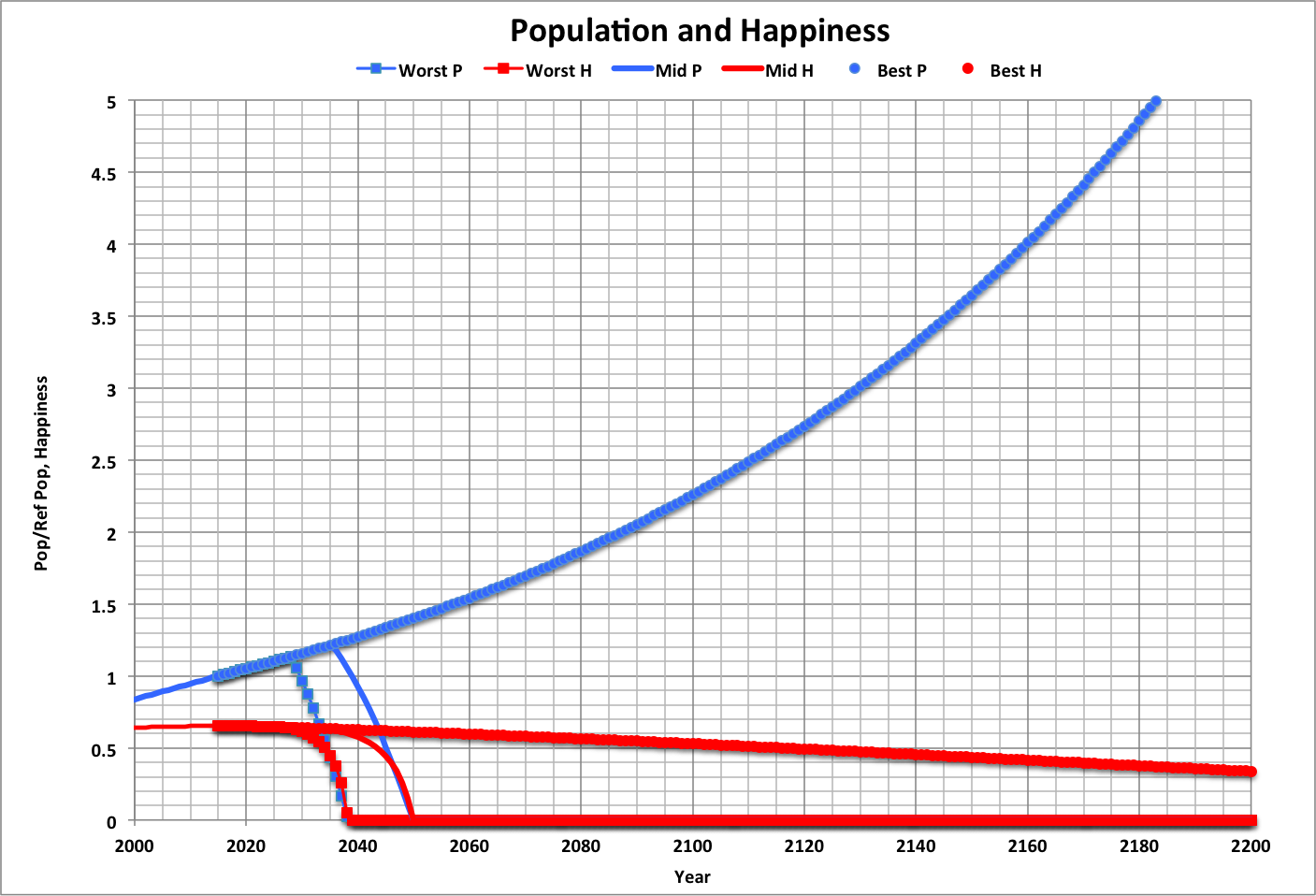
If our survival depends on keeping other species alive (those that directly support us, and those that support them), I now estimate that the combination of our consumption and worst-case global warming impact will drive us extinct by 2032; if not, then we'll have only another seven years. Without global warming impact, I expect humans will be gone by 2124 if killing those critical other species kills people; but if people can survive killing those species, then by 2160 over 29 billion people will be forced to live on fewer resources per person than anyone in history (with that consumption dropping rapidly).

The most reasonable expectation is that global warming will continue to increase for at least several decades, both in magnitude and impact; only how much and how fast is open for debate – until it happens, of course. While much attention has been rightly placed on this particular influence on our future, it is critical to keep in mind that it is a consequence, rather than the cause, of our imminent demise. The cause is humanity's pursuit of total dominance over the world, using its resources (living and not) to create environments suited to people's needs and wants. That pursuit unleashed the greenhouse gases now driving global warming, and it has diminished the ability of natural processes to compensate and keep that warming in check, all the while driving other species extinct at a rate that hasn't been experienced on our planet for many millions of years.

I was reminded recently of the slight chance for extending the lifetime of our species by leaving Earth, with the ultimate limits being the distribution of matter in the Universe and the laws of physics. Meanwhile, my research added a potential clue that humans might have natural limits built into our biology – first suggested by my study of the apparent relationship between happiness and consumption of natural resources – that will effectively cause us to starve ourselves under the most optimistic circumstances.

Use of this clue was behind my latest projections of population and consumption: that annual rates of change in world population and consumption (less so) are correlated with the total amount of those resources that we collectively consume. Those rates reached a peak in the 1960s, when we consumed two-thirds of the production of renewable resources by other species, and the consumption rate would plunge consumption to zero if we ever have the same amount left of total resources – which we won't because of how much we've already consumed, even if global warming spares us. Correlation is course not synonymous with cause, but it does beg for an explanation; and the hypothesis that our speed of growth is based on a basic sensitivity to how much of the world we use is tantalizing, to say the least.

We are still left with a range of stark options in the future of our species, just as each of us individuals must face the many different ways that we could die. The disturbing part now is how much they have in common, including timing, a conclusion I have been unable to shake after years of study and analysis.


Wednesday, March 16, 2016

A Brief History of Civilization


About one million people inhabited the world twelve thousand years ago at the beginning of civilization, and were consuming just barely enough natural resources to increase the population by a paltry few hundred per year.

Five of every six people believed that humanity's destiny was to take over the world, while the rest respected Nature and wanted to consume as much as was safe for them and the other creatures in the world. The vast majority in each group preferred to maximize the number of people without improving their lifestyle, with the minority preferring to maximize their lifestyle without increasing the number of people.

Mathematically, the history of global population consumption appears to have unfolded as a result of the activities of these groups which grew proportionately with population. Each has succeeded according to their size and natural constraints, and together forming a spectrum that is a composite of all of them.

The group that respected Nature achieved its goal in the 1920s, when (on average) about one-fourth of renewable resources were being consumed by humanity, leaving half to other creatures and the remaining quarter as a surplus for use in hard times. With nearly two billion people in the world, the minorities had grown so that more than one million people wanting maximum happiness were in this group. In the other group, seven thousand people were working for happiness and world domination.

By 2015 we were three years from achieving the goal of using the maximum amount of resources that would keep the world habitable, but it was snatched away due to an unintended consequence of the pursuit of that goal: global warming. Our use of fossil fuels had unleashed the equivalent of a competing species, effectively consuming a growing share of the remaining resources, depriving us of their use, and then forcing us to consume less.

As long as the group that prefers population over happiness is dominant, we can expect population to stay constant while per-capita consumption drops to the minimum required to maintain a healthy population with food security, which is what it was about 1500 years ago (and what I've been calling "minimum footprint"). That level will be reached by 2040. The preceding decrease in consumption would have kept up with the removal of resources due to global warming.

After 2040 our consumption decrease will slow; but, as it drops, our population will drop with it. Even worse, our collective decrease in consumption will not keep pace with global warming. By 2063 our population will reach zero just as global warming "consumes" all of the resources needed by us and the species we have depended upon.

This narrative tracks with updates to my population-consumption model utilizing new data and insights. It includes the results of a "backcasting" exercise that reproduced basic features of past population and consumption, lending credibility to its projections. My narrative of the future is based on an observed correlation between average global temperature and humanity's global ecological footprint, and assumes that self-sustained global warming will have its own global footprint, independent of ours after 2015 (which is when it is calculated to impose a limit to growth of our own global footprint). As my Twitter feed will attest, I have been monitoring related news and have become convinced that global warming is currently self-sustaining and is having a significant impact on other species, especially those near the bottom of the food chain that will directly impact our survival.

Given our proximity to the limits my model postulates with and without global warming, the model is now making clearly observable predictions of the behavior of familiar global variables in the very near-term: global population, economy (Gross World Product), and wealth. Perhaps the most obvious of these predictions is a rapid decrease in growth rates for these variables over the next two years, beginning soon this year, and an unstoppable contraction of the economy and wealth beginning in 2017.

I likely won't live to test the most critical of the predictions, around 2040, when population either begins to fall because humanity has reduced consumption too far, or we will have already gone extinct after finding a way to survive while killing the rest of the species that historically kept us alive. If some people are alive when my projections show there will be none under any circumstances, then my model will be a glorious failure, glorious because I wish more than anything that the hideous future it projects never comes true.


Tuesday, December 15, 2015

Assessments


I spent the last two weeks immersed in environmental news, much of it associated with news about the COP-21 climate talks that were in progress during that time. The news came so rapidly that I took to Twitter to both track and comment about it. Coincidentally I was attempting to map out what the next ten years might look like in detail so I could do better personal planning and inform my research and writing (blogs and fiction).

The effort left me stressed and depressed, disappointed and exhausted. Despite the generally positive press about precedent set by COP-21, I saw the result as clear evidence that our global socio-economic system is simply incapable of adequately addressing urgent environmental problems that it has created as a function of its existence and values. Civilization needs to be slamming on the brakes of ecological consumption so we don't critically disable the means of maintaining habitability, but instead we're looking for ways to change the direction of our metaphorical train by tapping the brakes on only some of the wheels.

Toward the end of last week I began trying to frame my assessments of news in terms of the three basic values I've identified in my own research: happiness, population, and longevity. I dove back into my research, looking for a simple graphical representation of the relationships of their physical expressions to each other, and ended up creating a simple statistical simulation of probabilities for various combinations of the three variables.

The simulation showed that in September we likely hit the ecological limit I've been most worried about, an event that it calculated has a 28% of occurring. Furthermore, there was less than a one-in-ten-thousand chance that we would be able to increase our happiness, population, and longevity from their values a few months ago – even if the amount of total resources was twice what I expected. Decreasing minimum happiness from 66% to 60% provided a 3% chance of growing longevity and population with expected resources, and 2% for double the resources. Allowing 50% happiness, corresponding to its value in 1850, increased the chance to 11% with expected resources and 4% with double the resources. Allowing global warming to potentially decrease the amount of resources reduced the chances even more than the dismal numbers I mentioned.

If we did already hit the ecological limit, then we are possibly following one of the reference cases I discussed last. Trying to prevent it is no longer an option; we can only deal with what's to come and apply what we've learned in order to maximize the number of survivors over time. Unfortunately, we still have vestiges of our healthier past that support the delusion that growth is still possible; and there may be enough of a delay in the onset of consequences that we won't easily appreciate the causal link between those consequences and the environmental degradation that triggered them.


Friday, October 2, 2015

Temperature


Assuming my modeling of population and consumption is correct, then the famous 2° Celsius limit for global warming by century's end is twice what it should be. According to my first attempt to incorporate global warming into the model, if we are successful and the warming is already self-sustaining then we need to immediately start reducing our per-capita ecological footprint by at least 0.7% per year to avoid casualties between now and the year 2200.

A decline in total ecological resources due to degradation will have the same effect as consuming too much, eventually making it impossible for people to survive and our population will crash. Whatever causes it (global warming as an example) must be stopped before that critical threshold is reached, otherwise all we can do is delay the end date.

If, as I expect, humanity will soon be forced to consume less overall (through personally cutting back, losing population, or both), then our slowing rate of pollution will enable natural systems to process the lesser amounts resulting in the approximation of no net increase in the amount, and eventually a decline. In the case of greenhouse gases, I've assumed no decline in the next two centuries, which means that temperature (their effect on the environment) will not decrease either. As far as I can tell from my data, that effect has been masked by our overall consumption, so it hasn't yet resulted in a decrease in total resources; but with us now pushing against the envelope of those resources, there won't be enough left to both process our waste and provide for the survival of the species we directly depend on.

Perhaps by coincidence, my projected temperature will match with the historical trend in 2019, and others who are planning for future emissions seem to be targeting 2020 as their starting point. Also, I projected that direct emissions will decrease around the same time, except for short pulses corresponding to attempts to reach the resource limit after drops in population. For these reasons I chose 2019 as the starting time for a hypothetical decrease in total resources responding to global warming, and for attributing the difference in emissions to other factors that make it self-sustaining so that the temperature trend continues into the future.

The result, which is as close as I can currently come to a representation of future global warming, has consequences much worse than the case I first presented above, which is the best my model can achieve in terms of avoiding casualties with declining resources. Whereas my default case with no resource decline projects a world population of 5.8 billion people by 2200 (a "loss" of at least 1.5 billion), the global warming case projects that everyone will be dead by 2165. Adaptation in the form of limiting population and consumption growth adds only four years to that end date. For reference, in most scenarios I've looked at, the temperature above preindustrial times when the population crashes is about 2.5° C (it is currently 0.7° C, and would be 1.7° in 2100).


Thursday, July 16, 2015

Tree Line

In the late 1990s, I was on a group hike that nearly ended in disaster. About a dozen of us were above tree line on a mountain just as a thunderstorm threatened to move in. Our goal was to reach a small lake near the top, but the thunderstorm made it too dangerous to continue. A handful of people insisted on going anyway. Since it was an organized hike, the entire group needed to return to the trailhead together, so the rest of us waited at an abandoned mine so the others could find us when they returned from the lake.

We hunkered down in what little cover we could find just as the thunderstorm moved over us and began dumping torrents of rain. In the distance, we saw a couple of people become trapped on a rock face, and we were soon joined by a larger group of hikers who were less prepared than we were. We assisted the newcomers and debated just how safe we really were. The storm was bigger than we hoped, and it became clear to most of us that the risk of staying was too great. During a brief lull in the rain, we and the newcomers made a dash for the trees. Luckily, the rest of our group had made the same decision, abandoning their trip to the lake, and joined us at tree line. After hiking down the mountain as fast as possible, we encountered emergency vehicles waiting for the hikers we had seen on rock face.

I was reminded of this story recently as more bad news came in about humanity's sabotage of natural systems. Honeybees, critical to the survival of plants, are losing habitat because of climate change. Meanwhile, scientists have documented a mass die-off of seabirds that suggests serious problems with ocean ecosystems. Catastrophic seal level rise may now be inevitable, again due to climate change; and a new study indicates that we humans are critically reducing the collection and availability of energy necessary for ecosystems – and us – to function.

Like hikers determined to get as far above tree line as possible, we have defined "progress" as distance from Nature. We have done the equivalent of cutting down trees to fuel our ascent, altering the weather in the process and spawning the thunderstorm that threatens to maroon us, and then kill us. Heading back down the mountain is perceived as an act of cowardice, giving up on our dreams; so some people go ahead, while others compromise by waiting in the brush just above tree line until they come to their senses. Meanwhile, the risk is growing that lightning will cause the remaining trees to burn, cutting off escape, and that the thunderstorm will grow and last a very long time.

We can do the equivalent of retreating below tree line, and try to grow as many trees back as possible to reduce the risk; we could hunker down and hope the storm passes; or we could follow our original plan and keep going up. The option you choose depends on what you value; and if you value people's lives above arbitrary personal attainment, then the choice is obvious.


Monday, March 16, 2015

Complexity and Global Warming

Global warming continues to generate bad news for the present and the future:


Meanwhile, the legislative branch and the governments of several states in the nation most responsible for the problem (mine) are actively trying to convince its citizens that the problem doesn't exist, and that it is acceptable to continue the actions that precipitated it. These actions benefit individuals and corporations who stand to lose large future profits if the actions don't continue, and who bankroll the campaigns of politicians who spend more time pandering for money than developing the legal framework for maintaining our increasingly complex society, which is arguably much more than a full-time job by itself. That complexity, and the inherent limitations of our minds and bodies in dealing with it, along with arbitrary values and knowledge unshared and untied to the realities of community survival in this new world, is fundamentally inhibiting the responsible application of the power granted humanity by its numbers and its technology, power which has enabled our present, existential crisis.

Ironically, reducing the complexity and the power likely have the best chance of reducing our risk, but it will also reduce our domination of the natural environment that is the measure of happiness that we are most tuned to. Some of those who resist such a reduction seem to have put their hopes in advanced technology, effectively outsourcing mental effort to computers now on the verge of artificial intelligence, and attempting to reduce our dependence on wild species for maintaining Earth's habitability by tinkering with their biology and ours. The resisters may however be trading one set of problems for a potentially more dangerous set, as some of the smartest (human) minds have warned regarding artificial intelligence.

Luckily for most of us, complexity is built upon simple building blocks and relationships; and with some training and freedom to explore and think about what's around us (instead of being slaves to our jobs, our tools, and distractions), we can use that fact to make a dent in creating a more healthy part of the world for ourselves and those we come in contact with. Global warming, for example, is a special case of too much waste in an effectively closed system like the Earth, a consequence of our physical relationship with Nature that people throughout the lifetime of our species have understood, or learned the hard way (as many of us are doing now).

Nature>Industry>Waste


When we acted as part of Nature (ecosystems) instead of apart from it, energy and materials cycled through us with negligible waste, where "waste" is the result of an activity that is unused or unusable by life for a period of time. Now we generate much more waste, and those materials (including gases) that do enter ecosystems can either be used by life, harm it, or kill it, at least until something evolves that can use (consume) it. One way to judge whether we are creating too much waste is to observe whether the amount of animals and their variety is decreasing around us, which is a basic sense built into our own biology. Clearly we are failing that test, and are on the way to failing the ultimate test while we keep doing so, as the growing list of hazards and catastrophic events stemming from global warming clearly indicates.


Monday, January 26, 2015

Spaceship Finance


In its simplest form, personal financial planning is governed by one inescapable requirement: Total income over remaining lifetime must be greater than or equal to expenses over remaining lifetime. If you're lucky, "remaining lifetime" is the sum of working years and retirement years, where you are not physically working during retirement.

In practice, planning gets complicated by the many forms of income and expense, but even they can be simplified when you realize that there are basically only two types of each: constant and exponential. The exponential types, in particular, can get pretty tricky, since they depend on the ability to accelerate growth of money without limits, and that money can represent both physical things and non-physical things. As the constant types have been increasingly linked to the exponential types (for example, your "constant" salary is likely paid by an employer who relies on exponential growth in profits), they too have become harder to plan for.

Now that we face hard limits to the availability of quality ecological resources, upon which our economy and our physical survival is based, basic assumptions built into our economy are beginning to lose their usefulness, which is making successful planning by most individuals and many organizations even more difficult. In addition to reducing room for growth, which has been assumed to be infinite, we are degrading the ability of social and physical ecosystems to absorb or nullify the negative effects of our actions within a period of time that is meaningful to people. This results in decreasing exponential income and increasing exponential expense, as an average, for our whole population, which reduces our effective lifetime.

One positive aspect of our situation is that we are collectively becoming a global village, re-creating some important dynamics of near-isolated communities of the past. In an idealized version of such a community, the social and environmental impacts of economic activity were felt directly by both businesses and their customers. Since the number of prospective customers was practically limited, businesses had to focus on keeping them satisfied; and since resources were limited, their consumption had to be kept below the regeneration rate (such as the growth of new trees for wood) if the business along with the community was to survive over a long period of time. Businesses were rewarded with enough profit to create new products or services only if they could find more resources or efficiencies in the use of existing resources, and if it didn't result in harming the community. Exponential growth became possible as a community's territory expanded and its population grew to take advantage of the newly available resources. Combining of multiple communities also contributed to that growth, leading to our present situation. Enabled by multiple technologies that have also grown exponentially, we have turned much of our planet-sized spaceship into a giant community of communities, subject to rules of survival similar to the ones those early communities had to live with, but without most of the self-replenishing resources they had.

Our new community and the environment it occupies is much more complex than the ones we were naturally evolved to maintain, which is a big reason for our heavy dependence on technology. Our computers and communications enable us to share and mentally process experiences around our community, translating its complexity into much simpler forms we can comprehend, thus keeping us from being aware of all but the largest of the consequences of our actions, and, even then, not with the gut-level feedback we naturally depend upon for knowing and acting to change the status of our environment. Put another way: We have taken over Spaceship Earth by cannibalizing its parts for our pleasure and thereby sabotaging its life support systems, while knowing a lot about the small part we were supposed to operate before we went rogue, and knowing very little about the rest of it.

One thing we do know is that life tends to maintain habitability for itself, and there is still a chance that species we haven't destroyed could fix enough of the damage we've inflicted to keep our planet habitable (if still uncomfortable) for at least a few decades more than if we don't let them. To give them that chance, we will need to let them have more resources. From a personal finance point of view, I estimate will all need to learn to limit our individual expenses to under $12,000 per year, which, not surprisingly, is most easily done by reinforcing the necessary regrowth of natural ecosystems and their denizens so they can provide more replenishing resources like what we evolved to consume (of which we should use less than half). This should also help reduce our greenhouse gas emissions, one of our largest negative impacts on ecosystems both directly and indirectly (through climate change).

Ideally, the world community would eventually function like an isolated sustainable community, utilizing exponential income and expense only as necessary to deal with conditions that require swift growth or contraction to maintain survivability, instead of an ongoing expectation for personal gain. For most of us, our life focus would shift to favoring quality over quantity. The inevitable fraction of the population that found this impossible to live with would have the option, like generations of the past, to explore new environments – this time in space – and make them habitable for people, so long as those efforts did not degrade the lives of existing communities.

Wednesday, November 19, 2014

Death Stoppers Imperative

Last week I published my new book, Death Stoppers Anthology, along with related music. Included with my favorite fiction and poetry are essays drawn from blog posts that, in my opinion, best address the most pivotal issues I've thought about. The last one, Options For A Reluctant Planet-killer, ended on a somewhat hopeful note when I wrote it back in June; but afterwards I fell again into despair, this time the deepest I have ever felt. A combination of factors contributed to it, which I was able to understand as I completed the memoir that ends the book. My life wasn't objectively worse, but my attitude was. With critical deadlines approaching or already past for transformation of our global culture into something much healthier in order to avoid catastrophe, I felt helpless to make even the slightest contribution, and my self respect was plummeting.

I pulled out of my tailspin and resolved never to let it happen again. The solution and its consequences are what I have been focusing on ever since. Essentially, I accepted that it's better to do whatever you can to solve the problems in front of you, than to hide from them or try to live with them, and it helps immensely to have a plan – even if it's one that needs changing later on. My old poem "Death Stoppers," included in the book (and where it got its title), is an outline of such a plan.

Key to the plan is fearlessness. When you've faced the reality that your life isn't worth much if you keep going in the direction you're going, and the security you expected from doing so is a hollow promise used to control you by people to whom you're just a thing (the root of all evil, as one of my essays explains), then going another way doesn't feel as scary. Knowing this, and feeling it at the deepest level, enables you to buck the system you've been depending upon for your survival, beginning with a fight for transparency and accountability for the damage being done to the world, by yourself and all of us, but especially the people who are most actively and willingly tearing it apart for their personal gain.

As my mathematical model of global population and consumption explains, our present crisis is a result of the relationships between personal happiness, consumption of ecological resources that meet our needs and wants, and population size, coupled with the fact that we have consumed a critical fraction of the ecological resources provided by our planet. This situation has made a few of us effectively too happy; and with no new resources to fuel their very human lust for more happiness, they are tapping into what the rest of us are using. Acceleration of this trend, and the depletion of limited resources used by us and other species who maintain our world's habitability, will cause more and more people to be deprived of their most basic needs, leading to their death and a decline in our overall population that we may never recover from.

Understanding this dynamic supports my argument that evil is a characteristic of actions, not people. We all have the drive to exploit our environment, and the power of physical and cultural technologies has enabled us to do so far more efficiently than our biology allows by forcing us to increasingly treat everything as abstract entities. We can – and must – be forgiven for following our nature and using the tools at our disposal to do so, but it must be accompanied by a commitment to offset it by adopting a set of values, such as love and health of all life, which translates into maintaining a habitable world for our population and the populations of other species whose own happiness is tied to their roles in maintaining its health.

Since we are currently at or near our maximum population, and climate change threatens to reduce ecological resources (including members of other species) regardless of our actions, we need to rapidly convince ourselves and others that: we are facing an existential crisis; we are responsible for it; we can be forgiven for our contribution to it (and thus avoid depression leading to suicide); we must adopt a new set of values that keeps it from accelerating and happening again; and immediate action is imperative. Then we have to take the action, beginning with cleaning up our collective mess and giving natural systems room to recover. That's a tall order, but if we are to be death stoppers instead of death enablers, we need to fill it.

Sunday, October 5, 2014

Political Responsibility

The elections over the next two years will be critical for the future of humanity and the other species we share the world with. Government, as the cultural institution entrusted with providing the basic needs for a healthy, thriving society, needs to focus on dealing with the imminent and existential threat of catastrophic climate change, as one of several mechanisms reducing the habitability of our planet. The people we elect to manage our governments (especially here in the U.S.) will be responsible for providing that focus, and doing whatever they can to ensure the survival of people alive today, and improve the chances of survival for at least the next fifty generations.

With the stakes so high, we can't afford to have people in government who are ignorant of the threat, deny its existence, choose to ignore it, or prefer to actively make it worse. Given how little time is left to act decisively and effectively, such people will become literally murderers on the largest of scales; and by allowing them to serve, the rest of us will be complicit and very likely suicidal.

This isn't to say that government is the only determinant of our survival. All of us need to begin reducing our contribution to global warming greenhouse gases such as those used for energy (coal, gas, and natural gas) by at least 5% per year just to have a chance, albeit a small one, of avoiding the worst effects. We need to also reduce other activities that are killing off other species that help keep our planet habitable, such as appropriating land that they need for habitat. This will be a huge challenge, given that most of us are hooked on increasing happiness through domination of Nature, and doing the exact opposite to serve that purpose. As a prerequisite to meeting hat challenge, we need to at least acknowledge its existence and the value of meeting it; this is a test that should apply to all us, but especially our leaders.

Sunday, September 28, 2014

Responses To The Habitability Threat


Earth is rapidly becoming uninhabitable by humans and many other species. Lately, and most critically for humans in near future, the climate is changing for the worst. Scientists interested in the truth are in the process of determining its exact trajectory based on what they continue to learn about the complex variables and systems that affect it, but they have no significant doubt about the general direction and the major reason why it is headed there: the atmosphere is trapping more and more heat due to humans releasing large amounts of greenhouse gases into the atmosphere. We are also influencing the climate in other ways, directly and indirectly; some effects are positive (such as pollution causing more sunlight to be reflected into space, having a cooling effect) and some are negative (darkening ice, causing it to melt and reflect less sunlight into space). The net effect is negative from the viewpoint of our ability to live here, which includes: contributing to greater uncertainty in availability of food and fresh water; increasing the amount and severity of floods and storms; and increasing temperatures so that more of us die from heat exhaustion.

The most obvious response to this existential threat is to stop doing what we're doing to cause it. This means abandoning our use of fossil fuels, which is the main source of greenhouse gases. It also means stopping our wholesale pillaging and destruction of other species and their habitats, species who have evolved to keep the planet habitable for themselves and others. On a deeper level, it leads to rewriting the definition of civilization to prioritize coexistence over exploitation, setting limits on our pursuit of resource-intensive happiness so that members of all species, including our own, can contribute constructively to maintaining a healthy, shared home.

Another response to the threat is to try dealing with the direct impacts, expanding our access to resources even more, so we can continue growing both our numbers and the creation of environments that maximize our happiness. Included in this response are various forms of geo-engineering, such as the development of new foods using genetically modified organisms (GMOs) that can live in the inhospitable environments we've created; removing excess greenhouse gases from the atmosphere; and blocking sunlight to manage temperatures at Earth's surface. Because this response doesn't account for the complexity of the systems and processes it affects, and proliferates the very approaches that created the current threat in the first place, it has the potential to itself create many more threats.

We could, alternatively, try to escape the threat. This might involve anything from building huge, underground habitats, to moving some people to another world where they have a better chance of survival. Neither option is practical for a significant fraction of our population, even if they could be exercised at all (or safely) in the time we have left before the threat becomes overwhelming, which could be anywhere from one to eight decades.

A fourth response is to deny that the threat even exists. This response includes dealing with the threat's consequences without knowledge or preparation, except to the extent that those consequences resemble otherwise acknowledged conditions. It also involves opposing any use of resources to support the other responses. Such a response has the effect of increasing personal jeopardy and the jeopardy of others who can be influenced to respond the same way.

If, as some scientists fear, we have activated multiple natural processes that are accelerating climate change, making it already too late to take any action that avoids the total extinction of our species, several other options present themselves. We could resign ourselves to that fate, like someone with a terminal disease, and try to have as much quality of life as possible until the end. For some, this will be too much to bear, and they could consider suicide before conditions become unbearable.

Based on population collapses of the past, the "unbearable" conditions following lack of success in reducing the threat (and avoiding worse ones) would be accompanied by increasingly violent competition for the remaining resources needed for survival. This fate is a certainty if it's either too late, or enough of us postpone significant remedial action until it becomes too late (such as if we are in denial, or if we believe failure is inevitable when it is not).

To take remedial action, it is psychologically necessary to have some hope that it will be successful. Among a growing number of people who are convinced that our extinction is practically inevitable, this is called "hopium," a drug that just makes us feel good. I suggest that the alternative be referred to as "mopium," because acceptance of the ultimate failure can lead to listlessness, depression, and in some cases suicide. Treating the symptoms of moping toward oblivion may deal with the feelings, but it also contributes toward making that fate more certain by inhibiting action to deal with the cause, both directly and indirectly (by criticizing others who threaten the failure worldview by believing action may succeed).

Advocates of remedial action have focused mostly on reducing what I call "dopium": intentional ignorance characterized by belief that the threat isn't real, and that remedial action itself represents a threat. Its causes are many, including misinformation campaigns intended to maintain the status quo, operated by a relative few who stand to lose substantial economic and social power that the status quo affords them, and stand to gain the most (in the short term, anyway) by panicked responses to future disasters. We need to instead focus on reducing both dopium and mopium if we are to marshal the human resources necessary to deal with the imminent threat at hand.


Saturday, May 18, 2013

Complexity and Hubris


In the book "Immoderate Greatness," author William Ophuls describes how an organization like a civilization grows complex by creating chaos and degradation in its environment, eventually using up or rendering useless one or more resources that is critical to its survival. Ironically, the complexity works against it, because the people in the civilization are inherently unable to understand it well enough to predict its effects, and can't recognize the symptoms of impending decline. When the decline starts, chaos grows and overwhelms them. They then react inappropriately, and the civilization rapidly collapses. This concurs with other things I've read, along with observations of how governments and businesses tend to develop.

There are, of course, some people who recognize the symptoms and what they mean. Unfortunately, they're not in the majority, and certainly not in the majority of leadership positions. As our worldwide civilization rapidly approaches the threshold where nothing can save it, in part due to the consequences of global warming, the majority of those who know what's coming hold out hope that somehow enlightenment will spread or technology will triumph, just in time. The rest have already given up, and are focused on explaining what's happening while salvaging what will be left by developing alternative values and ways of living like what I suggested in Beyond Hope.

In Efficiency and Completion Time, I described how progress on "tasks" evolves over time and depends upon preparation, action, and luck. As a test engineer, it's been my job to help designers and manufacturers to determine how much of a task remains, where the task is the creation and deployment of a technological system that meets a set of expectations called "requirements." This part of the preparation phase can only be done after the first attempt at completing the task, and real-world conditions (including how people will use the system) can be applied to demonstrate what the system will actually do, along with what affects it. Requirements, more often than not, are very simplistic guesses which should be modified or supplemented based on experience that checks assumptions they were based on and reveals unintended consequences of their application. I say "should be," because my specialty is finding these oversights, which tend to comprise most of problems discovered after the second attempt at completing the task, which can be up to 25% of the total task. Unfortunately, managers and those who pay them typically only plan for no more than two attempts, using their best guess as to how much time and resources are needed, and compensating for luck by hiring the most experienced and capable people they can find.

This a good example from my experience of the linear thinking that Ophuls attributes to system failure. I've heard it explained away as "realistic," and "pragmatic" by people who swear they would do more "in a perfect world." Yet they are also typically people who don't have the "bandwidth" (read "limit to the rate they can process information") to handle explanations that can't be captured in single pages of bullet points. To be fair, all of us can keep only a handful of ideas in our head at a time (I've heard between 3 and 7); and the people who have the power to decide what others should do often have more than a handful of complex tasks of their own that they are expected to work on simultaneously. The more power they have, the less time they have to do any part of it, even if they're highly efficient and work every waking hour, so it's no wonder that more than two attempts at a task is considered a luxury, and that 80% completion is considered acceptable, with the rest – hopefully – undetected, explained away, or blamed on someone else (such as bad luck as "acts of God").

Given enough time, we will experience the consequences of ignoring details that we missed. These consequences pile up, especially since we're driven to accomplish more and more, and the consequences interact to create amplifying feedback loops. Eventually they can't be ignored; but as Ophuls points out, by that point it may be too late to fix the underlying problems before we're overwhelmed. To the extent that people recognize this as a valid threat, they might be inclined to limit what they do to the consequences they can adequately foresee (matching power to acceptable responsibility), but our culture – and arguably human nature – makes their taking action on it highly unlikely. Most likely, people like me who are good at identifying the problems that aren't obvious, and yet potentially the most destructive in the long term, will be vilified, shunned, or merely tolerated, especially if we're vocal about what we find and what needs to be done to fix it.

Ophuls considers what I call "graceful shutdown" all but impossible without an extremely unlikely shift in values to ones like those I've promoted. I'm obviously inclined to agree; but I've grown even less optimistic than he is that it will happen, given the forces we have collectively unleashed with the prime focus of accelerating global extinction rates. In short, having already lost hope for civilization, I'm now a hair's-breadth away from searching for the planetary equivalent of hospice.