Showing posts with label space. Show all posts

Saturday, July 29, 2017

Diminished Futures


My latest research confirms that humanity remains on track to go extinct within a few decades as the result of our consumption and degradation of the natural environment, both directly and indirectly.

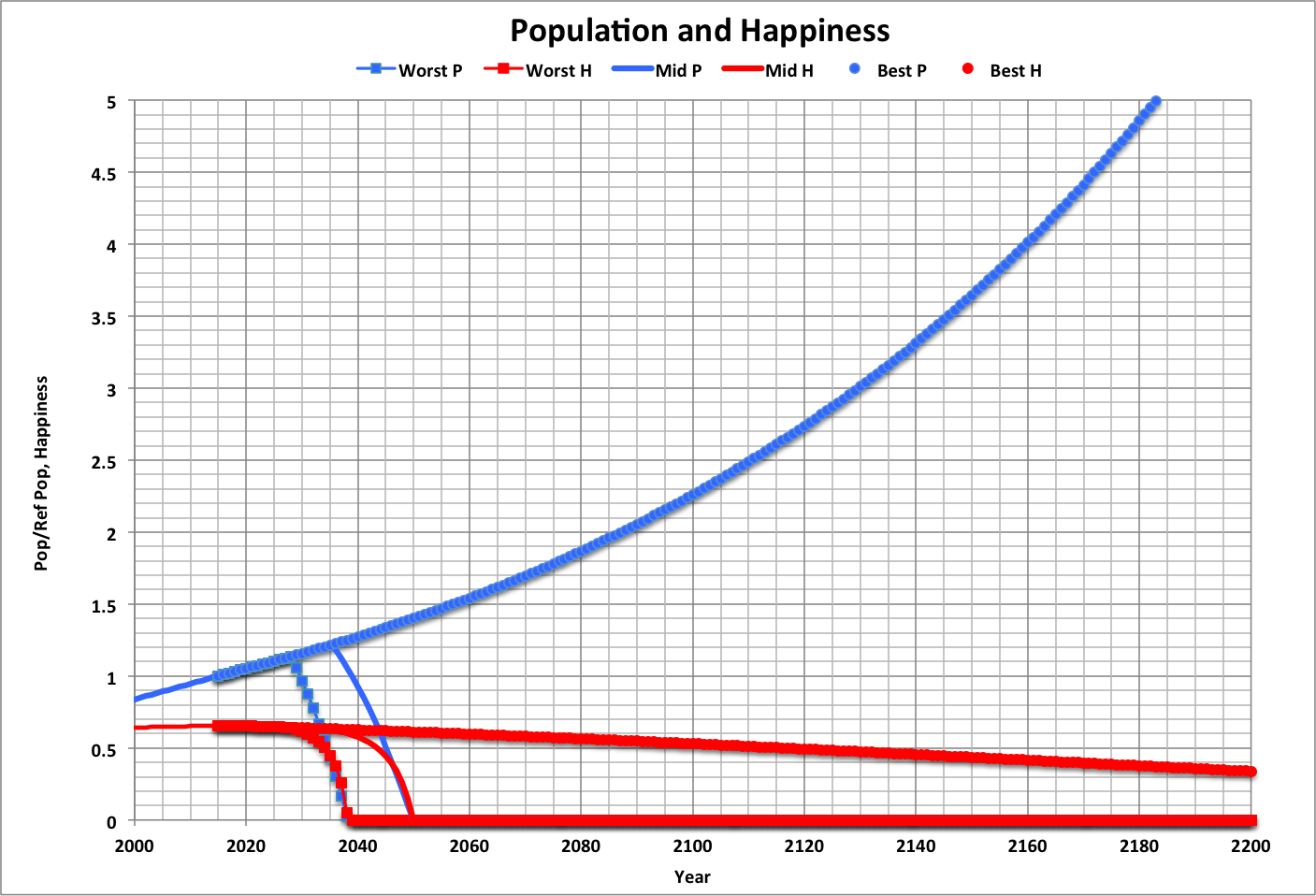
If our survival depends on keeping other species alive (those that directly support us, and those that support them), I now estimate that the combination of our consumption and worst-case global warming impact will drive us extinct by 2032; if not, then we'll have only another seven years. Without global warming impact, I expect humans will be gone by 2124 if killing those critical other species kills people; but if people can survive killing those species, then by 2160 over 29 billion people will be forced to live on fewer resources per person than anyone in history (with that consumption dropping rapidly).

The most reasonable expectation is that global warming will continue to increase for at least several decades, both in magnitude and impact; only how much and how fast is open for debate – until it happens, of course. While much attention has been rightly placed on this particular influence on our future, it is critical to keep in mind that it is a consequence, rather than the cause, of our imminent demise. The cause is humanity's pursuit of total dominance over the world, using its resources (living and not) to create environments suited to people's needs and wants. That pursuit unleashed the greenhouse gases now driving global warming, and it has diminished the ability of natural processes to compensate and keep that warming in check, all the while driving other species extinct at a rate that hasn't been experienced on our planet for many millions of years.

I was reminded recently of the slight chance for extending the lifetime of our species by leaving Earth, with the ultimate limits being the distribution of matter in the Universe and the laws of physics. Meanwhile, my research added a potential clue that humans might have natural limits built into our biology – first suggested by my study of the apparent relationship between happiness and consumption of natural resources – that will effectively cause us to starve ourselves under the most optimistic circumstances.

Use of this clue was behind my latest projections of population and consumption: that annual rates of change in world population and consumption (less so) are correlated with the total amount of those resources that we collectively consume. Those rates reached a peak in the 1960s, when we consumed two-thirds of the production of renewable resources by other species, and the consumption rate would plunge consumption to zero if we ever have the same amount left of total resources – which we won't because of how much we've already consumed, even if global warming spares us. Correlation is course not synonymous with cause, but it does beg for an explanation; and the hypothesis that our speed of growth is based on a basic sensitivity to how much of the world we use is tantalizing, to say the least.

We are still left with a range of stark options in the future of our species, just as each of us individuals must face the many different ways that we could die. The disturbing part now is how much they have in common, including timing, a conclusion I have been unable to shake after years of study and analysis.


Thursday, April 2, 2015

Complexity, Happiness, and Responsibility

Tying the insights discussed in "Communicating Complexity" back to the work I've done on understanding population and consumption, I found some tantalizing clues about how complexity relates to happiness and our ability to meet our personal and global responsibilities.

One clue involves how the complexity we each experience (complexity per person) tracks with happiness on a global scale. Since it is closely proportional to population size, it relates to happiness pretty much the same way. Until very recently, we could count on happiness increasing along with complexity, which is so intuitively obvious that many of us don't even think to question it: more people can provide more labor and creativity about how to both acquire new resources and use those resources to create environments suited to individual needs and wants.

As we were building environments, we were taking away or fouling the resources needed by other species to survive, including members of those species themselves, and since they were providing services and resources we depend on, it was inevitable that we would get to a point where there weren't enough of them left to replenish what we were using. We seem to have reached that point around 1970, and since then we have been struggling to provide enough environments for the people we've been adding to the world while using up more resources and killing more creatures. World happiness responded accordingly, reaching a peak level as Nature was unable to provide any more that we could dominate without increasingly severe consequences. We started focusing more on creatively using what we already had, which turned what might have been a smooth mountain-like peak into a very bumpy plateau, but we were still forced to deal with the need for some waste, especially of energy, the bulk of which we continued extracting from sources that could not be replaced in anything close to a human lifetime.

Another clue about complexity sheds some light on why we haven't done more to stop this suicidal behavior. One of the most obvious negative consequences of rising complexity is that people have less time to perform the same tasks, which risks (to put it lightly) sacrificing the quality of the results of those tasks. That decrease in time can be easily estimated for the world's population since the beginning of civilization based on population growth, and with reasonable assumptions about the time we are awake and the number of people and environments that would realistically be in our local communities which we could mostly interact with (interactions with the rest of the world's population would be negligible by comparison). One such estimate shows that 12,000 years ago people could have spent an average of about two weeks a year, at 16 hours a day, with each person in their community, along with their associated environments and worldviews, interacting to experience and shape their lives. Today, that time is down to two minutes. Put another way: we went from the time it would take to read a 7,300 page book to just a single page. Multiply these times by 24-millionths, and you'll get the time available for each person (and the rest) in the world.

Arguably, the sum of all of our interactions, directly and consciously with our local communities, and indirectly and unconsciously with the rest of the world, results in our net impact on human experience. Before civilization, when people lived in small groups that were effectively isolated from each other, each community was effectively a world. For the most part, personal responsibility, for oneself and family, was the same as global responsibility. But, on average, there were still impacts that could potentially or eventually affect others, mainly in the form of environmental change, but also in genetic changes that might be transmitted to other populations during chance encounters. Merging communities, as civilization did, enabled a critical divergence of these two kinds of responsibility, and complexity amplified it as people were torn between focusing on their immediate needs and those of people in a growing community. Competition for resources in the form of war simplified life for a while, by reducing population but leaving tools in place that helped the survivors support more offspring. On average, more people lived than died, with the tools, collective knowledge, and already-modified environments providing the means for further growth by dealing with more of the complexity with less direct human intervention. People were having more impact, but were feeling like they were still in small, manageable communities that happened to provide more of what they wanted and needed.

Now our numbers and our tools have created a global community where direct action is required to avoid catastrophic results of our collective impact that include increasing restriction of resources, both from overuse and fouling like that which has doomed too many other animals. Clearly, we don't have the time (and, for many, the inclination) to manage the complexity we already have, never mind adding some new variables to our internal constructs that will temporarily add to the complexity of our lives. Our tools may be able to pick up much of the slack; but by giving them more intelligence to do so, we risk them becoming our first serious competitors in millennia. This adds to the time-sensitivity of taking action, while avoiding the real temptation to accept the new capabilities as an excuse for increasing complexity further.

If we did take direct action, then, based upon my definition of complexity, we might try reducing the number of environments, roughly equivalent to creating less choice in products we can buy and sharing as much as possible. Unfortunately, even if we reduced that number to one for everybody, the complexity could only be cut by one-third, which wouldn't be enough (even if it didn't have the potential for much worse consequences) since we have nearly twice the complexity associated with safe consumption – and I'm not counting the possibly unstoppable and overwhelming effects of global warming.

In the past, we might have bought some time by reducing our population in a non-violent way: sending a large fraction to other, relatively isolated locations. Today our best option for doing so is a mass migration to other planets, beginning with Mars, but those worlds would need to be quickly made habitable, and the technology for transport would need to be created, tested, and put into mass production in even less time. The feasibility of doing so in the short time (less than a decade) we likely have before deadly competition becomes unavoidable is something I continue to reexamine and reject as too small to consider, but so are pretty much all of the other options, including the one I suggested at the end of "Communicating Complexity": cutting birth rates to zero and letting the population decline to a lower, sustainable level while regrowing ecosystems.

I remain committed to the belief that more understanding can lead to solutions that have a chance of working. While my recent research has added to that understanding (and hopefully the reader's), a viable path to solving this most critical of problems remains illusive. But it's good to remember that illusive does not necessarily mean nonexistent, and I plan to keep using some of my precious time to keep looking.


Wednesday, January 14, 2015

Spaceship Logic


We are the latest of many generations of astronauts on an intricately complex spaceship that is orbiting the Galaxy every 200 million years or so. Like other astronauts, we have a set of jobs to do in order to keep the spaceship functioning and its passengers alive. Unlike other astronauts, most of us have abandoned our jobs, and have been tearing apart the spaceship to create and maintain playgrounds so more of us can have more fun. We have been doing this without understanding or caring about how it affects how the spaceship works.

There are now many of us who have grown up in the playgrounds and know nothing else, including what our original jobs were. This is unfortunate, because we have now done so much damage to the spaceship that its life support systems are breaking down. The other astronauts have worked valiantly to repair the damage since they depend on the spaceship for survival too; but we have treated them like the rest of the spaceship, without regard for their value as fellow astronauts, what their jobs are, and what will happen when they can't do their jobs.

The lives of all aboard the spaceship depend upon using and reusing almost everything, preferably during the lifetimes of its passengers. It has many mechanisms for ensuring this, including passengers eating other passengers and converting them into forms that others can use, as well as producing more passengers. We have disrupted these processes, which is a large part of the damage we've done, by either hoarding a lot of what we take, or turning it into forms that others can't use within the time they need for survival.

Conditions have grown so bad that our playgrounds are in danger and people are becoming sick enough to notice. A growing number of us are realizing in horror that it may soon be too late to repair the damage before it kills our generation of fellow astronauts, and they are raising alarms. The alarms are muted, however, because the majority have grown up depending on the playgrounds and the people who manage them for their survival and fulfillment, and they are trapped, at least psychologically, in the patterns of living they know there. They continue to plan their lives so they can work for only part of the time, and enjoy a few of their later years without working; in part through saving, and in part by subsidizing the growth of activity by others, using abstractions that shield them from the real effects of what they do. The alarms make little sense, because the rest of the spaceship has no meaning except as a source of material for food and construction, and as a dumping ground for what we don't use.

Based on the logic of the playground, our best response is to make better playgrounds, isolated from the threat. This is, of course, the worst thing we can do, because it will cause more damage, amplifying the threat. We will be essentially fighting ourselves until we lose, and sadly most of us may never understand why. Our best hope is to keep that from happening by replacing the logic of the playground with the logic of the spaceship, and gaining more knowledge about how everything works by experiencing it with an open mind and respect grounded in our identity as part of the spaceship, instead of something apart.

Saturday, July 2, 2011

Tests of Survival

One of the common retorts to warnings of resource exhaustion and environmental catastrophe is that humanity has overcome similar problems in the past, and will continue to do so, primarily through innovating and exploring that is driven by the promise of great rewards for those doing both. This ignores the historical record of collapsing civilizations, the huge advantages accompanying our access to cheap energy in the form of fossil fuels, and the growing signs that we have merely postponed the worst consequences of our excesses, not eliminated them.

The bottom line is that every civilization – and every species – has lived or died based on its ability to solve two basic problems: matching resources with demand, and safely disposing of waste. It is far from a sure thing that our global civilization will solve these problems, though plenty of potential solutions are known. Whether you are optimistic or pessimistic about the future may, at some level, depend on your confidence that solutions will be implemented before resources run out and we are overwhelmed by our waste.

Given the stakes – entire species at risk – it is tempting to think that motivation won't be an issue. Those who acknowledge the stakes and are advocates of capitalism, even the distorted form currently dominating the world, expect that the price associated with demand exceeding supply will be enough of an incentive to spur discovery of new resources and innovative new ways of using the ones we have. This is certainly happening in the “green” industries, which are also taking on the waste issue by creating connections between waste and production, and increasingly altering the nature of ownership so that they can control everything but the use of the products, which is leased to their customers. To anyone who knows – or is – a true innovator, the majority of incentive to create comes from the innovation process itself; but true innovation is all-too-often a very minor part of industrial systems, where it is far cheaper to exploit workers and customers' ignorance than to provide quality, long-lasting products.

That so many people remain in ignorance or denial of the critical condition we're in by definition suppresses innovation. Not surprisingly, the people most responsible for disinformation are those whose personal power derives from the status quo, which in addition to causing the looming shortages and excess waste that is sabotaging Earth's life support systems, has no constructive alternatives to provide. Instead, all they can do is reap the profits of diminishing supply, and promising what they can't deliver (and convincing people that no one else can) while appearing to try by further exploiting the resources in decline.

Really sustainable solutions, because of the universal availability of resources and durability of products, will not ultimately lend themselves to profit-taking and power concentration. This is understandably unacceptable to those who have learned to value the maximizing of personal power. One tried-and-true alternative, which provided legitimately high rewards in the past, is to locate other sources of nonrenewable resources that can be controlled. Since such resources are limited or too dangerous to exploit here on Earth (whether people accept that fact or not), it is natural to try to find them on other worlds.

Various nations have space exploration programs, well-funded private groups not far behind. As noble as the search for scientific knowledge is, there is a strong component of the space community that has argued strongly and explicitly for the exploitation of other worlds. Now that NASA is terminating its Space Shuttle program and looking for a grander mission than remote observation and measurement, the space exploitation advocates (one of whom I used to be) see an opportunity to gain traction in the exploration and eventual settlement of Mars. I now find myself in the strange position of offering lackluster, if any, support for the idea, mainly because I fear that humanity hasn't learned the lesson of respect for other life that would keep us from spreading death and destruction as far as our technology can take us.

Not that long ago, I found people with attitudes like mine to be dangerously naive, idealistic, and maybe a bit crazy, mainly because I figured that our unique opportunity to transport life outside the death zone of our expanding Sun was worth the risk, and not likely to be available for much longer. Besides, I reasoned, we might still learn the life-respect lesson along the way. Now I figure that if we're bound to kill everything in our path anyway, it's probably good for the Universe if we stay right here and limit the damage. Of course, I hope that I'm proven wrong, but we should take the time to find out. A sustainable civilization is likely a good civilization, at least to those who value life and quality of life beyond our own experience.