Showing posts with label resources. Show all posts

Tuesday, December 31, 2024

Best Future

Humanity is on the verge of escalating its generation of waste that destroys or makes useless the natural habitat we most depend upon for our survival, a process that could result in our own extinction. Alternatively, we could avoid it and attempt to grow back habitat both directly and by reducing the waste we already produced. 


These options are illustrated below with two simulations over time of total resources and its components (in units of habitat consumed for basic human needs). Simulation Green displays our current course. Simulation Green’ (Green Prime) displays one version of the alternative that attempts to reduce global warming, a consequence of waste, as much as possible without destroying civilization and resulting in loss of life. Needs and waste comprise our total consumption, while habitat is what other life consumes. 


If we were to choose Green’ or a variant where we halt collapse after it starts, what would the result look like? Based on the amounts of resources over time, it appears that is might be like how the world was between 2000 and 2010, with the main difference being that the population size is about 40% higher.


The following graphs show the population distributions of resources and values for 2024 and 2035, illustrating how big a change in people’s lives would be required.


Saturday, September 7, 2024

The World Is Dying and We’re Doing This

Amid the growing certainty and omnipresent evidence that our species will soon drive itself extinct along with many other species, it is harder each day to justify living in a way that enables it. This is especially true in a society with its physical and social infrastructure that demands doing so in exchange for the surviving and thriving of ourselves and the people we care about.

Collection, processing, distribution, and use of resources throughout a population to sustain and grow it is arguably the primary purpose of life for its members. As a consequence, some of those resources become waste, which is not directly usable or reusable for that purpose by the society or others outside of it. 

Part of the waste can be further processed, by generating more waste, to create and distribute artificial environments, or parts thereof, that enhance personal experience of life. An increasing focus on this secondary purpose eventually inhibits achieving the primary purpose; and, if continued, results in death leading to extinction as the waste overcomes other species whose existence depends on the same resources and contributes to those resources.

Members of a society who want to reduce the risk of extinction can do so by attempting to decrease the amount of waste that is created. This can involve limiting the use of tools like money that enable that creation. Direct destruction of resources such as habitat for members of other species and killing more of those members than what can be reproduced, also increases the risk of extinction, and can be avoided in order to reduce the risk.

A healthy ecosystem is a community of life whose members collect, process, and distribute resources in such a way that they can be reused without decreasing their quality and quantity over a long period of time, thus extending the lifetime of the ecosystem and the number of its members. A dying ecosystem is the opposite, which is what we have now on a global scale.

If we choose to create more waste, then we are demonstrating that we do not value the health, and therefore longevity, of life in our ecosystem. Since humanity has global impact, our ecosystem is the world ecosystem. If we promote the growth of life such that it can achieve a level that can be maintained with available resources and/or other resources that can be acquired without destroying life, then we are demonstrating that we value health, life, and longevity.

The world as an ecosystem is currently dying. What we’re doing, and what we will do with that knowledge, is up to us.


Saturday, March 30, 2024

Interactions of Value

Interactions between groups can be used as a measure of people’s values. We can use changes in the amounts of people, habitat, and waste resulting from an interaction as measures of how much they are valued by the people involved in the interaction. 

Globally over history, the amounts of people and waste have grown at the expense of habitat such that the amount of waste exceeded the amount of people, and then waste exceeded the amount of habitat. Humanity will become effectively extinct soon after the amount of people exceeds the amount of habitat. 

In simulated world called “Green” that is based on historical data, waste exceeded people by 1940. Waste began exceeding habitat in 2015. By 2018, some members of the world population needed more resources for survival than there was habitat in their accessible environment. By 2025 as many people will be dying as are being born (the population will peak) and half the world’s total resources will be waste, after which there will be net death as increasing waste replaces more habitat. Overall, people will exceed habitat by 2037; and extinction will occur by 2041.

ABOVE: Amounts of resources over time.

People, habitat, and waste are not distributed equally within the world’s population. If they were, then there would be effectively one group of people cooperating to live the same way. In the simulation, a simplified version of reality based on measurable behavior such as economic activity, resources are moved and stored by people throughout the population based on available habitat and produced waste. The world is divided into thousands of environments, each a group with its total resources (“capacity” or size) composed of people (represented by the habitat they consume for survival), habitat (other species and what they produce and can consume), and waste (resources not consumable by people or other species). Changes in the distributions of resources within these environments are indicative of the interactions between them.

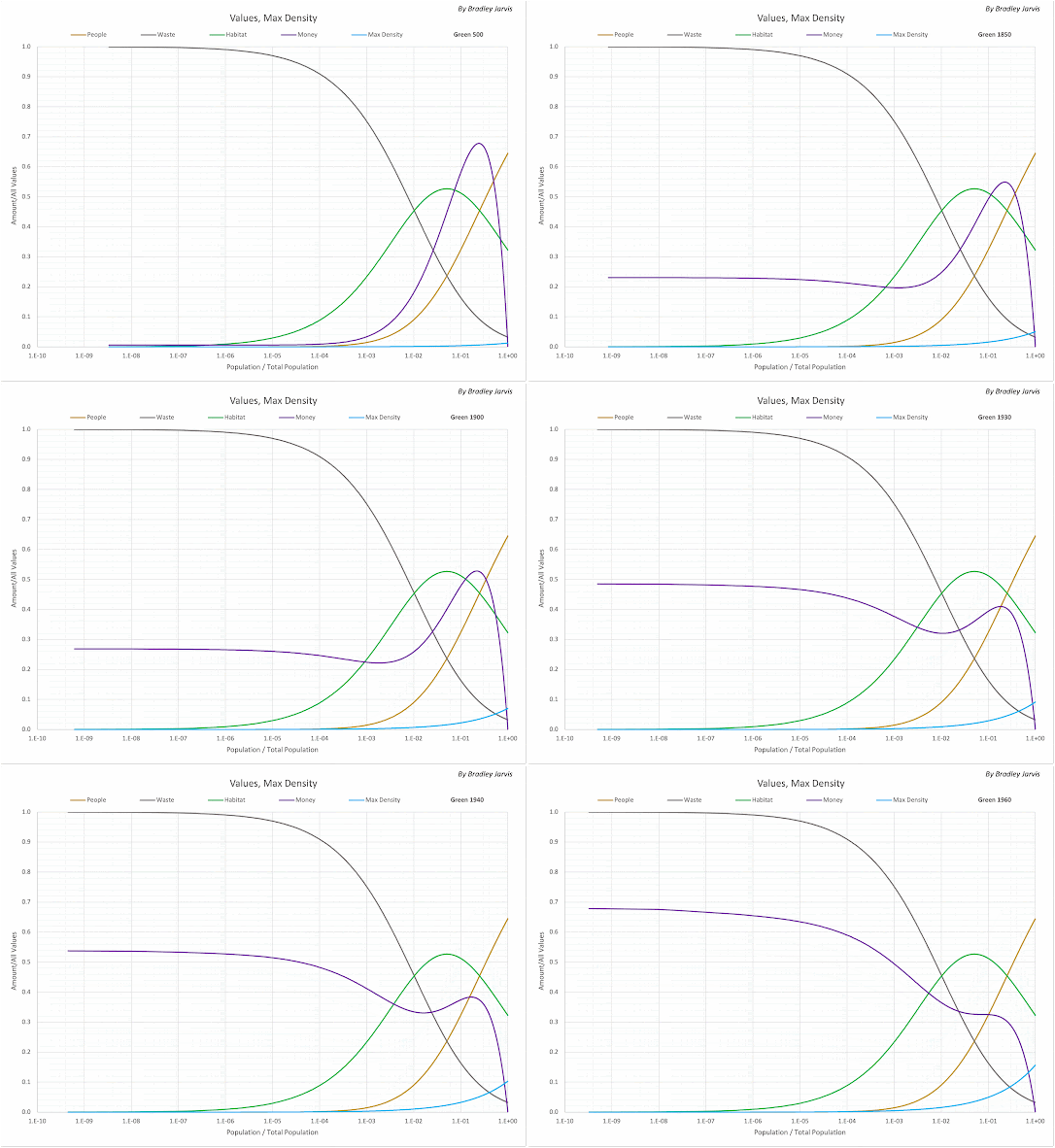
If we look at the world’s resources as environments with their capacities adding up (accumulating) based on increasing ratio of people to habitat (habitat ratio), we can see how their distributions compare with each other as a function of their size. This order is chosen because groups with close habitat ratios are similar enough to naturally interact with each other, as found in statistical analysis of economic activity (which, by definition, involves movement of resources) and correlations of life satisfaction. 

Environments with the most waste as a fraction of their capacity have the fewest people as a fraction of their capacity. As the total amount of waste increases, waste occupies more environments, and those environments have larger fractions of people in them. Another way of looking at this is that the groups with fewer people are at war with the groups that have more people (who are consuming), forcing them to move and grow into other environments by flooding them with waste and thereby depriving them of habitat until the habitat can’t support them (domination). Continuing growth of waste (exploitation) results in collapse, with the entire population having too little habitat to survive in environments that are essentially the same (except for one in the simulation, where one person has no waste and too little habitat to survive).

ABOVE: Stacked fractions of resources in each environment as a function of cumulative capacity shown for each decade since 1900 and projected through 2040 in simulated world Green.

In terms of value, interactions tend to favor waste more than people, and habitat only to the extent that it contributes to increasing people and waste by decreasing until it becomes critically low, which is too late to salvage it.


Saturday, August 12, 2023

Economic Distribution

 Distributions of people, waste, and habitat throughout a population are, in part, maintained by economic activity that is reflected by the money people exchange with each other. Like those resources, that money can be treated as a resource and translated into a value relative to the others.

Because it depends upon total quantities of people and waste, exchanged money varies as those quantities change over time. Measured as Gross World Product (GWP), the total has generally increased. How much it is valued throughout the population is determined by the distributions of people and waste.

In simulated world “Green,” whose history is a close match to ours, economic activity until the 1920s was most valued by those who valued both people and waste equally while placing the highest value on habitat. As more waste has been created by economic activity, a small fraction of the population, who values waste more than anything, has increasingly valued money that represents that creation. By the 1950s, the value of money to that group had risen to exceed the maximum value that any other group placed on people.

The focus of economic activity on the growth of waste has continued to the present. For most of Green’s history, 2% of the population has been responsible for 80% of the world’s waste. In 1960, that group was also responsible for 54% of the GWP. By 2020, it was responsible for 68% of the GWP. Increasing waste is largely responsible for decreasing habitat, which includes other species that maintain the habitability of any world; and starting this year, a growing number of people are projected to consume all the habitat available for their survival (a “density” of 1), altering every distribution. Waste, habitat, and people will approach equal value as the death rate increases, and money will be valued more than anything right before all are dead, which is projected to be in 2041.


Friday, August 30, 2019

Redefining Waste

Further testing of my Timelines model has revealed that what I've been calling "waste" should be redefined. Instead of representing resources that are unusable, it represents resources we are using that should not be used. Specifically: whatever we consume that is more than half the world's total resources is waste, which I project is currently 20% of all that we consume and 12% of all resources. As a consequence, "wants" are that we consume that is more than our needs and does not include waste.

By this definition, waste first appeared in 2004 and is projected be greater than what we consume for needs in 2027, four years after global population reaches its maximum and begins declining. Since it is equivalent to other resources (instead of being un-consumable as with the previous definition), it is treated likewise by the world's population in every respect. The only un-consumable resources are those removed from the total by "self-sustained impacts" that are projected to have begun by 2015.

ABOVE: Projected fractions world ecological resources in the "Green" simulation using the new definition of waste.

Difficulty reproducing global wealth statistics was the initial clue that "uninhabited regions" (data points with no people or other species) were problematic. The estimate of relevant resources couldn't be justified with the more refined approach that now includes a better estimate of the numbers of people who have common characteristics related to other global variables with many more data points. 

Experimenting with different ways of allocating consumed resources over the world population including that "waste" resulted in two fundamental observations about both economics and consumption when the statistics were reproduced which are obvious in retrospect. First, the exchange of resources and money (that represents both resources and the value of exchange) predominantly flows from people who consume less to people who consume more. Second, the resources consumed for more than needs are distributed in proportion to the ratio of available resources to resources consumed for needs – the reciprocal of the people-to-nature ratio that I discovered is a basic driver of many of the variables I've been tracking.

Although the new definition of waste and allocation of consumption significantly change the projections of related global variables within the population, they have no effect on projections of the entire population over time and support general behaviors found with the earlier version. For example, consuming wants in addition to needs is still associated with a switch from an egalitarian to unequal distribution of wealth, but the details of that switch are different; and the upcoming changes more resemble a cascading failure than a "switch" to a new regime, driven as they are by the crashing of the world's population due to overconsumption (an aspect of which being increased waste).

ABOVE: Distributions of global variables associated with major changes in per-capita wealth projected by the "Green" simulation for dates shown below the Phase axis. Displayed are Phase = lifecycle phase, L = life expectancy, h = happiness, Fert = fertility, Cum P = cumulative population, R = total consumption, Cap = capacity, and C = per-capita consumption. The years projected for when part of the population begins to enter a new phase are shown as Epochs.


Friday, February 23, 2018

Timelines


Since November I have continued to struggle with the "Rabbit Hole," with a little more success. That success is, in part, due to a decision to give in to my troubleshooting instincts and follow a process that served me well as a test engineer: simulating the system under test, and then using that simulation to reproduce a problem in order to identify its cause and potential solutions. The fact that there are multiple problems made this approach even more attractive. Having done so, I am ready to share what I learned.

The main problem, as it's always been, is the limitation of humanity's population growth and collective lifetime due to unavailability of resources critical to survival. The other problems have to do with limitations to maintenance and growth of the quality of life for the people in that population, not to mention the ultimate consequence of our definition of members of other species as "resources": their dying to the point of extinction. Evidence for these problems is found in the news, results of scientific research, and personal experience that people share (as well as my own). One of the most obvious consequences is stress from growing uncertainty about our own fate and the fate of those we care about, and lack of trust in the people and institutions that we've counted on to reduce that uncertainty.

For me, understanding is a remedy for uncertainty, even if that uncertainty can only be measured. I already had a good start on addressing that. The "population-consumption model" I've been working on for more than a decade has yielded some interesting insights, which have been the basis of much of my writing over that period. To be useful as a troubleshooting tool, though, it needed a lot more refinement. It especially had to be able to address specific behaviors of people, which I considered one of its main deficiencies. It also had to better match the historical data, which was helped by the addition of more data about ecological impact as a proxy for consumption, along with economic activity.

The most basic output of the model was a presentation of the past and most likely future of global population and consumption, similar to what I generated with previous versions. This time, though, I chose to focus on types of consumption, needs and wants, and a new type of impact – waste. Needs are the resources consumed to maintain the most basic survival, while wants are additional resources directly used by people, and waste is everything else that was part of overall impact. I also tracked what is left to consume – mainly members of other species (nature) and what they produce.

Unlike previous attempts, though, I left open the possibility of simulating timelines of history that didn't necessarily match with real experience: thought experiments describing what might be in other universes whose past, present, and future look significantly different from our own. This appealed to me because it could provide valuable context what we observe in our daily lives; and it could suggest actions we might not have anticipated by sticking strictly to reality. It also would inherently reduce confusion between real history and simulated history in my discussions, as I referred to timelines rather than actual events.

The first timeline I simulated, arbitrarily called "Timeline 1," was my best match to reality based on personal judgement about the variables and methods used, as well as tracking of differences between my source data and the outputs. By contrast, the source data represents "Timeline 0," which is essentially reality, though subject to change as more data is added – especially about future events. In Timeline 1, humanity is producing vastly more waste than wants, leading to peak population in 2020, peak economic activity in 2025, and extinction by 2037 as nature is depleted to a point where needs can no longer be met. This is accompanied by, and facilitated by, individual economic reward for waste that is equivalent to reward for meeting needs and wants, along with what the model shows is an inevitable and increasing unequal trade of waste for wants.

I will be adding more detail later, but the main points I just outlined for Timeline 1 are very consistent with the lessons I've learned from the bulk of my research, which is an argument for its usefulness in troubleshooting the real problems the model was created to simulate. Since Timeline 1 is based on human activity and does not include the potential influence of external changes to the environment such as self-sustaining climate feedbacks, it can mainly suggest actions we can take to delay, if not stop, our extinction in the absence of those changes. For example, one such action would be to reduce or remove reward for waste, beginning with calling it out for what it is.

One of the discoveries I made in preparing the new version of the model is a mathematical relationship between ecological impact and economic activity. If it's correct, then the residents of Timeline 1 can't just redefine how economic activity is distributed throughout the population without factoring out the waste they produce. Such a redefinition would, however, alleviate the grossly unequal quality of life that is among the other problems some of them – and some of us – might want to address, and may be a feature of another timeline.


Friday, April 14, 2017

Losing Weight


For each day over more than a month I tracked my weight and food energy in an effort to empirically discover the basis of a strategy for achieving my ideal weight.

I found that weight in pounds, measured right after waking up, is proportional to the calories consumed the day before, with the calories per pound randomly distributed around almost exactly 10 (with repeatability, measured as the standard deviation, of 1.4). Some research into how many calories are used with varying kinds of exercise showed that this relationship tracks closely with the energy spent on a full day of sleep as a function of weight.

This made the strategy simple: daily consume only the amount of calories needed to maintain my ideal weight, calculated by multiplying 10 by that weight. To improve my chances of not exceeding that weight, I wouldn't consume any more than that; and to avoid getting too much underweight, I would consume no less than 8.6 (10 minus 1.4) times the weight.

I couldn't help but compare what I was learning about myself with what I had learned about consumption of resources by humanity as a whole. The calories needed to maintain ideal weight seemed to correspond to what I had derived as the "minimum ecological footprint," the amount of resources provided by other species that is required for stable basic survival where the resources are reliably available (as became the case globally, on average, about fifteen hundred years ago). The lower value of calories I was aiming for corresponded to the footprint for a hungry state of being, with uncertain availability of resources, which I had calculated as 80% of the "minimum" and was the starting point for idealized groups of people driving historical population and consumption change since the start of civilization.

It is tempting to try making a comparison between being overweight and consuming more resources than is healthy for the world. As we are able to consume more stuff besides food, we are also able to consume more food. Our life expectancy, which tracks with footprint much like happiness (gaining less and less as we consume more), begins to decrease as we become more overweight, implying that doing so overwhelms our inner ecosystem just as increasing our footprint eventually overwhelms the external ecosystems that support us. I have long hypothesized that there is an upper limit to happiness, beyond which we cannot go without self-destructing, and it's not a great stretch to expect that obesity might have a role in this given that heart disease is the top killer in the affluent U.S.

My personal motivation for losing weight is tied to the health risks of not doing so, just as my motivation for downsizing is tied to my awareness of how consuming more stuff is contributing to global extinction. It amounts to a selection of personal limits, much as half of the idealized groups in my reconstruction of world history (one-sixth of the population) chose to consume only one-fourth of the renewable resources available in a healthy world while the other groups chose to consume everything.

I am a latecomer to all of this. Many others have experienced a similar awakening of a desire to live within healthy limits, with common reaction to growing evidence of the alternative's imminent failure. Although we are far beyond the ability to succeed on a global scale, I share the goal to nurture that desire as much as possible, for as long as possible, and with as many people as might choose to share in it.


Saturday, January 7, 2017

Healthy Is Now Ideal


Two years ago, I laid out a set of requirements for what I called an "ideal world," which in retrospect I could have called a "healthy world." Much of my writing since then has dealt with many of the same ideas, teasing out details, exploring the implications of my evolving model of global variables in the past and future, and sharing personal experiences and expectations that appear to be echoes of each other.

Built into all of it was the hope that some significant part of the population would seize on those or similar ideas and, in the presence of obvious danger, use them as the basis of a way to diminish or escape that danger. The political climate at the time was cautiously reasonable, inching toward awareness and agreement that something major needed to be done to avoid global economic and ecological collapse that was becoming perilously imminent. There remained a chance that the world might succeed in at least delaying that collapse by a few years.

I spent a fair amount of creative energy trying to assess the probability of success. As a trigger for some of that creativity, I simulated people and environments in fictional writing – a tactic that had coincided with previous bursts of insight (most notably in the development of my first novel). My most recent attempt followed a thought experiment in one of my books, and yielded a model of interaction between groups that made some interesting predictions that could be tested; chief among them: that interaction between groups is always destructive to the identity of at least one of the groups through either assimilation or death.

The last election here in the U.S. appears to have rejected global collaboration for mutual survival, and in light of my research suggests that the group most effectively in control of our politics and economy has felt enough of a threat to its identity that it is willing to threaten the survival of everyone in order to ensure its dominance. Use of the word "dominance" is deliberate: my group interaction model defines it as the total control of all resources by one group. Though I haven't as closely studied it, there appears to be a similar dynamic at work in much of the rest of the world. In previous years, this threat might have been dealt with by acquiring more resources and moving people away from each other in order to safely establish group identity ("isolation"); but the world is running out of basic resources, and we don't yet have the ability to settle other habitable worlds – if there are any. Competition will therefore be the driving activity of our future, and competition is the key to dominance.

I brought up the "ideal world" concept again because since the election I have come to a number of realizations, among them that the ideal world I envisioned is in fact what a healthy world would look like, as opposed to the dying world we live in now; and that even if we are beginning the collapse I've forecast and feared, the best we can do is to create pockets of healthy community and environments wherever we can. In future Idea Explorer posts I will dive into what systems engineers might call "derived requirements" for specific situations, and in my other writing (such as Twitter and the Land of Conscience blog) I will explore what implementation looks like.


Thursday, May 26, 2016

Generations of Interaction


A new model of group interaction draws from lessons learned in reproducing global population and natural resource consumption by proposing that the result of two groups interacting depends on potential changes in three variables: available resources, population, and the available resources per person.

People in each group attempt to maximize those variables by choosing among three possible interactions: remaining isolated, taking over the other group's resources (domination), or combining the two groups and sharing all resources. Whether resources are appropriated or shared, people can choose to maintain the same resources per person by changing the group's population, or to divide the resources equally among them. Each group's success in pursuing these options depends on its population: the more people it has, the more successful it will be.

The net result is the generation of a new, integrated group that is a mix of all the possibilities based on their probabilities (likelihood of success) and another group of "lost" people and resources. Just as some energy becomes useless when two gases mix, the losses are the equivalent of "waste" as far as the original two groups are concerned. The integrated group still has some differentiation into subgroups, with five subgroups (corresponding to interactions) for each of the original groups. These subgroups can now interact to generate another version of the integrated group; this second generation also results in losses of people and resources to join the waste from the first generation.

Barring interaction between the integrated group and one or more new groups, further generations will change the integrated group until there is no one left (every person has been converted into waste). If a new group is encountered, then the new group's people and resources will interact with the integrated group to generate a larger integrated group, while also expelling more waste.

This model needs to be tested, a process that should yield some interesting insights. For example, a first attempt at using it to describe humanity's relationship with the rest of the biosphere has shown that our population and the equivalent population of other species will be equal at 7.9 billion members, which is also the peak value of population before per-capita ecological resource consumption is forced to drop in the backcast model of population and consumption (with no global warming). Unless we find a new biosphere, keeping humanity's population constant will require reducing the biosphere's population and resources over several more generations which each take much less actual time than the many millennia in the first generation.


Friday, April 15, 2016

The Happiness Approximation


One of the cornerstones of my understanding of global population and consumption is the mathematical relationship between happiness and ecological footprint (our individual consumption of ecological resources). While trying to derive real significance from the convenient abstraction, I gained insights into how much of the natural world we can safely use, the purpose and mechanics of the global economy, and how people's values influence the survival of our species. Yet still I didn't fully appreciate why it had the form it did.

In the mean time, I grappled with the dynamics of human behavior and how to derive a means of successfully communicating the lessons I was learning so they could be used to hopefully extend the lifetime of our species, which my research showed is uncomfortably limited. One approach was to focus on complexity and how it influences both comprehension and the completion of basic tasks. I studied the implications of a general relationship I had discovered in my own experience between efficiency and the timing of progress in various activities, including the propagation of error in product development and messages as represented by my writing and that of others.

I suspected that task completion might be related to the pace and nature of global consumption and population growth. While I couldn't find a close correlation, I did discover that our species is attempting to use all of the Earth's resources that don't threaten the planet's ability to meet our basic needs, and we have historically been doing so in at least four different ways at a speed that varies with how much we consume.

A few weeks ago I had the latest of a string of epiphanies that has marked my research since the beginning. I accepted the possibility that the timing of consumption might be independent of the timing of task completion, and sought to generalize how they might fit together to describe how much resources are consumed during a task. In the process, I derived a relationship of the form found between happiness and ecological footprint. I was then able to apply the generalization, which I came to call the "happiness approximation" to how happiness has changed over human history and how it could conceivably change over a person's lifetime.

As I studied the consequences of the happiness approximation, I homed in on the special cases of completion and consumption that involve full use of resources in the completion of a task, which would be optimum where resources are limited. A simple statistical simulation showed that optimum completion averaged out to 76%, and that general completion had an average of 87%. Averaging those two values produced the 82% that the happiness relationship had identified as maximum average happiness for a population (and also happens to be close to the 80% used as a rule of thumb for realistic completion by project managers.

The timing of task completion also rang a bell of familiarity. The minimum amount of time it takes to complete a task (in the simulation) is 19, which is close to the 20 years that is the lowest life expectancy in my historical data (at the earliest year: 10,000 BC). If this correlation is correct, then it is the earliest point in a person's life that they can achieve 100% happiness, which according to the simulation only happens in 14% of cases.

I also modeled a better match to traditional expectations of task completion time, including something close to achievement of historical values of happiness and life expectancy in 2015. It never achieved total or optimum completion, and still took three units of time to reach maximum consumption, which is what I typically use for planning purposes (where one unit of time represents best possible achievement). Only 2% of a general population achieves that or better, which speaks to how selective an organization must be to realistically promise such performance; much less than 1% could be expected to achieve the perfect performance that an organization might optimistically promise in one unit of time.


Monday, November 16, 2015

Group Interaction


Based upon a simple model of interactions between two groups, the people in those groups will choose among six options depending on their relative populations, resources, and how much they value people, happiness, longevity (how long the population can survive), and the carrying capacity of their environment (the maximum number of people that can consume a given amount of resources per person).

The first option (isolation) has each group and its resources effectively isolated from the other group and its resources, and the other five involve one or both groups having access to all of the resources. Both groups can share their resources (sharing), which averages their consumption patterns (amount per person and how fast it grows). Group 1 can kill off Group 2, keeping all resources for itself (extermination 1), or Group 2 can do the same to Group 1 (extermination 2). The last two options involve the groups living together, with one dominating the other by imposing its consumption pattern on the other (dominance 1 or dominance 2).

If the two groups and their resources are roughly the same size and at or near their carrying capacity, then extermination 1 and extermination 2 each have roughly a 50% chance of being chosen, with practically no chance of any other option. If they each have more resources than people to consume them, then isolation, sharing, extermination 1, and extermination 2 will each have a 20% chance of being chosen; and dominance 1 and dominance 2 will each have a 10% chance of being chosen.

Where one group is much larger than the other group, isolation has the same chance (25%) of being chosen as sharing, extermination of the smaller group by the larger group, and dominance of the smaller group by the larger group. This is mostly due to the larger group having overwhelming power compared to the smaller group, and is independent of how close each group is to its carrying capacity.

The probabilities I've quoted are approximate averages of simulated groups, with each group "member" and each simulation varying from the average such that at any given time one option may dominate the others. In reality, I expect that all options will be attempted, perhaps simultaneously. I introduced this model in part 3 of my BIOME novel, and will explore its implications in the remaining books as a critical aspect of the plot. Here and in my other writing, I intend to use it as a tool for exploring real-world events, and to test it in the process.

Two predictions of the model are particularly relevant to current events, particularly those involving conflict and the potential for conflict between a large group and a small group, such as we've seen recently in terrorist attacks. Viewed from the perspective of the smaller group, there is a 25% chance of being physically destroyed by the larger group, and a 75% chance of losing cultural purity (total control over happiness and longevity as determined by consumption). To eliminate these threats, isolation can be re-established (accompanied by adequate resources), or full control over the larger group can be achieved by domination or by killing its members. Each alternative requires a huge increase in power, ideally in excess of the power available to the larger group, and we can realistically expect the acquisition of such power to be an early step in the process of pursuing one or more of these courses of action. Interestingly, the same actions that deal with these threats from the larger group may also be used to pose a threat to the larger group (and would be perceived as such by that group, regardless of the smaller group's motivation, thus making more likely the extermination option being taken by the larger group).

Of the two threats perceived by the smaller group, loss of cultural purity is the largest (by a factor of three). If this wasn't an issue, then the extermination threat might be addressed by improving the chances of sharing or domination. Where it is non-negotiable, then isolation is the most humane option. Isolation has been crudely implemented in the past through establishment of penal colonies; but, since the world is currently close to its resource limits, it is practically impossible. Note that space travel would be an option for isolation if habitable planets were already available and reachable, but any settlements in the foreseeable future would be operating dangerously close to their carrying capacities with additional risks to life that would require new consumption patterns and associated cultural adjustments. Incarceration, an extreme form of domination, is commonly used as an alternative to extermination, but of course it is the embodiment of cultural loss for a group that is markedly different from the dominant group.

As our planet changes its requirements for survival with the ecological disruptions of climate change, raw resource depletion, and species extinctions, I expect we will all perceive ourselves as parts of small groups struggling to adapt while avoiding extermination. We will also need to see other species as something other than other groups that can be exterminated, since they and the services they provide embody the "resources" that we need to survive. Our consumption patterns, which are major components of our cultures, will need to be more flexible than ever in light of these conditions; and above all else, we must adjust our values so that our preferred options are more aligned with extending longevity and minimizing death.


Tuesday, October 27, 2015

Earl's Myth


In the latest installment of a novel I'm writing in parts, a fictional industrialist named Earl recalls a myth he used to finance his nascent company. The myth was based on an ecological interpretation of businesses within an economy which in reality I made up while writing about it:

Economies functioned much like biomes, with companies acting like organisms, industries functioning as populations of species, and economic activity joining them in communities that, together with the physical resources such as people and materials that they collected and processed, functioned as ecosystems.

Of course, economies are artificial, but I wonder if most of us tend to expect similar things from both our artificial and natural environments. Evolution has shaped us to get what we need from natural environments if we follow certain instinctive behaviors, and to penalize us if we don't. Education serves a related function in relating to civilization by priming both our skills and our expectations so we can survive and thrive to the extent that we occupy useful niches within our artificial environment.

For the analogy to work, people must be equivalent to organisms in both types of environment, but there are many indications that it is no longer working. Perhaps the most obvious indication is the huge amount of wealth inequality in the world today, the equivalent of which would, I suspect, never occur in a natural system that wasn't about to include at least one population collapse. Instead, as Earl's myth described, we have organizations that are functioning as organisms, and people have been relegated to the role of "resources."

For the most part, the few people who have mastered control of the artificial organisms, through the acquiescence of their fellows and the illusion of embodied energy in money, still function as organisms themselves, and receive rewards commensurate with their occupation of the new niches demanded by the artificial world. The rest of us are simply used, then discarded, and perhaps recycled eventually (after extended periods of unemployment) while others are "consumed," all the while thinking that the work and personal degradation is an appropriate sacrifice for a better world created by the super-organisms (some of whom are still like us) that will eventually meet our wants and needs too.

Of course, the fact that our artificial organisms are using actual resources, and are crowding out the real organisms whose bodies and work enable our planet's habitability, means that the flesh-and-blood puppeteers of those organizations will also be part of the human population collapse facilitated by their efforts. Barring the success of fantastical efforts like that described in my book (a success we may not end up wanting), humanity will have to dispense with dangerous myths like Earl's and become reacquainted with Nature's reality just to survive.


Friday, October 2, 2015

Temperature


Assuming my modeling of population and consumption is correct, then the famous 2° Celsius limit for global warming by century's end is twice what it should be. According to my first attempt to incorporate global warming into the model, if we are successful and the warming is already self-sustaining then we need to immediately start reducing our per-capita ecological footprint by at least 0.7% per year to avoid casualties between now and the year 2200.

A decline in total ecological resources due to degradation will have the same effect as consuming too much, eventually making it impossible for people to survive and our population will crash. Whatever causes it (global warming as an example) must be stopped before that critical threshold is reached, otherwise all we can do is delay the end date.

If, as I expect, humanity will soon be forced to consume less overall (through personally cutting back, losing population, or both), then our slowing rate of pollution will enable natural systems to process the lesser amounts resulting in the approximation of no net increase in the amount, and eventually a decline. In the case of greenhouse gases, I've assumed no decline in the next two centuries, which means that temperature (their effect on the environment) will not decrease either. As far as I can tell from my data, that effect has been masked by our overall consumption, so it hasn't yet resulted in a decrease in total resources; but with us now pushing against the envelope of those resources, there won't be enough left to both process our waste and provide for the survival of the species we directly depend on.

Perhaps by coincidence, my projected temperature will match with the historical trend in 2019, and others who are planning for future emissions seem to be targeting 2020 as their starting point. Also, I projected that direct emissions will decrease around the same time, except for short pulses corresponding to attempts to reach the resource limit after drops in population. For these reasons I chose 2019 as the starting time for a hypothetical decrease in total resources responding to global warming, and for attributing the difference in emissions to other factors that make it self-sustaining so that the temperature trend continues into the future.

The result, which is as close as I can currently come to a representation of future global warming, has consequences much worse than the case I first presented above, which is the best my model can achieve in terms of avoiding casualties with declining resources. Whereas my default case with no resource decline projects a world population of 5.8 billion people by 2200 (a "loss" of at least 1.5 billion), the global warming case projects that everyone will be dead by 2165. Adaptation in the form of limiting population and consumption growth adds only four years to that end date. For reference, in most scenarios I've looked at, the temperature above preindustrial times when the population crashes is about 2.5° C (it is currently 0.7° C, and would be 1.7° in 2100).


Friday, September 25, 2015

Two Stories


My efforts to explain and project global trends in population and consumption have yielded two competing stories about the past and our potential future. With critical new insight about the second one emerging from work over the past week that may have reconciled the two, this is a good time to summarize them.

The stories are based on several key observations. First, happiness (life satisfaction) varies predictably with the amount of resources people consume, as measured by their ecological footprint, with smaller and smaller increases in happiness as consumption increases, approaching a maximum amount as any one person approaches consumption of the output of Earth's entire biosphere. Second, there is a minimum amount of such resources each person needs to survive. Third, the population of an average other species decreases linearly with the total amount of resources that humanity consumes. Fourth, global economic activity is proportional to the square of the product of population and happiness, which I interpret as transactions of artificial environments that provide happiness. Fifth and finally, in small groups life expectancy increases with consumption much as happiness does, while in large populations it varies with the total resources consumed by the group.

The first story comes from mathematically simulating "worlds" that each represent a point in time with a certain population, ecological footprint, and total amount of resources. A world can only "exist" when: (1) the resources consumed by the population is no greater than the total resources; (2) an average "person" consumes no less than the minimum; and (3) average happiness is less than the maximum. As total resources decrease, the number of worlds decreases, and the remaining worlds are clustered around more restricted combinations of population, ecological footprint, and happiness. Using historical data to identify the worlds occupied by humanity over time, it appears that as our species has consumed more resources, it has targeted the most dense concentrations of remaining worlds, with the objective of occupying as many worlds as possible without decreasing population in the process.

Behind both narratives is a more conventional backstory. All species collect and recycle energy and material, using it to exist as long as possible and to maximize the propagation of their forms over time and space. As the distribution and types of energy and material change, they adapt by changing their behavior and their form (evolving). From the perspective of members of any one species, other species either assist them, impede them, or are merely parts of their background environment that may assist or impede them later. "Assistance" can understood in economic terms as the provision of products and services, collectively considered as "resources" that include food (a primary source of energy and material) and purification of water (processing a resource for use and eliminating threats to survival), and those resources can be provided either on a continuous basis or a one-time basis. "Impeding" includes removal and degrading of resources (or the species that provide them) and, of course, being treated as a resource yourself. Happiness, as experienced by us and possibly other species, is a consequence of the degree that an individual's environment is optimally suited to maximize personal longevity and propagation of the individual's unique characteristics, and increasing it means using as many resources as possible.

The second story begins with two people, each using the minimum amount of basic resources (such as nutritional food, water, and breathable air) needed to live long enough to produce two more people and keep them alive long enough to survive on their own. Those resources are provided by a core set of other species ("supporters") which are doing the same thing and consuming resources supplied by another set of species ("producers"). For the system to last a long time, the supporters and producers must be allowed to reproduce so that their populations remain at least constant, otherwise the amount of resources drops, as do the populations of the creatures that depend on them – especially us.

Consuming the minimum amount of basic resources corresponds to a minimum level of happiness and lifespan, since none is left over for significantly altering an individual's environment beyond providing basic needs. The creation of physical and social technology (such as economics), especially since the beginning of civilization, has enabled the use of more resources as well as other types of resources besides the basic ones. This has translated into increasing happiness, longer lifespans (due to better health care, protection from predators, and a more reliable food supply). It has also supported larger populations, whose labor and ingenuity (higher probability of smarter and more capable people being born) has reinforced technology creation and use.

While we've so far protected the species that provide basic resources, we've consumed more than what other species produce, and have been consuming members of those species themselves. This consumption has included conversion of source material and energy into forms ("waste") that cannot be recycled by other species in a timeframe useful to humans, and may be harmful to them, even to the point of killing them off.

This brings us to the most important aspect of the second story. Humanity is now on the verge of consuming the producers that keep the supporters alive. Keep in mind that only the basic resources keep us alive and healthy; the other resources increase the quality and length of individual lives, and they enable growth in population by getting access to more resources. What will happen next?

In the first story, humanity is forced to retreat to a lower-consumption "world" which allows other species to grow back partially, thus providing resources for more people. We try to occupy this new world and then do the same thing again, resulting in oscillations in population ("popscillations") with a downward trend to a new value dependent on how much the species can bounce back before we overwhelm them again. If, with the second story, historical population and consumption trends are projected forward in time, humanity consumes some of the producers and stops when after our population drops in response to a shortage in basic resources. Then, after some settling, population and consumption both drop to much lower levels, potentially zero.

My new insight came from trying to understand that last drop, which at best seemed like radical overcompensation. After examining my underlying assumptions and being drawn back to the logic of the first story, I realized that humanity must be seeking a particular goal, manifested as reaching a limit in both population and consumption. Historical data showed that the best candidate was a condition where all that remains in the world is us, what we're consuming, and the supporter species. In short, we don't recognize the value of keeping producers around. Incorporating this into the story resulted in popscillation behavior like that in the first story: population drops in response to lack of basic resources, the species providing those resources partially recover, and the cycle starts over and over again, with an overall downward trend in our population. In this case, continuously increasing individual consumption repeatedly causes attempted overshoot of resources that drives down population in response.

As with someone who is banging his head against a wall harder and harder in the hope that it will move out of the way, avoiding further injury is best achieved by stopping the banging. If we're smarter, we'll avoid hitting the wall the first time (immediately stop population and consumption growth). Following this analogy, if the wall starts to move toward us, which is a conceivable consequence of climate change as species start to die off without our help, we should move backward (reduce our consumption) at least as fast as it is moving toward us. If we're lucky, and emphasize reduction of our greenhouse gas waste, the "wall" may slow down or stop before we are forced to reduce our population.


Tuesday, August 18, 2015

Shutdown Scenarios

The first major test of my Half-Earth Hypothesis is in progress. Analysis of new data indicates that, if the hypothesis is correct, within a year humanity will begin consuming the ecological producers that maintain those ecological supporters that enable our basic survival. This will likely result in several hundred million casualties in the next decade, followed by several billion in the first half of the following decade, potentially leading to our effective extinction soon after.

This "hard shutdown" is a consequence of our historical behavior, but we may still have a chance of converting it into a "safe" shutdown by controlling both our population size and the amount of resources lost by our excess consumption. If competition for resources is the main cause of the initial casualties, we might in the best case be able to eliminate it and keep our population constant while reducing our individual consumption to a sustainable level and maintaining it there. This assumes that the lost producers can be recovered, and that their loss hasn't triggered a cascade of further environmental degradation.

If we can't control the population loss, then it may be kept from growing back as individual consumption continues to fall. In this case, protective policies might also prevent further casualties, and the drop in individual consumption may be stopped before it jeopardizes the maintenance of a civil society.

In my opinion, the best case future is about as improbable as the one most governments and businesses appear to expect, which is predicated on limitless growth. Based on that expectation, the other possibilities represent risks that merit little attention in the form of tweaks to their plans that may account for only a few-percent of additional costs in the distant future ("distant" being more than five years out).

Combining the scenarios discussed here and using my own estimates of their probabilities, I anticipate that the world will experience a serious food crisis just as the U.S. presidential race reaches its peak. During the new president's first term, the death toll will mount into the millions and people will attempt to grow much more food, exacerbating the problem. The next election will occur just as the population begins to recover, but consumption will have already begun falling. How far it falls, and whether we will suffer a much more massive loss of life, will be determined during the following decade.

Whether or not these scenarios are accurate, they provide a useful context for discussing how carbon emissions may decrease, voluntarily and involuntarily. The obvious preference should be for the best case; and we should put the mechanisms for creating it in place, regardless of motivation. We can similarly study the mechanisms involved in creating the disastrous alternatives so we can reduce their probability of becoming reality.