Showing posts with label waste. Show all posts

Saturday, March 22, 2025

Life vs. Artificial Life


Of the simulated worlds I've explored in my research and fiction, the most fantastical is the subject of my novels which I hope one day to compile into a trilogy if the real world and I survive long enough to complete it (a condition that appears less probable every day). Nicknamed Futuria for a fictional community that plays a prominent role in the novel Biome, this simulation explores a potential escape from human extinction through bioengineering. 

In the post Earl's Myth, I discussed an inspiration for doing this as an interpretation of economies as artificial biomes (types of ecosystems) inhabited by people and organizations functioning as species of organisms that feed on each other and biological ecosystems of which they are ultimately a part. A consequence of this is destruction of life both directly (by overconsumption) and indirectly (by the production of waste that reduces quantity and quality of needed resources). Because generation of waste is essential to the existence and functioning of economies, a choice must ultimately be made between the survival of artificial life (economies) and human life (along with other biological life). Fictional Earl Oldfield realizes that he has accidentally been provided an alternative to that choice: alter some of life, especially humans, so that it can consume waste and ultimately become it.

Here on Earth, some worshippers of technology as the ultimate savior of humanity have apparently embraced variations of that alternative and are crafting different ways to apply it. One way is the physical merging of humans with machines beginning with the use of neural implants to enhance the functioning of our brains. Pharmaceuticals have long been used to supplement or offset our natural abilities and characteristics, typically on an ad hoc basis. As other species struggle using behavior change and natural evolution to adapt to the damage we are inflicting, it is perceived as a logical next step for us to augment our own changes in behavior (including alteration of environments) with changes to our biology and controlled evolution, the latter two having already been experimented with on other species throughout our history up to and including the use of invasive bioengineering.

Another alternative, the one I favor because I value life, is to reduce the waste and help other species to repair the damage and grow healthy ecosystems that primarily support biological life. The denizens of simulated world Hikeyay (also named for a fictional community and featured in my Simulated News blog) effectively embrace this approach and the ultimate consequence of having a smaller population consuming much less than when they started their "global strategy" to fight the extinction threat. Much of my recent thinking of how to implement this alternative was developed during the writing of that blog, which I am continuing even as the probability of its implementation in real life drops closer to zero. While improbable, partially implementing this alternative is theoretically possible (as I indicated in the post Best Future) but it soon won't be without significant loss of life if we are already on the cusp or in the beginning stage of collapse.

Total elimination of humanity, what the alternatives are trying to avoid, is manifested in simulated world Green (the name of a mountain and a fictional research station), which is my best approximation of our own past and future. Over the next 15 years, that world's production of waste will rapidly increase, destroying the natural habitat that supplies what's needed for basic survival, and killing off the human population as a result. Waste will become irrelevant after that, unless part of it has been replaced with actually artificial life (particularly artificial human life). Because my simulations are based on historical trends of biological life, they offer no guidance about whether techno-saviors would be successful or not.

The people in simulated world Futuria, however, will see gradual growth in waste and a corresponding decrease in habitat, with population peaking about now and then dropping gradually. Rising global temperature is a serious problem for them as well as us and the worlds that choose to increase habitat; this is because there is a lower limit to how much people can consume, and temperature is dependent on the cumulative amount of waste as heat-trapping gas in the atmosphere. The fate of Earl's plan is to be determined, though it will play a major role in this year's events, not the least being those featured in my novel Lights Out.


Saturday, September 7, 2024

The World Is Dying and We’re Doing This

Amid the growing certainty and omnipresent evidence that our species will soon drive itself extinct along with many other species, it is harder each day to justify living in a way that enables it. This is especially true in a society with its physical and social infrastructure that demands doing so in exchange for the surviving and thriving of ourselves and the people we care about.

Collection, processing, distribution, and use of resources throughout a population to sustain and grow it is arguably the primary purpose of life for its members. As a consequence, some of those resources become waste, which is not directly usable or reusable for that purpose by the society or others outside of it. 

Part of the waste can be further processed, by generating more waste, to create and distribute artificial environments, or parts thereof, that enhance personal experience of life. An increasing focus on this secondary purpose eventually inhibits achieving the primary purpose; and, if continued, results in death leading to extinction as the waste overcomes other species whose existence depends on the same resources and contributes to those resources.

Members of a society who want to reduce the risk of extinction can do so by attempting to decrease the amount of waste that is created. This can involve limiting the use of tools like money that enable that creation. Direct destruction of resources such as habitat for members of other species and killing more of those members than what can be reproduced, also increases the risk of extinction, and can be avoided in order to reduce the risk.

A healthy ecosystem is a community of life whose members collect, process, and distribute resources in such a way that they can be reused without decreasing their quality and quantity over a long period of time, thus extending the lifetime of the ecosystem and the number of its members. A dying ecosystem is the opposite, which is what we have now on a global scale.

If we choose to create more waste, then we are demonstrating that we do not value the health, and therefore longevity, of life in our ecosystem. Since humanity has global impact, our ecosystem is the world ecosystem. If we promote the growth of life such that it can achieve a level that can be maintained with available resources and/or other resources that can be acquired without destroying life, then we are demonstrating that we value health, life, and longevity.

The world as an ecosystem is currently dying. What we’re doing, and what we will do with that knowledge, is up to us.


Saturday, April 6, 2024

Value Statement

“Exploring new ways of thinking, for fun and optimization of the amount, longevity, and quality of life.” – Bradley Jarvis profile, X (formerly Twitter) @bradjarvis

That introduction is a succinct statement of my values and how I most prefer to serve them. The term “life” is more general than I’ve typically used it elsewhere, applying to both humanity and other species. 

By my calculations, collapse of both populations is avoided where natural habitat that includes other species accounts for more than 63% of the sum of habitat and what people are consuming to survive. Put another way: The habitat that supports humans requires about the same amount of additional habitat to support it; less than that and it decreases, unable to support as many of us. If we were like other species and did not generate waste, our population would decrease to a level that could be supported by the remaining habitat which is supported by what it needs that grows back; but with increasing waste, that can’t happen, and we all die together.

What I just described accounts for the amount of life. How long both populations can survive is the longevity. Quality of life is how well members are matched to their environments, receiving benefits commensurate with what they contribute to the health of others. Humanity’s creation of waste, whose function as the essence of artificial environments is to provide benefits without requiring the giving of benefits, has enabled increasing quality of life for some at the expense of life itself for others – nonhuman and human.

One of my “new ways of thinking” is to tie amount, longevity, and quality as aspects of life to the values of people, habitat, and waste that I’ve identified in my other writing and described briefly above. How the aspects of life are to be optimized depends on the relative priorities of the values; and those priorities will be different for different people. For that reason, my recent research has been focused on deriving what those priorities might be (and how they might change) within given populations of people; and presenting the results as aspects of life within simulated “worlds” with similar pasts and different futures – one of which might be our own.

My greatest interest has been how to increase human longevity since our extinction would be the end of all our lives and our values along with them. The dependency of longevity on the amount of available habitat over time and the number of people consuming it to meet basic needs is a good reason to give habitat at least as high a priority as people. Waste would be the lowest priority, though it can serve longevity if a fixed amount of it is used as protection from threats to it that can’t be dealt with otherwise. Waste also can be, and has been, used to access more habitat if habitat is diminishing or population is growing beyond what existing habitat can support.

 From the perspective of other species, my guess based on extensive reading about biology and specifically ecology is that, for many, the value of population size (as procreation) would be the highest priority. Habitat (food supply and shelter) would be second. Waste wouldn’t even occur to them unless it was mistaken to be part of their habitat. Generally speaking, enabling development and maintenance of healthy, diverse ecosystems is the best way to optimize non-human life. This would, as a minimum, involve getting rid of waste and making the rest as harmless as possible.

As for the fun part of creative thinking, it’s a natural reward that draws me to do more of it no matter what circumstances I’m in.


Saturday, March 30, 2024

Interactions of Value

Interactions between groups can be used as a measure of people’s values. We can use changes in the amounts of people, habitat, and waste resulting from an interaction as measures of how much they are valued by the people involved in the interaction. 

Globally over history, the amounts of people and waste have grown at the expense of habitat such that the amount of waste exceeded the amount of people, and then waste exceeded the amount of habitat. Humanity will become effectively extinct soon after the amount of people exceeds the amount of habitat. 

In simulated world called “Green” that is based on historical data, waste exceeded people by 1940. Waste began exceeding habitat in 2015. By 2018, some members of the world population needed more resources for survival than there was habitat in their accessible environment. By 2025 as many people will be dying as are being born (the population will peak) and half the world’s total resources will be waste, after which there will be net death as increasing waste replaces more habitat. Overall, people will exceed habitat by 2037; and extinction will occur by 2041.

ABOVE: Amounts of resources over time.

People, habitat, and waste are not distributed equally within the world’s population. If they were, then there would be effectively one group of people cooperating to live the same way. In the simulation, a simplified version of reality based on measurable behavior such as economic activity, resources are moved and stored by people throughout the population based on available habitat and produced waste. The world is divided into thousands of environments, each a group with its total resources (“capacity” or size) composed of people (represented by the habitat they consume for survival), habitat (other species and what they produce and can consume), and waste (resources not consumable by people or other species). Changes in the distributions of resources within these environments are indicative of the interactions between them.

If we look at the world’s resources as environments with their capacities adding up (accumulating) based on increasing ratio of people to habitat (habitat ratio), we can see how their distributions compare with each other as a function of their size. This order is chosen because groups with close habitat ratios are similar enough to naturally interact with each other, as found in statistical analysis of economic activity (which, by definition, involves movement of resources) and correlations of life satisfaction. 

Environments with the most waste as a fraction of their capacity have the fewest people as a fraction of their capacity. As the total amount of waste increases, waste occupies more environments, and those environments have larger fractions of people in them. Another way of looking at this is that the groups with fewer people are at war with the groups that have more people (who are consuming), forcing them to move and grow into other environments by flooding them with waste and thereby depriving them of habitat until the habitat can’t support them (domination). Continuing growth of waste (exploitation) results in collapse, with the entire population having too little habitat to survive in environments that are essentially the same (except for one in the simulation, where one person has no waste and too little habitat to survive).

ABOVE: Stacked fractions of resources in each environment as a function of cumulative capacity shown for each decade since 1900 and projected through 2040 in simulated world Green.

In terms of value, interactions tend to favor waste more than people, and habitat only to the extent that it contributes to increasing people and waste by decreasing until it becomes critically low, which is too late to salvage it.


Saturday, February 10, 2024

Interactions

 The people in two groups can avoid interacting with each other, remaining in isolation. They each have an amount of habitat (resources that meet the needs of people and other species), and waste (resources that displace habitat).

People in each group can interact with each other, with several results based on the rates of change of people, habitat, and waste. 

COMPETITION: 

Domination – One group dominates the other by killing its members.

War – The groups fight each other, replacing people with waste. 

COOPERATION:

Sum – The groups live together, meeting their basic needs and not changing the amount of people or waste.

Restoration – The groups live together, increasing habitat by having less people and less waste. 

Cleanup – The groups live together, increasing habitat and reducing waste. 

EXPLOITATION:

Consumption – The groups reduce habitat by converting it into people and waste.

Collapse – Habitat is reduced to less than what is needed for people to survive, resulting in mass die-off.

If one group is the global population and the other is the next year’s global population, then mostly consumption has occurred, with very few years of cleanup. Collapse is likely soon.

ABOVE: Example of two groups and results of interaction. Area is proportional to the amount of resources. The amount of people is equal to the needs they consume.


Saturday, August 26, 2023

Groups of Value

The term “values” can be reduced to what someone uses to define “good” and “bad.” In my attempts to quantify it and relate it to behavior and global outcomes, I’ve identified a set of resources and amounts of them that everyone has and uses to some extent. Fractions of the totals of each per person throughout a population, representing how much each resource is valued, are ranked based on calculated distributions of each using historical projections of the totals over time that are embodied in simulations.

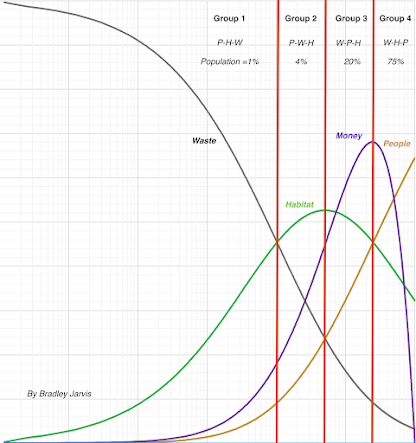
There are four identifiable groups that remain constant in their fractions of the population until too little habitat remains to support each person and members of the species that maintain it. The ranks of value placed on waste (artificial environments), habitat (natural environments), and people are unique to each group, as shown below. Note that the two middle groups could also be considered one group, as mentioned in Distributions.

Waste is valued most by the smallest group and people are valued most by the largest group. Habitat is valued most by the two middle groups, with one valuing waste second and the other valuing people second. No one in one group places the same amount of value on people or waste as anyone in another group. Members of either of the middle two groups can value habitat the same as members of the other group, but not members of either of the two remaining groups. Some members of the smallest and largest groups can value habitat the same, but no one can value habitat the same as members of the two middle groups.

If the value placed on each of the resources is exclusive of the others across the whole population, the fraction of the population valuing waste is 9%, the fraction valuing habitat is 40%, and fraction valuing people is 51%. Note that even for these groups, the fraction valuing people is much larger than the fraction valuing waste.

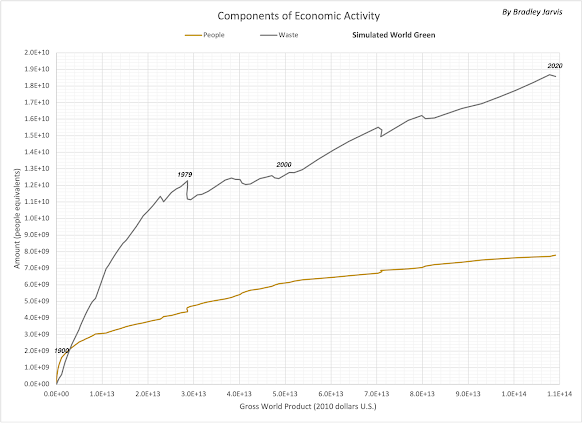
Money as a resource indicating relative economic activity (as indicated in the diagram for small populations and discussed in Economic Distribution) have favored equal value placed on people and habitat (corresponding to half the total habitat available to the population) while promoting increased waste by those who value it most. As shown in the following graph, waste production by a simulated world like ours has outstripped population growth (driving human transactions) as a component of economic activity and remains strongly associated with it. The “rich,” those benefiting most from that activity, and everyone else, represent another set of groups - defined by the value placed on money.

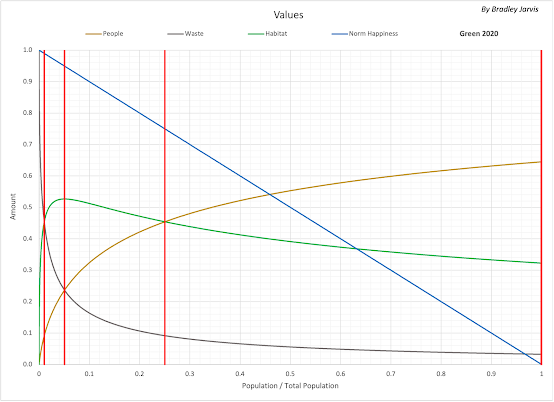
Implicit in this approach to quantifying what someone considers good and bad is the debatable assumption that their current conditions represent what they prefer, and that others they compare themselves to are likewise in preferred conditions. Even using change over time might not be a reliable indicator of preferences; the change could be so far beyond the person’s control and the destination is opposite to their preference. Referenced to groups, a person could move from one group to another due to the actions of others or environmental effects that force change in availability and consumption of resources. This appears to necessitate an additional variable for consideration: choice. Based on national statistics from 1800-2017, happiness varies as shown below, as does life expectancy, where the red lines mark the limits of each the four groups we started with; this suggests that members of a population will tend to prefer a higher value of waste.


As waste effectively decreases habitat, the ability of nature to provide basic biological needs decreases to a point where more people die than are born, beyond which the population crashes. Thus, increased waste decreases how long the population can exist (its longevity). Another set of groups could therefore consist of a group that cares about longevity being longer and the other that doesn’t. The group that cares about longevity would likely value habitat more than anything and waste less than people; the other group would consist of everyone else.


Saturday, August 12, 2023

Economic Distribution

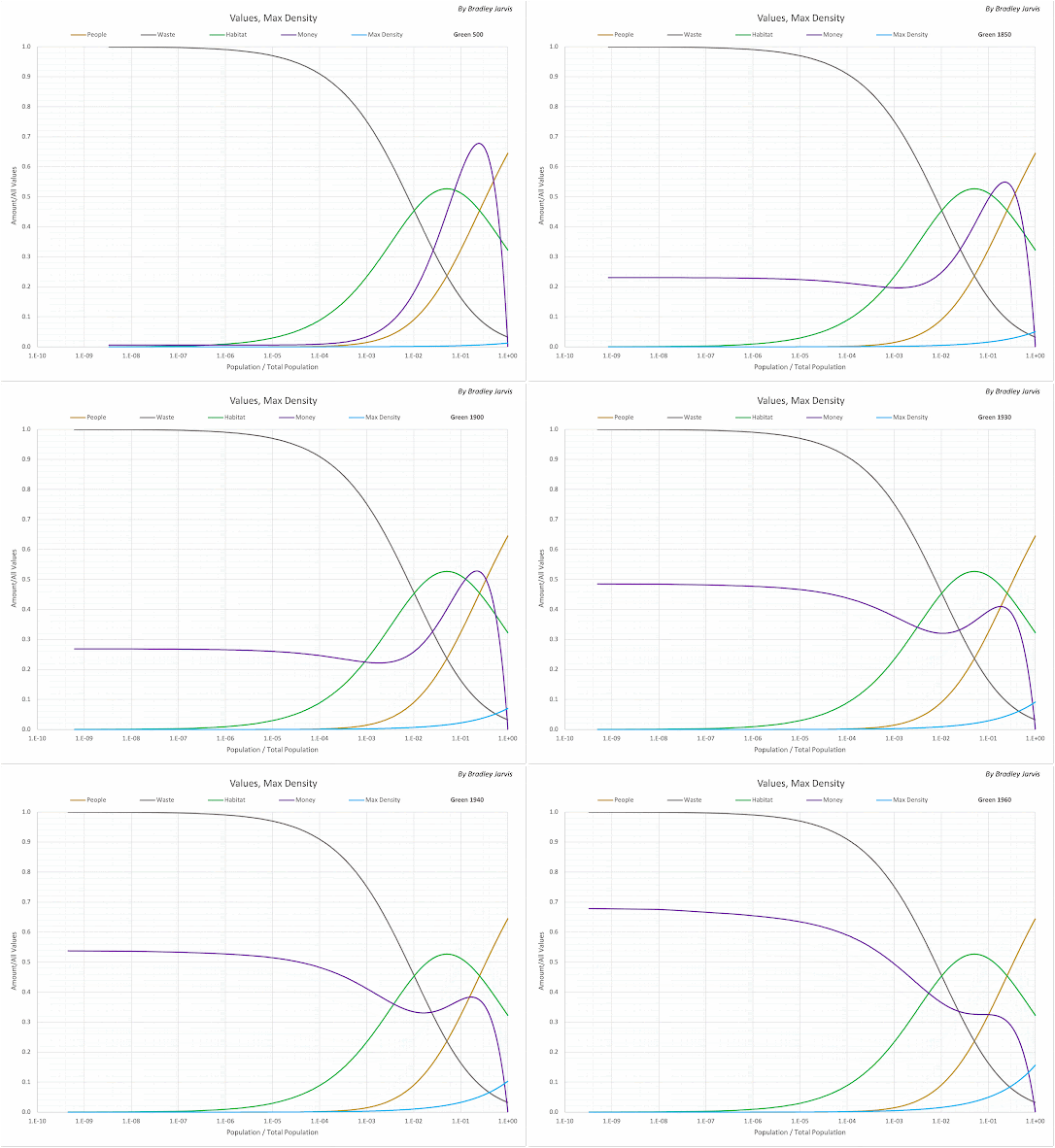
 Distributions of people, waste, and habitat throughout a population are, in part, maintained by economic activity that is reflected by the money people exchange with each other. Like those resources, that money can be treated as a resource and translated into a value relative to the others.

Because it depends upon total quantities of people and waste, exchanged money varies as those quantities change over time. Measured as Gross World Product (GWP), the total has generally increased. How much it is valued throughout the population is determined by the distributions of people and waste.

In simulated world “Green,” whose history is a close match to ours, economic activity until the 1920s was most valued by those who valued both people and waste equally while placing the highest value on habitat. As more waste has been created by economic activity, a small fraction of the population, who values waste more than anything, has increasingly valued money that represents that creation. By the 1950s, the value of money to that group had risen to exceed the maximum value that any other group placed on people.

The focus of economic activity on the growth of waste has continued to the present. For most of Green’s history, 2% of the population has been responsible for 80% of the world’s waste. In 1960, that group was also responsible for 54% of the GWP. By 2020, it was responsible for 68% of the GWP. Increasing waste is largely responsible for decreasing habitat, which includes other species that maintain the habitability of any world; and starting this year, a growing number of people are projected to consume all the habitat available for their survival (a “density” of 1), altering every distribution. Waste, habitat, and people will approach equal value as the death rate increases, and money will be valued more than anything right before all are dead, which is projected to be in 2041.


Saturday, July 15, 2023

Distributions

People are organized into communities that enable the acquisition, movement, manipulation, and use of resources in order to maximize the quantity and quality of what they value. Each community has its own strategy for doing so based on its values, its abilities and the composition of its environment.


Averaged over the world population for more than 70 years, my simulations show that the annual distributions among people of biologically useful resources have maintained a common pattern, with communities changing what parts of the pattern they occupy and the parts they interact with. The primary distributions are people, habitat (resources composed of, and used by, other species), and waste (resources converted by humans into forms that are not biologically useful). 

Processed to display how their amounts change relative each other, the distributions can be used to indicate how much different parts of the world’s population value people, natural environments (habitat), and created environments (waste). As the number of people is added up in order of increasing habitat density (people per unit of habitat), the value of people rises; the value of created environments drops; and the value of natural environments climbs to a peak and then falls. This is shown below.


There are three distinct groups defined by the intersections of the trends. The smallest, amounting to 1% of the population, is dominated by the value of waste over habitat and people. The second, amounting to 24%, is dominated by the value of habitat over the rest. The third and largest group, 75% of the population, is dominated by the value of people. Based upon my simulations, any isolated population with limited resources (embodied by habitat), that is not consuming more than a critical amount of them, will have these characteristics. 

Consuming more than two-thirds (67%) of total resources results in the first group growing at the expense of the other two until the amount of remaining resources is less than the total number of people - who will be in just one group that values everything equally. My simulation that best matches history shows that this year humanity will be consuming more than the critical amount, as shown below, and will reach the end point bordering on extinction by 2040.


Friday, August 30, 2019

Redefining Waste

Further testing of my Timelines model has revealed that what I've been calling "waste" should be redefined. Instead of representing resources that are unusable, it represents resources we are using that should not be used. Specifically: whatever we consume that is more than half the world's total resources is waste, which I project is currently 20% of all that we consume and 12% of all resources. As a consequence, "wants" are that we consume that is more than our needs and does not include waste.

By this definition, waste first appeared in 2004 and is projected be greater than what we consume for needs in 2027, four years after global population reaches its maximum and begins declining. Since it is equivalent to other resources (instead of being un-consumable as with the previous definition), it is treated likewise by the world's population in every respect. The only un-consumable resources are those removed from the total by "self-sustained impacts" that are projected to have begun by 2015.

ABOVE: Projected fractions world ecological resources in the "Green" simulation using the new definition of waste.

Difficulty reproducing global wealth statistics was the initial clue that "uninhabited regions" (data points with no people or other species) were problematic. The estimate of relevant resources couldn't be justified with the more refined approach that now includes a better estimate of the numbers of people who have common characteristics related to other global variables with many more data points. 

Experimenting with different ways of allocating consumed resources over the world population including that "waste" resulted in two fundamental observations about both economics and consumption when the statistics were reproduced which are obvious in retrospect. First, the exchange of resources and money (that represents both resources and the value of exchange) predominantly flows from people who consume less to people who consume more. Second, the resources consumed for more than needs are distributed in proportion to the ratio of available resources to resources consumed for needs – the reciprocal of the people-to-nature ratio that I discovered is a basic driver of many of the variables I've been tracking.

Although the new definition of waste and allocation of consumption significantly change the projections of related global variables within the population, they have no effect on projections of the entire population over time and support general behaviors found with the earlier version. For example, consuming wants in addition to needs is still associated with a switch from an egalitarian to unequal distribution of wealth, but the details of that switch are different; and the upcoming changes more resemble a cascading failure than a "switch" to a new regime, driven as they are by the crashing of the world's population due to overconsumption (an aspect of which being increased waste).

ABOVE: Distributions of global variables associated with major changes in per-capita wealth projected by the "Green" simulation for dates shown below the Phase axis. Displayed are Phase = lifecycle phase, L = life expectancy, h = happiness, Fert = fertility, Cum P = cumulative population, R = total consumption, Cap = capacity, and C = per-capita consumption. The years projected for when part of the population begins to enter a new phase are shown as Epochs.


Thursday, August 22, 2019

A Brief History of Simulated Wealth

About sixteen hundred years ago, people on average began consuming more than what nature had allocated to meet their basic needs. At that point, personal wealth switched from depending on access to people to depending on access to resources. This enabled wealth to flow to fewer people who could trade and consume more resources. Extraction of resources increased environmental degradation which made fewer resources available for trade (the difference being "waste"). Perhaps as soon as 2025 there will be more waste than what people consume for basic needs, and more people will die than are being born. With fewer resources and fewer people, wealth will become more evenly distributed until everyone is dead. 

That scenario is based on a simulation of civilization, with a likely future where people do not work to reduce waste that is increasing faster than they are creating it (such as greenhouse gases that by amplifying climate extremes and chaos are making more of the world uninhabitable). In an alternative future projected by the fictional denizens of the simulated world "Hikeyay" featured in my Simulated News blog, total consumption is humanely forced down until 2040 so natural ecosystems can assist fighting climate change, resulting in wealth being cut to 1/6 of its starting value this year and wealth inequality dropping by more than half while waste is totally removed. Waste could come back with a vengeance if its external sources aren't disabled, but the means of stopping it cannot be done with wealth compensation if additional consumption is to be avoided.

The inherent dependency of wealth on per-capita consumption and transactions (proportional to the square of population) is also true of economic activity (embodied in gross domestic product) both as an observation and as a fundamental aspect of any economy. If everyone is consuming the same amount, such as meeting their basic needs, people's economic activity and wealth (the amount of resources being exclusively used) will vary with differences in population between groups. If people are consuming different amounts of resources (such as when consumption exceeds basic needs), then those who have the most resources (as wealth) will be at the focus of the most activity.

Performing functions such as removing waste would undoubtedly require some consumption of resources to create, deploy, and maintain any technologies involved. Offsetting existing consumption is one way to avoid this problem, which governments traditionally accomplish by collecting taxes and ensconcing wealth as capital "owned" by its citizens that cannot be traded by them. Other species (as our species once did) perform many such functions as part of meeting their basic needs, and as "resources" meeting the basic needs of others, therefore making that work and its results essentially free. Using other species in this way is ideal if we are to limit our consumption, while using institutions such as government is justifiable only until existing consumption can no longer be offset, such as when taxes keep citizens from meeting their basic needs. 

In the admittedly unlikely future of Hikeyay, people will work together to improve the scope and health of natural ecosystems while reducing their personal consumption and population to what can be maintained with the amount of available resources projected for 2040 by a coordinating institution that collects and processes observations from around the world. In the worst case, externally increasing waste is unstoppable and people end up barely meeting their basic needs until diminishing resources crash the population. In the best case, a stable population consumes the same amount per person as the world did around 1920. This is what I see as the best case for us too.


BELOW: L = life expectancy, h = happiness, Fert = fertility, Cum P = cumulative population, World P = world population, R = total consumption, Cap = capacity, C = per-capita consumption. Year of plot indicates associated phase with dark triangle below x-axis.


Friday, May 25, 2018

Waste Age


new version of my Timelines model introduces a simulated history, Timeline 2, that is a better match to real history than the previous one (Timeline 1) and includes more variables. The following discussion is based on that timeline with reference to events in our own pastReferences to years after 2013 are entirely based on projections for Timeline 2.

In the second decade of the twentieth century, science and technology was undergoing revolutionary innovation, especially in the areas of physics, medicine, and transportation. They both aided, and were aided by, the conversion of energy, material, and other life into forms that humans could not directly consume in the wild ("waste"), whose yearly impact on natural ecosystems for the first time in history exceeded what the entire population needed for basic survival.

Three decades and two world wars later, that innovation along with global awareness and social innovation was coming to terms with the consequences of that waste. Among the benefits was an increase in life expectancy (when the death toll of war was excluded) and increased potential to customize people's individual environments, reflected in life satisfaction (happiness). Costs included the potential for a few people to inflict harm and death on a large fraction of the world's population, intentionally or by accident.

By the 1950s, waste was more than double the amount humanity consumed to survive, and that ratio grew faster than it would any other time before 2020. By itself, our timeline's waste was one-eighth of all life-related resources on our timeline, while Timeline 2's waste was one-seventh of its resources. This included both reusable resources and the creatures that produced them; but the fractions of just reusable resources were three times as much.

The limit of reusable resources was passed on both timelines in the early 1970s, with each converting more than three times as many resources into waste as were consumed for basic survival. By then, it was glaringly obvious that the environment was deteriorating on a global scale, especially in response to pollution. At the same time, supplies of fossil fuels that had enabled much of the previous years' growth were becoming harder to find and economically extract. 

Scientific and technological research focused in response on increasing energy and material efficiency to reduce the speed of resource use and the harmful and costly impacts of continuing the lifestyle that waste had enabled. It also also turned toward repair of the damage already done and identifying how humanity could survive if the situation got worse. Biotechnology explored the alteration of biological systems, including food sources and ultimately humans, so that a variety of different resources could be used and harsher environmental conditions could be tolerated. Space exploration, initiated in the 1950s in tandem with mini-wars and rivalries that barely avoided devastating scenarios enabled by the last world war, served as a test bed for technologies that might help people escape Earth and survive in the most inhospitable of environments.

These developments were accompanied by a reduction and leveling off of the waste-to-needs ratio, which was a result of growth in population (and its associated needs-consumption) exceeding the growth of waste production. That waste, by 1998 in Timeline 2 and 2003 in our timeline, itself took up an amount of resources equal to the reusable resources (technically, an ecological footprint of one Earth per year), with needs taking up one-third as much. 

Until 2005 in both timelines, life expectancy could be expected to increase along with waste-driven economic activity. After that year, though, that advantage became a statistical disadvantage and then a liability. More affluent people were able to live longer, so the fraction of children (people younger than 20) fell for what was already a small part of the population to a level where life expectancy became effectively zero for the richest in 2016. Life expectancy continued to increase for the younger and less affluent, driving the population average upward as more people gained access to the technology embedded in the still-growing waste. 

By 2020, waste will have rendered dead or unusable half of the entire world's life-based resources. This would coincide with a peak in total human population, two-thirds of them adults, consuming enough in needs and wants to leave only one-third of the world's original resources intact for planetary life and life support. 

The urge to grow older might be behind what is likely to come next, if a series of possible natural catastrophes, perhaps related to climate change, doesn't reduce the remaining resources on their own. Continuing growth in waste that enables survivors to grow older will by 2022 cause the growth in life expectancy to stop for the average person in the population and decrease after that. This might be perceived as increasing protection of the younger people more likely to have children, but with more people dying than being born this will be a fleeting advantage at best.

The world economy, measured in Gross World Product and wealth, based on transactions of products and services mostly consisting of waste, will continue to grow until 2025 and then fall as the loss of people able to make transactions offsets the growth in waste.

Average life expectancy will be zero in 2031, followed by population (and of course, the economy) in 2038. The waste created by humanity will persist longer, such as greenhouse gases that could still be warming the atmosphere for thousands of years. After we have briefly benefitted from it, it and the destruction it has caused will be our most consequential legacy.


Wednesday, January 6, 2016

Use It Or Lose It


Waste ultimately is created by expending effort and using resources without benefit to you or anyone else, or so that your actions cause harm or death in any timeframe. If you value life, then waste is bad by definition. If you make or acquire something and don't use it to benefit you or others, then to be good you must lose it – convert it into a form that isn't waste, or give it to someone who will use it appropriately.

My New Year's resolution was to reduce waste, personally and in general, embodied by the phrase "use it or lose it." In the worst case, it keeps new waste from being generated; in the best case, it increases the net amount of benefit in the world. Knowing how much discretionary time we have provides a means for determining what we can use, what to lose, and what we shouldn't make or acquire. If the actions we take during our work time create waste, then we need to change what we do for work; and since in most cases what we do for work is traded for things we acquire for personal use, we should find less wasteful ways of acquiring those things, including making them ourselves.

I personally like to read, watch TV and movies, and listen to music. Even more, I like to explore, daydream and assemble thoughts in writing, take photographs, and create music. Obviously I can provide much of my own knowledge and entertainment without acquiring it from others, thus reducing personal waste. Waste can be reduced further by trading what I create with people who don't have those skills (or the desire, resources, or ability to develop them) in exchange for things and experiences I can't or choose not to develop on my own. In that case, I have gained benefit already, and am creating a chance for the effort to accrue further benefit for someone else.

Paradoxically, forcing everything to be subject to trade, as is the trend here in the U.S. and with international trade agreements, promotes the chances of more waste being generated. The reason is that trade, to be profitable, exponentially increases consumption by enabling more people to consume, and each person to do more of it (by increasing the efficiency of converting resources into products). Consumption, as I define it in my research, is the conversion of resources into forms that cannot be used as resources by natural systems over a period of a year (which from an ecological perspective is "waste"). Creating something for your own use is less likely to be as efficient (in the economic sense), and your consumption – including generation of ecological waste – less likely to grow exponentially.

Ideally, each of us would create what we need, and then sell (or otherwise trade) what we can't gain benefit from, either in the process of creation or changes in what defines "benefit" in terms of what we created. We would use the proceeds to buy what we need but can't create on our own. Anything left from transactions would be converted into resources that can be used for other purposes by us or other species.

My personal application of "use it or lose it" is likely to be more practical than ideal, enabled by a simple change in expectations and a process of testing. Anything new that I create, such as a book or music track, will need to be personally satisfying in its creation and its usability, thus achieving a minimum degree of benefit. If possible, it would also preempt consumption of something similar from another source that would provide an equivalent amount of benefit. This would be my minimum acceptable expectation for creating it, and is totally under my control. If in the process I have to learn something, including a new skill, then the benefit of that learning would be factored into my expectation. What I create would be offered to others as a gift (such as this blog post) or for trade (such as a book) if there is a good reason to believe they would benefit from it and if any costs involved in the gifting or trade can be recoverable in either the satisfaction of gifting or the value of what was received in trade (otherwise the cost would be waste, so this assumption will need to be tested).

I plan to give away or trade things I currently own that cannot be expected to provide any future benefit to me (thus "losing" them). Like with new things, the costs should be recoverable as satisfaction or in what was received in trade. Throwing something away is committing it to being waste, and will be avoided if possible, such as by trying to give away or trade its parts (essentially, recycling). For things I've been selling that incur periodic costs (such as distribution of music), I will use testing to find justification for future costs (such as others benefitting from them), and will discontinue them if justification can't be found; otherwise the costs would qualify as waste.

"Use it or lose it" is a good rule to promote as well as to practice, which is why I'm discussing it here. The minimum benefit from doing so is the feeling of developing and shaping potentially meaningful and useful ideas. The greatest benefit would be evidence that I am contributing to my primary value: maximization of life's ability to survive and thrive for as long as possible.


Sunday, August 12, 2012

Dangerous Optimism


I've seen it so often now that I can put numbers to it, and it applies to both individuals and organizations. A goal is set based on an optimistic judgement of what's involved, and one of the following results: (1) the goal isn't met; (2) the quality of what's done ends up being a fraction of what was intended; or (3) the goal is met, but someone else pays a large part of the price for it. Typically, the effort and resources required to accomplish any given task is two to three times these optimistic estimates, a factor that determines either the diminishing of quality or the "externalized cost" incurred.

For those who are successful at externalizing costs, it can appear that they are up to three times more efficient than others who incur more of the costs. Where competition for resources depends on achievement of more aggressive goals and on low internalized costs, such as in the world economy, everyone involved eventually must externalize as much as possible just to survive, and waste grows exponentially.

The poorest people are often those who have been forced to bear the costs pushed off by more "successful" people. As the waste grows, it overwhelms the ability of people to deal with it, and the number of poor and dying people grows with it. The world's combined waste is now nearly 60% of what the rest of nature can annually recycle, and still growing. The consequences are becoming catastrophic; like a Ponzi scheme, if it keeps going then everyone loses (I estimate this to be when the waste nears 75%).

Obviously, the simplest solution is to try to make more realistic assessments of the resources involved in meeting our goals, and to put as at least as much effort in assessing the impacts of our actions on everyone and everything potentially affected by them. In the simplest case, we would triple our estimates of required resources. The extreme case would involve full accountability: all of us honestly studying and publicizing the full effects of what we do and plan to do. This would no doubt slow down "progress," but it would also make it less destructive. Any error would be in large part due to lack of knowledge and understanding, which could be reduced by targeted efforts to increase both (as science is dedicated to doing).

Such solutions are, on their face, extremely unrealistic. It is human nature to compete, and deception is easier (and cheaper) than improving performance as long as the other competitors can be kept ignorant until the prize is won. Even a single competitor willing to deceive will decrease any value to performance for everyone else. A compromise is to have judges, which in society may consist of unbiased entities such as governments and journalists. The success of many of today's societies is often determined by how successful these entities are in maintaining their objectivity and power to limit deception.

Governments have the larger role of ensuring that their citizens can meet their basic needs, which includes keeping waste below an amount that overwhelms people's ability to survive. Not all governments acknowledge this role, and factions within every country actively debate its validity, but it remains a role that must be assumed by someone (if not everyone) within a society for the society to function.

Ideally – and I would argue, no matter what – plans for every goal, by every individual and group, should provide for preserving this basic right for the people impacted by the actions taken to meet the goal. Those who believe in limited government should take this into account before they act on their belief, or they should accept responsibility for the harm caused by not meeting this fundamental responsibility of society. We can't enjoy the benefits of society without providing for its survival, and that means avoiding dangerously optimistic planning that increases the waste that society has to deal with.