Showing posts with label Gross World Product. Show all posts

Saturday, August 26, 2023

Groups of Value

The term “values” can be reduced to what someone uses to define “good” and “bad.” In my attempts to quantify it and relate it to behavior and global outcomes, I’ve identified a set of resources and amounts of them that everyone has and uses to some extent. Fractions of the totals of each per person throughout a population, representing how much each resource is valued, are ranked based on calculated distributions of each using historical projections of the totals over time that are embodied in simulations.

There are four identifiable groups that remain constant in their fractions of the population until too little habitat remains to support each person and members of the species that maintain it. The ranks of value placed on waste (artificial environments), habitat (natural environments), and people are unique to each group, as shown below. Note that the two middle groups could also be considered one group, as mentioned in Distributions.
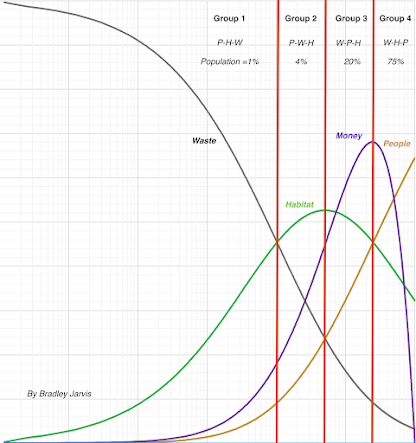
Waste is valued most by the smallest group and people are valued most by the largest group. Habitat is valued most by the two middle groups, with one valuing waste second and the other valuing people second. No one in one group places the same amount of value on people or waste as anyone in another group. Members of either of the middle two groups can value habitat the same as members of the other group, but not members of either of the two remaining groups. Some members of the smallest and largest groups can value habitat the same, but no one can value habitat the same as members of the two middle groups.

If the value placed on each of the resources is exclusive of the others across the whole population, the fraction of the population valuing waste is 9%, the fraction valuing habitat is 40%, and fraction valuing people is 51%. Note that even for these groups, the fraction valuing people is much larger than the fraction valuing waste.

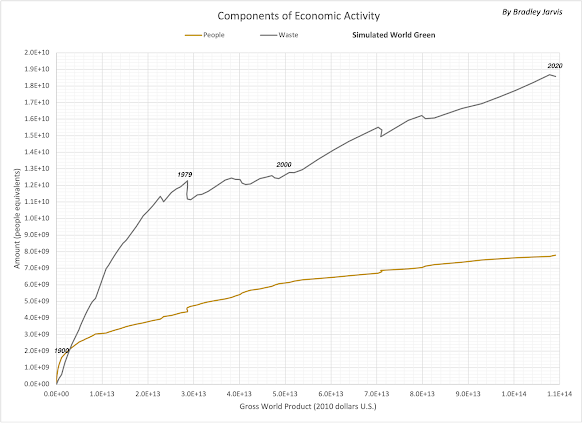
Money as a resource indicating relative economic activity (as indicated in the diagram for small populations and discussed in Economic Distribution) have favored equal value placed on people and habitat (corresponding to half the total habitat available to the population) while promoting increased waste by those who value it most. As shown in the following graph, waste production by a simulated world like ours has outstripped population growth (driving human transactions) as a component of economic activity and remains strongly associated with it. The “rich,” those benefiting most from that activity, and everyone else, represent another set of groups - defined by the value placed on money.
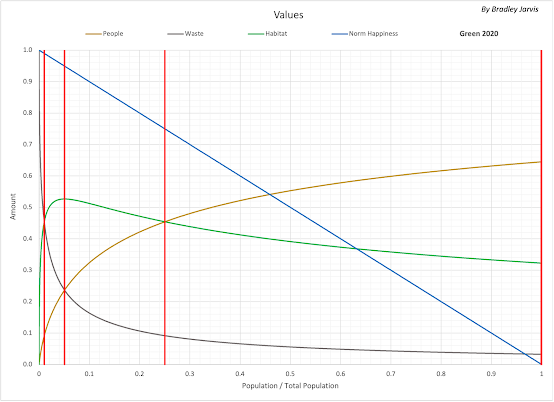
Implicit in this approach to quantifying what someone considers good and bad is the debatable assumption that their current conditions represent what they prefer, and that others they compare themselves to are likewise in preferred conditions. Even using change over time might not be a reliable indicator of preferences; the change could be so far beyond the person’s control and the destination is opposite to their preference. Referenced to groups, a person could move from one group to another due to the actions of others or environmental effects that force change in availability and consumption of resources. This appears to necessitate an additional variable for consideration: choice. Based on national statistics from 1800-2017, happiness varies as shown below, as does life expectancy, where the red lines mark the limits of each the four groups we started with; this suggests that members of a population will tend to prefer a higher value of waste.

As waste effectively decreases habitat, the ability of nature to provide basic biological needs decreases to a point where more people die than are born, beyond which the population crashes. Thus, increased waste decreases how long the population can exist (its longevity). Another set of groups could therefore consist of a group that cares about longevity being longer and the other that doesn’t. The group that cares about longevity would likely value habitat more than anything and waste less than people; the other group would consist of everyone else.


Wednesday, October 26, 2011

Peak Economy

In a recent comment about the 99% Movement (a.k.a. Occupy Wall Street), I introduced what I think is a fundamental problem with our economy. We have demonstrated a willingness and ability to assign arbitrary economic value to configurations of matter and energy as well as non-physical (virtual) things such as intellectual property and debt. The most “successful” people in our economy – those who can effectively consume whatever they want – are best at manipulating the value, manifested as demand, for the things (whether physical or virtual) whose supply they control. The ability to exchange virtual things of arbitrary value for physical commodities that are inherently limited, either in supply or access to them, poses the threat of potentially exhausting the physical commodities, leaving virtual ones which cannot by themselves contribute to people's basic survival.

For much of the last 50 years, Gross World Product (GWP), a measure of world economic activity, has grown faster than the world's consumption of ecological resources (total ecological footprint). GWP is now about 1.8 times what it was in 1980, when humanity was consuming as much ecological resources as the Earth could provide on a renewable basis, while consumption is nearly 1.6 times its 1980 value (population is 1.5). When we were consuming all of the “production” of the natural world, the value of the economy presumably embodied all of that consumption; simplistically, the GWP was equal to its value. GWP tracks with consumption in a predictable way, suggesting that the difference since then is due to value added to the resources we consume, that is, the creation of virtual commodities.

Generally, both GWP and consumption have been slowing down (consumption since 1960, GWP since 1989), yet the annual rate of GWP growth has fluctuated wildly, likely in response to the movement of virtual wealth. The recent fluctuations in the GWP growth rate are not unusually large, but they are unusual in that they've briefly gone negative, causing major economic and social upheaval, due mainly to how far from peak growth we have gotten.

If my projections are accurate, the average rate will continue steadily, inexorably, downward, though there may be more fluctuations. GWP, along with consumption and population, will reach a maximum (zero growth) by 2029, when consumption approaches the habitability limit, and take another 42 years to drop to zero. At the peak, GWP will be about 3.7 times its value in 1980, about twice what it would have been if it had kept pace with consumption and consumption reached the habitability limit. Put another way: The world economy will reach its maximum when the value of virtual commodities is the same as the value of physical commodities, where our consumption is at the limit where the remaining other species can just keep the planet habitable and survive.

Using virtual wealth to purchase all the physical wealth would be at least theoretically possible at the peak. Since virtual wealth declines after the peak, it's conceivable that such a possibility may be acted upon, driving the population down in the process as more and more people can't meet their physical needs from this and the resulting competition. Needless to say, this is a future we want to avoid.

In the commentary that introduced this concern, I suggested that we could begin dealing with it by more closely matching our economy to physical constraints. This is not a new idea; ecologically-minded economists have been making the case for a long time that we should account for the value of products and services that other species provide, viewing our economy as part of a larger system that includes the rest of Nature. I'm taking a bit of a short cut by assigning economic value to the ecological footprint (again, the basis of my “consumption” numbers). I'm also suggesting that we at least decouple virtual wealth from physical wealth (consumption) enough that people can retain enough physical wealth to survive and maintain a functioning society while keeping the overall amount low enough so we never get too close to the habitability limit.

Perhaps we could start by limiting the GWP to a value between what it was in 1980 and what it was at peak growth, in 1989 (27.2T to 39.9T in 2009 U.S. dollars). We would need to reshape the way we live so that everyone could meet their basic needs on 54% to 68% of the average current per capita economic activity, and preferably less than half. As unrealistic as this appears, it at least frames the scale of the problem we need to solve, and the sooner we can start figuring out how to do so with the minimum hardship, the better.