Showing posts with label Earth. Show all posts

Saturday, July 29, 2017

Diminished Futures


My latest research confirms that humanity remains on track to go extinct within a few decades as the result of our consumption and degradation of the natural environment, both directly and indirectly.

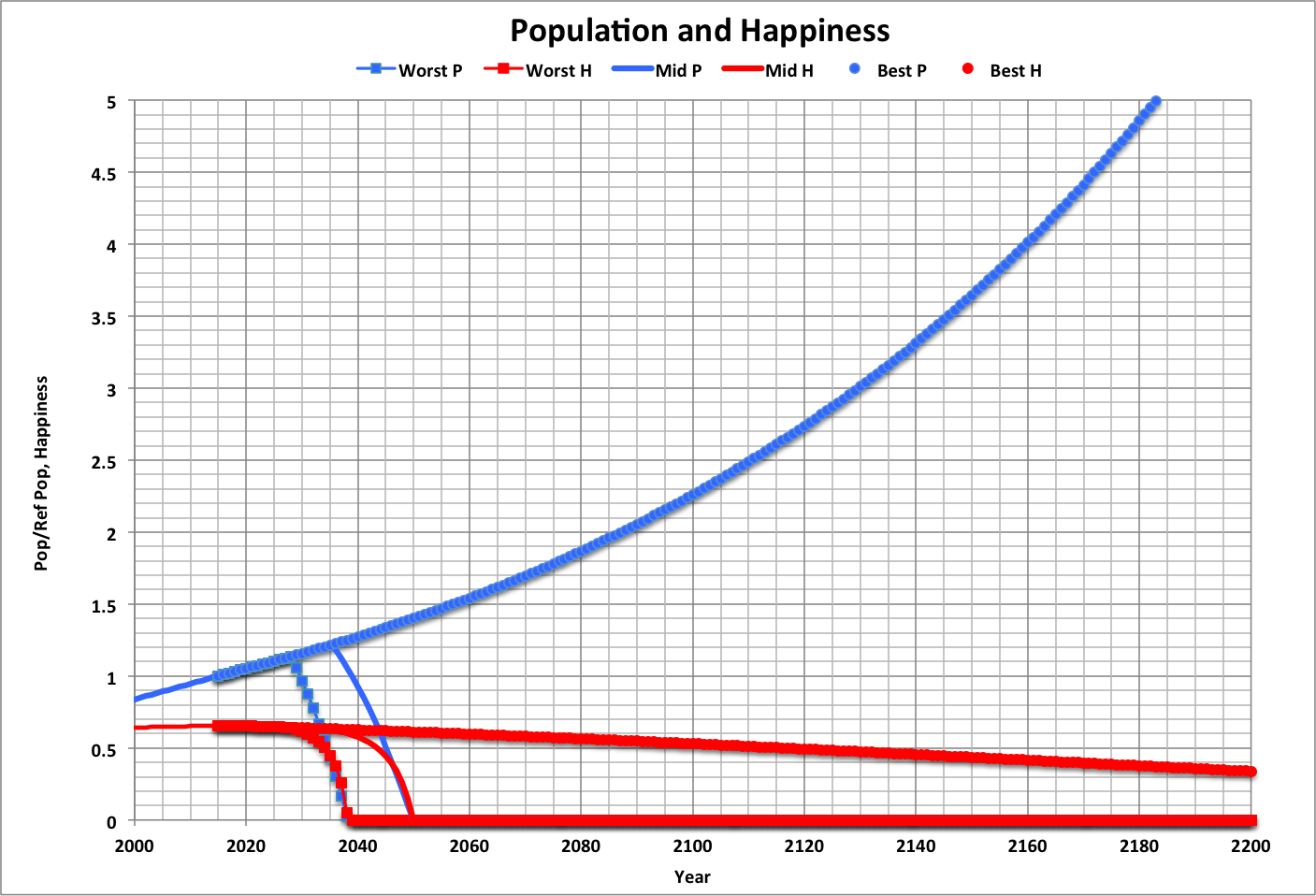
If our survival depends on keeping other species alive (those that directly support us, and those that support them), I now estimate that the combination of our consumption and worst-case global warming impact will drive us extinct by 2032; if not, then we'll have only another seven years. Without global warming impact, I expect humans will be gone by 2124 if killing those critical other species kills people; but if people can survive killing those species, then by 2160 over 29 billion people will be forced to live on fewer resources per person than anyone in history (with that consumption dropping rapidly).

The most reasonable expectation is that global warming will continue to increase for at least several decades, both in magnitude and impact; only how much and how fast is open for debate – until it happens, of course. While much attention has been rightly placed on this particular influence on our future, it is critical to keep in mind that it is a consequence, rather than the cause, of our imminent demise. The cause is humanity's pursuit of total dominance over the world, using its resources (living and not) to create environments suited to people's needs and wants. That pursuit unleashed the greenhouse gases now driving global warming, and it has diminished the ability of natural processes to compensate and keep that warming in check, all the while driving other species extinct at a rate that hasn't been experienced on our planet for many millions of years.

I was reminded recently of the slight chance for extending the lifetime of our species by leaving Earth, with the ultimate limits being the distribution of matter in the Universe and the laws of physics. Meanwhile, my research added a potential clue that humans might have natural limits built into our biology – first suggested by my study of the apparent relationship between happiness and consumption of natural resources – that will effectively cause us to starve ourselves under the most optimistic circumstances.

Use of this clue was behind my latest projections of population and consumption: that annual rates of change in world population and consumption (less so) are correlated with the total amount of those resources that we collectively consume. Those rates reached a peak in the 1960s, when we consumed two-thirds of the production of renewable resources by other species, and the consumption rate would plunge consumption to zero if we ever have the same amount left of total resources – which we won't because of how much we've already consumed, even if global warming spares us. Correlation is course not synonymous with cause, but it does beg for an explanation; and the hypothesis that our speed of growth is based on a basic sensitivity to how much of the world we use is tantalizing, to say the least.

We are still left with a range of stark options in the future of our species, just as each of us individuals must face the many different ways that we could die. The disturbing part now is how much they have in common, including timing, a conclusion I have been unable to shake after years of study and analysis.


Wednesday, April 29, 2015

The Half-Earth Hypothesis

Following up on my epiphany about the significance of historical happiness, I reanalyzed the data and developed an explanation that I call the "Half-Earth Hypothesis." Simply: there are a fixed amount of ecological resources, which include both producers and what they produce; and we, like other creatures, have been programmed by evolution to make sure that a critical minimum amount of those resources (18% of the total) is never used up.

In our natural state, we require a minimum amount of resources to survive. That same amount is used by a supporting group of producers, which means we use only half of the resources in our environment. To preserve our basic functioning, we've had to protect the supporting producers and enlist enough more to supply our growing population.

We would like to use more, and technology (physical and cultural) has enabled us to do so since the start of civilization, some 12,000 years ago. The motivation for doing so seems to be connected to a need to dominate our environment, and is clearly manifested by increasing both lifespan and happiness. Increasing our population has provided a labor pool for finding and converting resources into creations that are more of a match to our personal wants and needs than the minimum can provide. These "creations" also include byproducts such as pollution. Nature appears to have limited the amount of resources we can use for creations to 52% of the total, with our basic resources and supporters together limited to 30%. To use more reduces the producers available to sustain our supporters, which of course sustain us.

At present, we are essentially at the limit. Any increase in consumption, whether individually or due to added population will likely reduce the supply of resources we need for basic survival. This makes the growing threat of climate change particularly troubling, since it could have the same effect regardless of what we do, like being on the edge of a precipice and having someone pushing you toward the abyss.


Wednesday, January 14, 2015

Spaceship Logic


We are the latest of many generations of astronauts on an intricately complex spaceship that is orbiting the Galaxy every 200 million years or so. Like other astronauts, we have a set of jobs to do in order to keep the spaceship functioning and its passengers alive. Unlike other astronauts, most of us have abandoned our jobs, and have been tearing apart the spaceship to create and maintain playgrounds so more of us can have more fun. We have been doing this without understanding or caring about how it affects how the spaceship works.

There are now many of us who have grown up in the playgrounds and know nothing else, including what our original jobs were. This is unfortunate, because we have now done so much damage to the spaceship that its life support systems are breaking down. The other astronauts have worked valiantly to repair the damage since they depend on the spaceship for survival too; but we have treated them like the rest of the spaceship, without regard for their value as fellow astronauts, what their jobs are, and what will happen when they can't do their jobs.

The lives of all aboard the spaceship depend upon using and reusing almost everything, preferably during the lifetimes of its passengers. It has many mechanisms for ensuring this, including passengers eating other passengers and converting them into forms that others can use, as well as producing more passengers. We have disrupted these processes, which is a large part of the damage we've done, by either hoarding a lot of what we take, or turning it into forms that others can't use within the time they need for survival.

Conditions have grown so bad that our playgrounds are in danger and people are becoming sick enough to notice. A growing number of us are realizing in horror that it may soon be too late to repair the damage before it kills our generation of fellow astronauts, and they are raising alarms. The alarms are muted, however, because the majority have grown up depending on the playgrounds and the people who manage them for their survival and fulfillment, and they are trapped, at least psychologically, in the patterns of living they know there. They continue to plan their lives so they can work for only part of the time, and enjoy a few of their later years without working; in part through saving, and in part by subsidizing the growth of activity by others, using abstractions that shield them from the real effects of what they do. The alarms make little sense, because the rest of the spaceship has no meaning except as a source of material for food and construction, and as a dumping ground for what we don't use.

Based on the logic of the playground, our best response is to make better playgrounds, isolated from the threat. This is, of course, the worst thing we can do, because it will cause more damage, amplifying the threat. We will be essentially fighting ourselves until we lose, and sadly most of us may never understand why. Our best hope is to keep that from happening by replacing the logic of the playground with the logic of the spaceship, and gaining more knowledge about how everything works by experiencing it with an open mind and respect grounded in our identity as part of the spaceship, instead of something apart.