Tuesday, December 29, 2015
The Longevity Trap
Saturday, April 6, 2024
Value Statement
“Exploring new ways of thinking, for fun and optimization of the amount, longevity, and quality of life.” – Bradley Jarvis profile, X (formerly Twitter) @bradjarvis
That introduction is a succinct statement of my values and how I most prefer to serve them. The term “life” is more general than I’ve typically used it elsewhere, applying to both humanity and other species.
By my calculations, collapse of both populations is avoided where natural habitat that includes other species accounts for more than 63% of the sum of habitat and what people are consuming to survive. Put another way: The habitat that supports humans requires about the same amount of additional habitat to support it; less than that and it decreases, unable to support as many of us. If we were like other species and did not generate waste, our population would decrease to a level that could be supported by the remaining habitat which is supported by what it needs that grows back; but with increasing waste, that can’t happen, and we all die together.
What I just described accounts for the amount of life. How long both populations can survive is the longevity. Quality of life is how well members are matched to their environments, receiving benefits commensurate with what they contribute to the health of others. Humanity’s creation of waste, whose function as the essence of artificial environments is to provide benefits without requiring the giving of benefits, has enabled increasing quality of life for some at the expense of life itself for others – nonhuman and human.
One of my “new ways of thinking” is to tie amount, longevity, and quality as aspects of life to the values of people, habitat, and waste that I’ve identified in my other writing and described briefly above. How the aspects of life are to be optimized depends on the relative priorities of the values; and those priorities will be different for different people. For that reason, my recent research has been focused on deriving what those priorities might be (and how they might change) within given populations of people; and presenting the results as aspects of life within simulated “worlds” with similar pasts and different futures – one of which might be our own.
My greatest interest has been how to increase human longevity since our extinction would be the end of all our lives and our values along with them. The dependency of longevity on the amount of available habitat over time and the number of people consuming it to meet basic needs is a good reason to give habitat at least as high a priority as people. Waste would be the lowest priority, though it can serve longevity if a fixed amount of it is used as protection from threats to it that can’t be dealt with otherwise. Waste also can be, and has been, used to access more habitat if habitat is diminishing or population is growing beyond what existing habitat can support.
From the perspective of other species, my guess based on extensive reading about biology and specifically ecology is that, for many, the value of population size (as procreation) would be the highest priority. Habitat (food supply and shelter) would be second. Waste wouldn’t even occur to them unless it was mistaken to be part of their habitat. Generally speaking, enabling development and maintenance of healthy, diverse ecosystems is the best way to optimize non-human life. This would, as a minimum, involve getting rid of waste and making the rest as harmless as possible.
As for the fun part of creative thinking, it’s a natural reward that draws me to do more of it no matter what circumstances I’m in.
Friday, July 27, 2007
Longevity
Threats to the survival of our species can be measured in terms of three variables: uncontrollability, unavoidability, and extinction time. Uncontrollability is the extent that humans cannot influence the source of a threat. Unavoidability is the extent that humans cannot escape the threat. If uncontrollability and unavoidability are expressed as probabilities, then the probability of extinction is the result of multiplying them together. Extinction time is the time remaining from the present before the threat totally assures our extinction. Dividing the extinction time by the probability of extinction results in a number, in years, that expresses the longevity associated with the threat. Our goal when dealing with a threat is to maximize this “survival time.”
Threats to individual survival can be measured in a similar way. Just substitute “death” for “extinction.”
Since the shortest survival time is equal to longevity, any strategy to maximize it must include identifying all threats and decreasing uncontrollability and unavoidability for those with the shortest extinction or death times.
Sunday, August 30, 2015
Groups, Goals, and Actions
Thursday, March 11, 2021
Values and Responsibilities
Sunday, October 7, 2007
Ideal Decision-Making
Many would probably argue that following these rules is difficult, if not impractical. I fail to see how doing so would be any harder than considering supply and demand, two other variables which virtually everyone in the world uses to make routine economic decisions. Economic activity depends on imperfect knowledge of the present and future behavior of supply and demand. Supply is loosely related to longevity, and demand is loosely related to both quality of life and longevity; so one pair of variables may even be translatable into the other pair.
Saturday, August 26, 2023
Groups of Value
The term “values” can be reduced to what someone uses to define “good” and “bad.” In my attempts to quantify it and relate it to behavior and global outcomes, I’ve identified a set of resources and amounts of them that everyone has and uses to some extent. Fractions of the totals of each per person throughout a population, representing how much each resource is valued, are ranked based on calculated distributions of each using historical projections of the totals over time that are embodied in simulations.
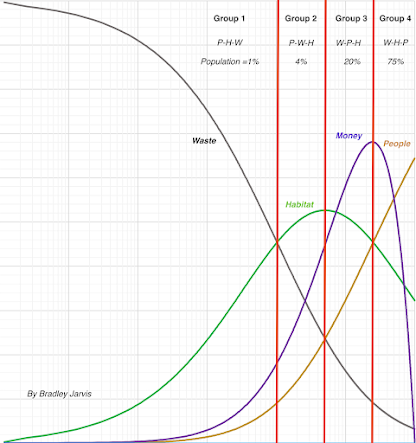
There are four identifiable groups that remain constant in their fractions of the population until too little habitat remains to support each person and members of the species that maintain it. The ranks of value placed on waste (artificial environments), habitat (natural environments), and people are unique to each group, as shown below. Note that the two middle groups could also be considered one group, as mentioned in Distributions.
Waste is valued most by the smallest group and people are valued most by the largest group. Habitat is valued most by the two middle groups, with one valuing waste second and the other valuing people second. No one in one group places the same amount of value on people or waste as anyone in another group. Members of either of the middle two groups can value habitat the same as members of the other group, but not members of either of the two remaining groups. Some members of the smallest and largest groups can value habitat the same, but no one can value habitat the same as members of the two middle groups.
If the value placed on each of the resources is exclusive of the others across the whole population, the fraction of the population valuing waste is 9%, the fraction valuing habitat is 40%, and fraction valuing people is 51%. Note that even for these groups, the fraction valuing people is much larger than the fraction valuing waste.
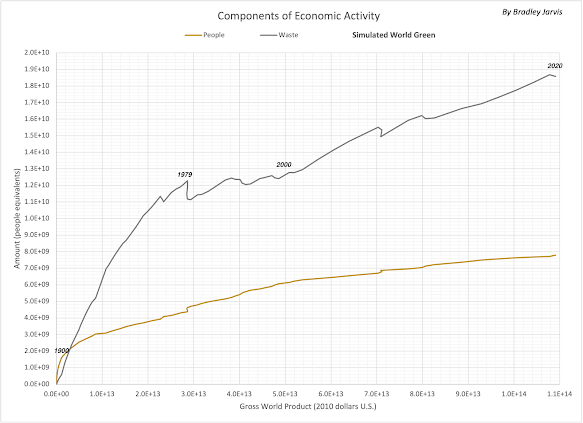
Money as a resource indicating relative economic activity (as indicated in the diagram for small populations and discussed in Economic Distribution) have favored equal value placed on people and habitat (corresponding to half the total habitat available to the population) while promoting increased waste by those who value it most. As shown in the following graph, waste production by a simulated world like ours has outstripped population growth (driving human transactions) as a component of economic activity and remains strongly associated with it. The “rich,” those benefiting most from that activity, and everyone else, represent another set of groups - defined by the value placed on money.
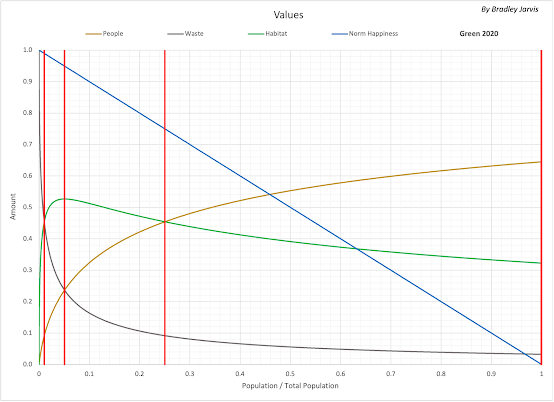
Implicit in this approach to quantifying what someone considers good and bad is the debatable assumption that their current conditions represent what they prefer, and that others they compare themselves to are likewise in preferred conditions. Even using change over time might not be a reliable indicator of preferences; the change could be so far beyond the person’s control and the destination is opposite to their preference. Referenced to groups, a person could move from one group to another due to the actions of others or environmental effects that force change in availability and consumption of resources. This appears to necessitate an additional variable for consideration: choice. Based on national statistics from 1800-2017, happiness varies as shown below, as does life expectancy, where the red lines mark the limits of each the four groups we started with; this suggests that members of a population will tend to prefer a higher value of waste.
As waste effectively decreases habitat, the ability of nature to provide basic biological needs decreases to a point where more people die than are born, beyond which the population crashes. Thus, increased waste decreases how long the population can exist (its longevity). Another set of groups could therefore consist of a group that cares about longevity being longer and the other that doesn’t. The group that cares about longevity would likely value habitat more than anything and waste less than people; the other group would consist of everyone else.
Tuesday, December 15, 2015
Assessments
Friday, August 31, 2007
Threats to Longevity
There are other threats to our longevity. During the latter half of the twentieth century, our greatest fear was the use of weapons of mass destruction (WMD) by the world’s superpowers. With thousands of nuclear warheads aimed at each other, the United States and Soviet Union stood within minutes of killing many millions of people and plunging the rest of the world into a horrific winter that would cause starvation on an epic scale. In this century it is just as likely only a fraction of such weapons may be used, but recent research indicates that even a limited nuclear exchange would lead to devastating human and environmental consequences. This prospect has led a growing number of rational and caring people to conclude that the presence of ANY nuclear weapons is unacceptable. Unfortunately, not enough of the world’s leaders and their terrorist counterparts have adopted this point of view. Surely a critical step toward avoiding a decline in human longevity must be to ban all such weapons.
Monday, November 16, 2015
Group Interaction
Saturday, September 7, 2024
The World Is Dying and We’re Doing This
Amid the growing certainty and omnipresent evidence that our species will soon drive itself extinct along with many other species, it is harder each day to justify living in a way that enables it. This is especially true in a society with its physical and social infrastructure that demands doing so in exchange for the surviving and thriving of ourselves and the people we care about.
Collection, processing, distribution, and use of resources throughout a population to sustain and grow it is arguably the primary purpose of life for its members. As a consequence, some of those resources become waste, which is not directly usable or reusable for that purpose by the society or others outside of it.
Part of the waste can be further processed, by generating more waste, to create and distribute artificial environments, or parts thereof, that enhance personal experience of life. An increasing focus on this secondary purpose eventually inhibits achieving the primary purpose; and, if continued, results in death leading to extinction as the waste overcomes other species whose existence depends on the same resources and contributes to those resources.
Members of a society who want to reduce the risk of extinction can do so by attempting to decrease the amount of waste that is created. This can involve limiting the use of tools like money that enable that creation. Direct destruction of resources such as habitat for members of other species and killing more of those members than what can be reproduced, also increases the risk of extinction, and can be avoided in order to reduce the risk.
A healthy ecosystem is a community of life whose members collect, process, and distribute resources in such a way that they can be reused without decreasing their quality and quantity over a long period of time, thus extending the lifetime of the ecosystem and the number of its members. A dying ecosystem is the opposite, which is what we have now on a global scale.
If we choose to create more waste, then we are demonstrating that we do not value the health, and therefore longevity, of life in our ecosystem. Since humanity has global impact, our ecosystem is the world ecosystem. If we promote the growth of life such that it can achieve a level that can be maintained with available resources and/or other resources that can be acquired without destroying life, then we are demonstrating that we value health, life, and longevity.
The world as an ecosystem is currently dying. What we’re doing, and what we will do with that knowledge, is up to us.
Wednesday, March 23, 2011
Delta World
Tuesday, October 21, 2008
Government and the Economy
Of the assumptions built into the Right’s assertion, the last one blows the others apart. Government and industry have two distinctly different economic roles, and are therefore not interchangeable. Government’s purpose is to maximize the wealth and longevity of society, while private industry’s purpose is to maximize the wealth and longevity of individuals. There is some interplay between the two: By providing resources and infrastructure (both physical and social), government supports private industry and individuals, and therefore economic growth and capitalism; in return, industry and individuals support government by paying taxes and following laws. Since industry is composed of people whose goal is to acquire as much power as possible, it has no inherent stake in controlling its impact on anyone other than its direct suppliers and customers (self-regulation).
Because their purposes are different, the definition of “waste” must be different for government and industry: For government, resources (including labor) are wasted if they do not serve the public good; for industry, resources are wasted if they translate into costs that restrict choices available to individuals. The solution to excess waste in government is therefore not to reduce its inputs, but to make it more efficient, since society (industry included) depends heavily on what it provides.
There is a grain of truth in the prediction that increased taxes and regulation can lead to socialism (social control of the economy). Many taxes (and tax “breaks”) are used to encourage or discourage certain behavior, and regulation explicitly alters the behavior of business. The controls used by government (in our country, the society) are legitimate to the extent that they protect and provide equal access to resources and infrastructure; they lose legitimacy when they attempt to do anything else. Government intervention in the economy may temporarily appear socialist if it must wrest control of resources and infrastructure from private individuals or organizations who are limiting its access by everyone else. True socialism exists, however, when the government institutionally and permanently controls all aspects of the economy (private, in addition to common elements).
Like it or not, a society is most healthy when everyone has equal access to adequate resources and infrastructure, and individuals have the freedom to maximize their own happiness through what they do with those things. Because individuals can’t do everything, especially in large populations with highly complex interactions, they create organizations with specific roles. Government, one such organization, acquires and provides the basic requirements for everyone, while businesses in private industry are organizations that enable individuals to pursue their own happiness. As long as these organizations stick to their specific roles and perform them well, there is no reason for them to clash.
Unfortunately, the world is running out of useful natural resources, which is forcing a colossal shift in every economy – especially the rich ones like ours. Dissatisfaction with governments, given their responsibility in this area, will only grow as we get closer to the limit. We must be careful not to assign blame for this universal problem, to government or anyone else, but rather we need to all work together to deal with it.
Saturday, August 11, 2007
Agreement to a Vision
One aspect of the vision that I think all of us would support is increasing individual longevity (especially since it has such a strong correlation with happiness). Historically, average life expectancy has varied between 18 and 67 years. The oldest anyone has ever lived is over 122 years. While we may want it for ourselves, how many of us could be persuaded to want it for others, and what would it take to convince us?
More problematic is getting people to sign on to the idea of maximizing population over time. My guess is that most would be amenable to the idea as it relates to their own families; and less so with others, especially those who are very different from them. I expect that only in cases where the entire present population was in peril would most of us agree to improve the chances of everyone.
The probability of success is perhaps most dependent on the prevalence of altruism in any given population (we would have to convince not just those alive today, but all who will ever be born). From a strictly personality point of view, less than half of us may be expected to be altruistic enough to make a difference.
Saturday, March 10, 2012
Changing Values
If the definition of the community is extended to include more members, the community must either make more resources available (such as acquiring the resources already used by the new members), get more use out of the resources already consumed (increase efficiency), or settle for a lower level of happiness. If the amount of happiness is increased, statistical trends indicate that consumption – and the amount of available resources – will need to increase exponentially to compensate.
If the community defines itself more restrictively, then it may view former members as competitors or even resources to be "consumed." This could result in an increase in happiness, an increase in longevity (the amount of time that resources can last), or both, by decreasing the happiness and longevity of the members it shed. A more humane way to shed members is to send them to other areas, voluntarily or otherwise, which has the potential benefit of providing access to additional resources.
Changing values is especially costly if a community reclassifies someone or something it typically consumes (uses and throws away) as a member. Slaves and species used for food are obvious examples. The community's resource base must be redefined in fundamental ways that can fundamentally change how the community deals with itself and its environment. What was good is now evil, and what could be counted on to enhance happiness must either be replaced or happiness must be reduced. Understandably, a reduction in happiness (which is proportional to life expectancy) would be considered unacceptable by many people, so we could expect a lot of resistance to a such a change in values.
With humanity's ecological impact rising so high that it threatens the habitability of our planet, our values must change in such a way as to reduce that impact to a safe level, and this must happen soon – in much less than 20 years. Arguably, all of the alternatives are already being tried. Environmentalists are promoting the redefinition of community to include more of the biosphere (other species), while limiting population growth as a multiplier on individual impact/consumption; this potentially has the additional benefit of growing the resource base, especially when combined with efficiency-increasing measures. Those who favor restricting communities are promoting the "shedding" of members of the population, most without acknowledging the threat, by favoring perpetual warfare and declining working conditions as "others" either become slaves or die. Space enthusiasts are pushing for the settlement of other planets, which is the equivalent of humane population-shedding – though most of the places people might go are uninhabitable wastelands, just as the Earth is in danger of becoming.
Given the urgency of the task of reducing our ecological impact, the first two options have the best chance of working, while the third (space settlement) is at best a desperate insurance policy against total extinction. If all human life is valued, the second option must be ruled out, though it is arguably built into human nature (and some humans more than others). Unfortunately, the environmentalist's approach requires the most change, and is therefore prone to facing the most resistance – which it is getting.
For those of us who favor an emphasis on the environmentalist's approach, reducing resistance to it is critical. Based on this discussion, it should be clear that attempting to counter the resistance without addressing the associated values is likely doomed to failure.
Thursday, September 25, 2008
Consumption Rule of Thumb
My analysis of consumption, population, and group sizes leads to the following rule of thumb. As the daily time taken by the average person in a community to interact with others (consume resources) increases by a factor of three, the community’s size and per capita consumption increase by the same factor, longevity (time taken for the community to deplete all of its resources) decreases by 90 percent, life expectancy increases by half a generation (a decade), and the required speed increases by a factor of nine.
Using one full hour per day, the life expectancy is one generation (20 years), the community has 40 million people, and the speed is one foot per minute. In 0 A.D., longevity for one hour of interaction was about 3 million years; it is now 2 million years.
Beyond a full day of consumption, with a population of one billion people, automation must be used to enable the required interactions for consumption and life expectancy to increase (with such “productivity” squeezing out more than 24 hours in a day). Put another way, the world depends on technology to entirely support more than five billion people.
Monday, January 30, 2023
Lay of The Landscape
For many years I had a bad sense of direction when thinking about how to get from one place to another. One way I learned to cope with that condition was to embrace getting lost as a learning experience and develop a “feel” for the organization of the places around me. By focusing on exploration instead of going somewhere, I became aware of the many ways that places are connected as a landscape instead of as a network of paths.
When someone would tell me how to go someplace, or how to achieve a particular objective, I would use their procedure to imagine a landscape being revealed. What my guide considered useful features along a chosen path, I found to be slivers of visibility into a system-as-landscape that the path and its endpoints were likely just a minor part of.
If I was responsible for achieving a particular objective, and therefore forced to limit my exploration, I would focus on how being at that end would look and feel, discovering what variables most clearly de-fined it in a way that could be experienced through translation into ideas that made intuitive as well as abstract sense. In many cases, “navigation” involved changing the configuration of a system either directly or by integrating myself into it, where the feeling was largely one of artistically sculpting experience until it matched my definition of the system’s end state.
Often in my careers as a test engineer and technical writer, I was tasked with helping others achieve a given objective; and my exploration expanded to include the people I was helping, as part of the inhabited space. Understanding it as the flip side of being helped, where I had to translate what others shared with me, either by communication or shared experience, I included helping their translation as part of my personal interpretation of the task (a service I greatly appreciated when people would do the same for me).
I became more conscious of these facts as a consequence of trying to distill a lifetime of experience into a framework for dealing with multiple existential crises that threaten both personal and societal longevity. My personal longevity crisis is simply one of age: biological breakdown is inevitable and imminent for someone this close to his life expectancy. Society, which I think of as the whole of organized humanity, is facing a limit to lifetime that is more self-imposed than inherently inevitable. If the whole of experience is a landscape, the part we share, as well as our own lives, has a rapidly approaching edge. Death defines the space beyond the edge, a world without us.
Taken as merely a region in a vastly larger landscape, our experience may be unique, but it is hardly special in any universal sense. As co-creators of our experience with its many components, we arbitrarily assign value to both it and parts of it, with differences in value a function of how we choose to define it. Large differences in value create contrast in our minds, which we associate with degrees of “specialness” of the underlying experience. Since value is purely arbitrary and we can’t physically access the full range of experiences it would take to define a common standard, we can either acknowledge or deny the limitations of our experience and perception of it.
At some deep level, I think I have always distrusted people who act certain that where they want to go is the right way to go. That attitude suggests a belief that their experience and their judgment are innately more valuable than the experience and judgment of others. Alternatively, I have no problem with someone who has learned enough to make more useful guesses about how to get somewhere as long as they are honest about what they don’t know and can’t do; and are willing to learn and adapt, encouraging the same for those they might lead. People I trust the most, and who I’ve chosen to emulate, are willing to challenge what they know and what they value, learning and testing both of these by getting more experience and engaging in respectful collaboration with other people. In short, I tend to distrust those who deny limitations and trust those who acknowledge them; but overall, in the spirit of acknowledging limitations, trust is always provisional - especially trust in myself – which might ultimately be the reason I got lost so easily.
Self-confidence is, literally, trust in yourself. With it comes a sense of power and focus that encourages action. The opposite is what I feel as fear and disorientation that elicits indecision to the point of paralysis. An early lesson I learned from my father and later proved for myself through living was that trust must be earned and its basis always tested through observation. This lesson demands a range of caution that accompanies every action and is proportional to uncertainty that never falls to zero (which an honest person knows is impossible) and has an upper limit that enables learning through experience.
Discomfort is always present but doesn’t have to be intolerable. I discovered what can best be described as fun fatalism: playfully creating new experience that reflects my chosen values that will be frozen in space and time beyond the boundaries of my life wherever and whenever those boundaries might be. The discomfort of provisional trust in myself thus became comparable to the aching of muscles that are stretched will per-forming one’s favorite sport, which in my case is exploring the lay of the landscape of my limited existence.
Note: This post was updated on 2/4/2023 with the image above. It depicts relationships of variables in my Timelines model: population (yellow), remaining nature (green), and happiness (red), as functions of habitat density (horizontal, left to right) and waste per person (depth, close to far).
Sunday, August 23, 2009
Niches and Comfort Zones
Discussions with fellow members of the Transition movement and ruminations about my future employment have led to some interesting insights about both my ongoing research into the future of humanity and my own potential role in that future.
The Transition discussions have centered on what kind of society the core members of my local group prefer to live in, setting the basis for a mission statement and the definition of an “energy descent plan” that most painlessly removes dependency on our omnipresent fossil fuel based economy and reduces the risk of catastrophic climate change. There is a growing consensus that the best of all future societies would resemble an ecosystem that is in synergy with the rest of Nature; unlike the economy we currently live with, which ignores Nature (other than as an infinite source of material, and an infinite sink for waste) and the well-being of the people the economy serves.
Meanwhile, I have been conflicted about how to advance professionally. Everything that defines who I am -- values, personality, capabilities, and knowledge -- motivates me to provide the exact opposite of what is favored in our economy: things of high quality, low material input and waste, meeting needs more than arbitrary wants, and lasting a very long time (having maximum reusability) thus keeping quantity small. In my view, adequate time must be taken, not only to realistically achieve the desired quality, but to responsibly evaluate and adjust for the impact of production, use, and disposal on human and (other) natural systems. I also tend to favor knowledge, understanding, and ideas (which I’ve lumped in with “things”) that don’t translate well into monetary terms.
In the course of my search for some simple and basic relationships that connect quality of life, the longevity of individuals, and the trajectory of world population over time, I found that there is a strong proportional correlation between measurements of happiness -- people’s satisfaction with life -- and average life expectancy. I was also able to define happiness in terms of the distance that a person might be from a preferred position (“comfort zone”) within a totally abstract spectrum of what I called “environments”: the closer the person is to the comfort zone, the greater the happiness, and therefore the longer the person lives. Unfortunately, there is a down side for the population: life expectancy increases logarithmically with per-capita consumption; and the more people consume, the less time it takes to deplete a non-renewable resource base.
If my satisfaction with life is low, manifested in how I relate to my society or job, how can I use the concepts of an ecosystem and a comfort zone to explain and then increase it without jeopardizing the future of humanity? Clearly I must consume less non-renewable resources over time, while getting the same utility out of the reusable and renewable resources I do consume.
Ecosystems are Nature’s tried and true mechanisms for reusing everything and getting the most use out of renewable resources such as sunlight. Each species has a role to play in this, a “niche” that is the equivalent of a job that allows it to survive the longest, but at a price to the individuals: each of them is both predator and prey. Those individuals that cease being prey survive just long enough to deplete the other species and non-living resources they consume; if they comprise the entire species, then the entire species goes extinct.
The lesson is clear for us, if we accept that we are part of a larger ecosystem (the biosphere): We can either redefine our individual well-being as how close we are to meeting our responsibilities to the biosphere (living within our niche), or we can use the definition we appear to have adopted, as individuals maximizing how long we live, and become the last of our species. For me as an individual who values the longevity of my species more than myself, this means finding the role I can best play to increase it, and accepting the personal consequence that there is a degree of comfort and corresponding life expectancy I will never be able to achieve.
Within the context of a social system that includes an economy functioning to determine who gets what and when, some people have warped the “personal responsibility” theme, similar to what I just outlined, to justify preying on members of our own species or letting them die if they cannot take care of themselves (or bribe enough other people to help them). This may be one of Nature’s way of keeping our species in check, but it can go too far and not serve the larger purpose of extending the lifetime of our species: If some person or group gets too powerful and lets too many others die who are lower on this artificial food chain, then they will die too.
I would like to think that we don’t have to resort to such extreme measures at this late date or wait for some killer disease to thin us out. Instead, we should reevaluate our relationship to the rest of life on this planet and find a way to support its continued existence, along with ours, into the far future. This will require an effort by everyone, and some personal and cultural decisions about how to provide that support with minimum (if any) harm to any of us.
Saturday, November 3, 2007
Harmful Consumption
The transition occurred when the growth rate of ideality caught up to the growth rate of consumption. Population growth continued to increase after that, pulling resources away from improvements in the quality and longevity of people’s lives. In the 1970s, as the rate of ideality growth dipped slightly below zero, the rate of population growth reached a maximum that came close to the rate of consumption.
Since 1980, increased consumption has had a net negative effect on humanity. The decreasing population growth rate has not translated into an increase in ideality, which confirms that more and more resources are being converted into not just waste, but harmful waste.
Harmful consumption likely falls into three categories: Destruction of natural capital (which has occurred since 1990), direct poisoning of people, and war making. If we could stop poisoning people and repair the damage to natural infrastructure we have caused, we might at least stand a chance at long term survival. Even if we found some way to live without Nature’s services (“eating rocks” as I’ve indicated elsewhere), we would still need to clean up our environment. Stress from other people interfering with survival-related tasks can lead to the diversion of resources toward weapons manufacture and their use to reduce the number of people.