Tuesday, June 16, 2026

Partial Shutdown

It has been more than a year since my last blog post. Tomorrow I will shut down my two Web sites, bradswriting.com and bigpicexplorer.com. The most public activity has been on Bluesky and YouTube, while in private I continue working on my novel “Biome” (the prequel to the book “Lights Out”) and hope to produce at least one more book when that is complete — the long promised sequel “Visitors” whose back story was necessary to fill out before writing it.

This partial shutdown of my business activity is driven by financial and logistical reality. I am getting old enough that I need to be more careful with my resources, especially since stretching them to downsize in a move from my house of 23 years. Most of my creative energy and time is spent on a full time job that enables everything else and provides an experiential grounding in the world we all share. Recognition that my remaining work years are more limited, and that the traditional supports for retirement can’t be relied on, has kept me anchored to the options at hand.


As for the subjects of my blogs, I am collecting more understanding and ideas that can be shared, yet I find that most of what I would consider writing has already been written. This is both fortunate and sad: fortunate because my previous insights are still useful and relevant; and sad because my most dire expectations of the future are coming true. My research is dominated by discoveries others are making about the wide range of topics I am interested in, with particular focus on what proves or disproves hypotheses generated in the process of overall learning.


Exploration of the interaction of values and their consequences (the subject of my Bluesky banner, summarizing the most basic lessons of my mathematical research) remains a major driver of my views about human activity at all scales from the personal to the community to the world system. It is fascinating to watch how it is both explanatory and predictive, and fun to craft into opinions about current events that expose both opportunities and threats that can potentially be acted on.


My focus on fiction in my limited spare time has been both a coping approach and a means of viscerally playing with alternative experiences as other “people” occupying a simulated world. Ventures into imaginary use cases of arbitrary requirements develop and amplify skills useful in real-world requirements and activities; at least, that’s how I justify it and have used it in actual application. Tying my fictional events (albeit loosely) to physical and historical reality has provided motivation to study a variety of related subjects, and with those studies, a way to exercise curiosity - which is perhaps the most useful of traits for those who care to acknowledge it.

Saturday, March 22, 2025

Life vs. Artificial Life


Of the simulated worlds I've explored in my research and fiction, the most fantastical is the subject of my novels which I hope one day to compile into a trilogy if the real world and I survive long enough to complete it (a condition that appears less probable every day). Nicknamed Futuria for a fictional community that plays a prominent role in the novel Biome, this simulation explores a potential escape from human extinction through bioengineering. 

In the post Earl's Myth, I discussed an inspiration for doing this as an interpretation of economies as artificial biomes (types of ecosystems) inhabited by people and organizations functioning as species of organisms that feed on each other and biological ecosystems of which they are ultimately a part. A consequence of this is destruction of life both directly (by overconsumption) and indirectly (by the production of waste that reduces quantity and quality of needed resources). Because generation of waste is essential to the existence and functioning of economies, a choice must ultimately be made between the survival of artificial life (economies) and human life (along with other biological life). Fictional Earl Oldfield realizes that he has accidentally been provided an alternative to that choice: alter some of life, especially humans, so that it can consume waste and ultimately become it.

Here on Earth, some worshippers of technology as the ultimate savior of humanity have apparently embraced variations of that alternative and are crafting different ways to apply it. One way is the physical merging of humans with machines beginning with the use of neural implants to enhance the functioning of our brains. Pharmaceuticals have long been used to supplement or offset our natural abilities and characteristics, typically on an ad hoc basis. As other species struggle using behavior change and natural evolution to adapt to the damage we are inflicting, it is perceived as a logical next step for us to augment our own changes in behavior (including alteration of environments) with changes to our biology and controlled evolution, the latter two having already been experimented with on other species throughout our history up to and including the use of invasive bioengineering.

Another alternative, the one I favor because I value life, is to reduce the waste and help other species to repair the damage and grow healthy ecosystems that primarily support biological life. The denizens of simulated world Hikeyay (also named for a fictional community and featured in my Simulated News blog) effectively embrace this approach and the ultimate consequence of having a smaller population consuming much less than when they started their "global strategy" to fight the extinction threat. Much of my recent thinking of how to implement this alternative was developed during the writing of that blog, which I am continuing even as the probability of its implementation in real life drops closer to zero. While improbable, partially implementing this alternative is theoretically possible (as I indicated in the post Best Future) but it soon won't be without significant loss of life if we are already on the cusp or in the beginning stage of collapse.

Total elimination of humanity, what the alternatives are trying to avoid, is manifested in simulated world Green (the name of a mountain and a fictional research station), which is my best approximation of our own past and future. Over the next 15 years, that world's production of waste will rapidly increase, destroying the natural habitat that supplies what's needed for basic survival, and killing off the human population as a result. Waste will become irrelevant after that, unless part of it has been replaced with actually artificial life (particularly artificial human life). Because my simulations are based on historical trends of biological life, they offer no guidance about whether techno-saviors would be successful or not.

The people in simulated world Futuria, however, will see gradual growth in waste and a corresponding decrease in habitat, with population peaking about now and then dropping gradually. Rising global temperature is a serious problem for them as well as us and the worlds that choose to increase habitat; this is because there is a lower limit to how much people can consume, and temperature is dependent on the cumulative amount of waste as heat-trapping gas in the atmosphere. The fate of Earl's plan is to be determined, though it will play a major role in this year's events, not the least being those featured in my novel Lights Out.


Saturday, January 4, 2025

Can’t Give Up

Two days ago, I started a social media thread on Bluesky and adapted it for distribution to my U.S. senators and others in anticipation of the upcoming certification of the presidential election votes:


If Donald Trump is allowed to become president, the coup that started on 1/6/2021 will be complete and we will no longer be living in the United States of America.


‪He has openly and brazenly violated laws he swore to “faithfully execute” as his presidential duty, and assaulted the Constitution they derive from, which he swore to "preserve, protect and defend” and might do so again. To entrust its protection to its enemy is the ultimate act of treason.


The clearest way to avoid this disaster is to sustain Trump's disqualification from holding office under Section 3 of the Constitution's 14th Amendment.


It is my contribution to the work done by many others who are making cases for the remedy. The next and last chance of stopping Trump will be just before he takes the oath of office on January 20, after which he will likely be protected by the foolish presidential immunity granted by the Supreme Court and begin taking revenge on all those who have tried to hold him to account for his crimes, charged and otherwise.


I am under no illusion that the chance of success is extremely low, just as I have been realistic about the chances of humanity avoiding extinction due to overconsumption and destruction of the parts of our planet’s biosphere that provide our most basic needs. But I can’t give up.


A survey of past blog posts and my earliest research into the subject of humanity’s survival reveals many echoes of what I know and feel now. The introduction to my writing and music YouTube channel, created four years ago, is a reminder of how long I have nursed the now-suspect expectation that facts, logic, informed speculation, and frank discussion of values can enable and persuade enough people to do what it takes for individuals, communities, and our species to survive and thrive for as long as physically possible. Other videos clearly show my exasperation, weariness, and sadness bordering on depression about the growing evidence that our species is committed to exterminating other life in selfish pursuit of an artificial existence that would ultimately exterminate us too. But I can’t give up.


If, as I suspect based on my modeling and study of history, our global civilization has begun the process of collapse, and what is happening in the U.S. is both a cause and effect of it, then the next logical alternative to giving up is to do whatever can be done to slow and then stop it, knowing that loss of human life  - something I’ve avoided in my search for solutions - is now inevitable. In this context, we will collectively be sacrificing more people than are added by birth and immigration for the quality of life that increasing waste can for now provide to a very few. My personal valuing of all life, especially human life, above all else, has translated despondency into anger that drives me to prioritize fighting the taking of life. In that fight, stopping death is a natural focus; when population stops dropping, then the focus will shift. 


To stop the collapse, our collective focus as a species must be on growing natural habitat while reducing waste, both new and existing, and enabling that is where I prefer my personal focus to be. But I’ll do whatever I can wherever I can to serve the ultimate goal, long-term surviving and thriving of all life. Because, as a bare minimum to succeed, we can’t give up.


Tuesday, December 31, 2024

Best Future

Humanity is on the verge of escalating its generation of waste that destroys or makes useless the natural habitat we most depend upon for our survival, a process that could result in our own extinction. Alternatively, we could avoid it and attempt to grow back habitat both directly and by reducing the waste we already produced. 


These options are illustrated below with two simulations over time of total resources and its components (in units of habitat consumed for basic human needs). Simulation Green displays our current course. Simulation Green’ (Green Prime) displays one version of the alternative that attempts to reduce global warming, a consequence of waste, as much as possible without destroying civilization and resulting in loss of life. Needs and waste comprise our total consumption, while habitat is what other life consumes. 


If we were to choose Green’ or a variant where we halt collapse after it starts, what would the result look like? Based on the amounts of resources over time, it appears that is might be like how the world was between 2000 and 2010, with the main difference being that the population size is about 40% higher.


The following graphs show the population distributions of resources and values for 2024 and 2035, illustrating how big a change in people’s lives would be required.


Saturday, October 19, 2024

Limits to Superiority


We are animals. Each of us has only been on the world for a few decades at most. We are not the sum of all of the people who have lived before us. We are not the sum of even the people who are around us.

It doesn't matter who we are, we all have the same limits. No matter how smart we are, no matter how innately capable we are, we all must use several hours a day for sleep. Admittedly there’s a lot more of other people's experience shared in many different ways; but we have about the same amount of time to take in information.

We are not better than anyone around us, or anyone who has come before us, because we have the same fundamental limitations. We might shine in certain circumstances that other people don't, but there almost certainly are other circumstances where we are as much of a failure as somebody else in either similar or other circumstances.

We are not superior because of our culture, because cultures are products of people. They are subject to the same limitations: their physical environment; their access to resources; the collective knowledge that they can pass along to each of their fundamentally limited members; and, of course, time.

What is superiority anyway? Each creature has its own limitations in many ways shaped by their environment, by their experiences, and their genetics, which are themselves products of a process of trial and error in a variety of different environments that enable them to survive and sometimes thrive in some places (in others, not so much).

Once we accept that we have limitations, that we are not fundamentally superior to anybody or anything else, that we are a product of environment and events that brought us into being, whether they be biological or circumstantial, then we can go about living our lives with judgment based in reality. 

We might invent values and use them to guide our actions and the actions of others who adopt them voluntarily or otherwise. Values are inherently arbitrary, limited by the imagination, experience, and intelligence of their sources; they should themselves be judged accordingly. 

One value is common to all, whether explicit or not: survival. Without those who hold values, the values themselves cease to exist, though the consequences of actions based on those values will continue into the future whether or not anyone can judge them. 

This value highlights a fundamental aspect of existence that can be seen as the ultimate meaning of our lives: we are part of the universe, and the universe is part of us. We are not superior because we are not separate; we are a part, not apart.

As I worry about the future existence of life on Earth, I accept that whatever contribution I make to extending it will be limited. The influence of actions taken based on the values I choose is going to be beyond my control, beyond my limited ability to anticipate what it is. The stress I feel about not living up to those values is as much a consequence of my expectations and understanding as it is about what I accomplish.


Saturday, September 7, 2024

The World Is Dying and We’re Doing This

Amid the growing certainty and omnipresent evidence that our species will soon drive itself extinct along with many other species, it is harder each day to justify living in a way that enables it. This is especially true in a society with its physical and social infrastructure that demands doing so in exchange for the surviving and thriving of ourselves and the people we care about.

Collection, processing, distribution, and use of resources throughout a population to sustain and grow it is arguably the primary purpose of life for its members. As a consequence, some of those resources become waste, which is not directly usable or reusable for that purpose by the society or others outside of it. 

Part of the waste can be further processed, by generating more waste, to create and distribute artificial environments, or parts thereof, that enhance personal experience of life. An increasing focus on this secondary purpose eventually inhibits achieving the primary purpose; and, if continued, results in death leading to extinction as the waste overcomes other species whose existence depends on the same resources and contributes to those resources.

Members of a society who want to reduce the risk of extinction can do so by attempting to decrease the amount of waste that is created. This can involve limiting the use of tools like money that enable that creation. Direct destruction of resources such as habitat for members of other species and killing more of those members than what can be reproduced, also increases the risk of extinction, and can be avoided in order to reduce the risk.

A healthy ecosystem is a community of life whose members collect, process, and distribute resources in such a way that they can be reused without decreasing their quality and quantity over a long period of time, thus extending the lifetime of the ecosystem and the number of its members. A dying ecosystem is the opposite, which is what we have now on a global scale.

If we choose to create more waste, then we are demonstrating that we do not value the health, and therefore longevity, of life in our ecosystem. Since humanity has global impact, our ecosystem is the world ecosystem. If we promote the growth of life such that it can achieve a level that can be maintained with available resources and/or other resources that can be acquired without destroying life, then we are demonstrating that we value health, life, and longevity.

The world as an ecosystem is currently dying. What we’re doing, and what we will do with that knowledge, is up to us.


Saturday, June 8, 2024

Belief and Reality

Belief is ultimately based on reality: the believers’ experiences, how they explain those experiences, and how much they trust their explanations. The experiences can be direct or shared by someone else. Explanations can be created by the believer or provided by others. Trust is based on how well explanations match with experience, and how well other explanations from the sources have matched with experience.

Explanations are used to craft expectations of what exists and what is likely to exist as a result of certain actions by oneself and others. Treating those expectations as reality is a fundamental outcome of belief, enabling action unhindered by doubt that could trigger diversion of resources into investigating the validity of the reasons for it. Belief thus increases the efficiency of attaining goals that depend on actions, with a maximum that is limited by how closely its basis matches reality.

Another outcome of belief is reduction of stress triggered by uncertainty, especially about what affects one’s survival. Belief masks the unknown with a fictional alternative that feels known, or at least knowable, often with a narrative that provides prescriptions for interpreting and dealing with its experiential manifestations. People have different tolerances for this kind of stress, and so will prefer to rely on belief to varying degrees and in different ways. 

Social pressure, partly due to dependence on others for surviving and thriving, can enforce a set of beliefs that supersedes personal preference in order to maintain group coherence that sustains that dependence, experienced by its members as part of a shared identity. In an increasingly unpredictable environment, where explanations underlying current beliefs cease to match current experience to an extent necessary for survival (and maintain tolerable stress), trust in the beliefs will necessarily erode; and for a group whose identity is strongly tied to its beliefs, that environment will be perceived as a threat to its existence.

Threats can be tolerated, escaped, or confronted. Changing beliefs is an approach to toleration. Changing location is a way to escape with beliefs intact. Confronting a threat might be successful with current beliefs; but if it isn’t, then developing new understanding of the threat is a critical first step that might require changing beliefs, especially if actions taken based on those beliefs are found to have contributed to the threat or could in the future.

Constant development and test of explanations based on growing collection of experience is an alternative to belief that attacks uncertainty directly and reduces stress by providing a realistic basis for identifying and managing both opportunities and threats. The consequences of actions can be better understood and predicted, increasing their efficiency in pursuit of goals that themselves can be better chosen in the pursuit of surviving and thriving, if that is what people want to do. This approach, in its most organized form known as science, treats alternate descriptions and explanations as means toward ultimately achieving a common set that accounts for all of experience: past, present, and future. Identity based on favored descriptions and explanations is considered counterproductive except to the extent that it promotes competition that can help in the process.


Saturday, April 6, 2024

Value Statement

“Exploring new ways of thinking, for fun and optimization of the amount, longevity, and quality of life.” – Bradley Jarvis profile, X (formerly Twitter) @bradjarvis

That introduction is a succinct statement of my values and how I most prefer to serve them. The term “life” is more general than I’ve typically used it elsewhere, applying to both humanity and other species. 

By my calculations, collapse of both populations is avoided where natural habitat that includes other species accounts for more than 63% of the sum of habitat and what people are consuming to survive. Put another way: The habitat that supports humans requires about the same amount of additional habitat to support it; less than that and it decreases, unable to support as many of us. If we were like other species and did not generate waste, our population would decrease to a level that could be supported by the remaining habitat which is supported by what it needs that grows back; but with increasing waste, that can’t happen, and we all die together.

What I just described accounts for the amount of life. How long both populations can survive is the longevity. Quality of life is how well members are matched to their environments, receiving benefits commensurate with what they contribute to the health of others. Humanity’s creation of waste, whose function as the essence of artificial environments is to provide benefits without requiring the giving of benefits, has enabled increasing quality of life for some at the expense of life itself for others – nonhuman and human.

One of my “new ways of thinking” is to tie amount, longevity, and quality as aspects of life to the values of people, habitat, and waste that I’ve identified in my other writing and described briefly above. How the aspects of life are to be optimized depends on the relative priorities of the values; and those priorities will be different for different people. For that reason, my recent research has been focused on deriving what those priorities might be (and how they might change) within given populations of people; and presenting the results as aspects of life within simulated “worlds” with similar pasts and different futures – one of which might be our own.

My greatest interest has been how to increase human longevity since our extinction would be the end of all our lives and our values along with them. The dependency of longevity on the amount of available habitat over time and the number of people consuming it to meet basic needs is a good reason to give habitat at least as high a priority as people. Waste would be the lowest priority, though it can serve longevity if a fixed amount of it is used as protection from threats to it that can’t be dealt with otherwise. Waste also can be, and has been, used to access more habitat if habitat is diminishing or population is growing beyond what existing habitat can support.

 From the perspective of other species, my guess based on extensive reading about biology and specifically ecology is that, for many, the value of population size (as procreation) would be the highest priority. Habitat (food supply and shelter) would be second. Waste wouldn’t even occur to them unless it was mistaken to be part of their habitat. Generally speaking, enabling development and maintenance of healthy, diverse ecosystems is the best way to optimize non-human life. This would, as a minimum, involve getting rid of waste and making the rest as harmless as possible.

As for the fun part of creative thinking, it’s a natural reward that draws me to do more of it no matter what circumstances I’m in.


Saturday, March 30, 2024

Interactions of Value

Interactions between groups can be used as a measure of people’s values. We can use changes in the amounts of people, habitat, and waste resulting from an interaction as measures of how much they are valued by the people involved in the interaction. 

Globally over history, the amounts of people and waste have grown at the expense of habitat such that the amount of waste exceeded the amount of people, and then waste exceeded the amount of habitat. Humanity will become effectively extinct soon after the amount of people exceeds the amount of habitat. 

In simulated world called “Green” that is based on historical data, waste exceeded people by 1940. Waste began exceeding habitat in 2015. By 2018, some members of the world population needed more resources for survival than there was habitat in their accessible environment. By 2025 as many people will be dying as are being born (the population will peak) and half the world’s total resources will be waste, after which there will be net death as increasing waste replaces more habitat. Overall, people will exceed habitat by 2037; and extinction will occur by 2041.

ABOVE: Amounts of resources over time.

People, habitat, and waste are not distributed equally within the world’s population. If they were, then there would be effectively one group of people cooperating to live the same way. In the simulation, a simplified version of reality based on measurable behavior such as economic activity, resources are moved and stored by people throughout the population based on available habitat and produced waste. The world is divided into thousands of environments, each a group with its total resources (“capacity” or size) composed of people (represented by the habitat they consume for survival), habitat (other species and what they produce and can consume), and waste (resources not consumable by people or other species). Changes in the distributions of resources within these environments are indicative of the interactions between them.

If we look at the world’s resources as environments with their capacities adding up (accumulating) based on increasing ratio of people to habitat (habitat ratio), we can see how their distributions compare with each other as a function of their size. This order is chosen because groups with close habitat ratios are similar enough to naturally interact with each other, as found in statistical analysis of economic activity (which, by definition, involves movement of resources) and correlations of life satisfaction. 

Environments with the most waste as a fraction of their capacity have the fewest people as a fraction of their capacity. As the total amount of waste increases, waste occupies more environments, and those environments have larger fractions of people in them. Another way of looking at this is that the groups with fewer people are at war with the groups that have more people (who are consuming), forcing them to move and grow into other environments by flooding them with waste and thereby depriving them of habitat until the habitat can’t support them (domination). Continuing growth of waste (exploitation) results in collapse, with the entire population having too little habitat to survive in environments that are essentially the same (except for one in the simulation, where one person has no waste and too little habitat to survive).

ABOVE: Stacked fractions of resources in each environment as a function of cumulative capacity shown for each decade since 1900 and projected through 2040 in simulated world Green.

In terms of value, interactions tend to favor waste more than people, and habitat only to the extent that it contributes to increasing people and waste by decreasing until it becomes critically low, which is too late to salvage it.


Saturday, February 10, 2024

Interactions

 The people in two groups can avoid interacting with each other, remaining in isolation. They each have an amount of habitat (resources that meet the needs of people and other species), and waste (resources that displace habitat).

People in each group can interact with each other, with several results based on the rates of change of people, habitat, and waste. 

COMPETITION: 

Domination – One group dominates the other by killing its members.

War – The groups fight each other, replacing people with waste. 

COOPERATION:

Sum – The groups live together, meeting their basic needs and not changing the amount of people or waste.

Restoration – The groups live together, increasing habitat by having less people and less waste. 

Cleanup – The groups live together, increasing habitat and reducing waste. 

EXPLOITATION:

Consumption – The groups reduce habitat by converting it into people and waste.

Collapse – Habitat is reduced to less than what is needed for people to survive, resulting in mass die-off.

If one group is the global population and the other is the next year’s global population, then mostly consumption has occurred, with very few years of cleanup. Collapse is likely soon.

ABOVE: Example of two groups and results of interaction. Area is proportional to the amount of resources. The amount of people is equal to the needs they consume.


Saturday, January 6, 2024

Troubleshooting and Understanding

For more than two decades I have known that civilization and possibly the life of our entire species might end before I would naturally be expected to die. The past year brought ample evidence that it was likely. Most significantly, there was a growing lack of interest and will on the part of millions to help protect other people and other species from increasingly catastrophic consequences of their behavior. From the spread of disease and misinformation to the destruction of ecosystems by creation and distribution of waste, the ability of life to support life has been degraded to the point where a cascade of death like the collapse of a house of cards is virtually certain to be unstoppable.

A big part of my personal effort to forestall this catastrophe has been to use imaginative thinking coupled with communication and troubleshooting skills to identify and motivate actions that a critical fraction of the population can take physically and socially to achieve the best possible outcome. I have been both heartened and dismayed that others far more knowledgeable and skilled than me have made a lot of progress along similar lines, but with nowhere near the success that’s needed. This has been a variation of a lesson learned and relearned at various times and scales: if you’re not going where you want to go, try going somewhere else that’s as good or better.

An effective approach to testing and troubleshooting in both my professional personal experience has been to observe the behavior of something and attempt to identify basic variables in its makeup and its environment that can help to predict that behavior. Changing conditions to establish how values of those variables are associated with behavior of interest is then done creatively so that the relationships between the variables along with the behavior can be represented in a conceptual or quantitative model. The model is then tested for its correspondence with reality while being used to converge on a solution to a problem at hand, which is essentially a question that needs answering and can lead to other questions whose answers deepen understanding of the system and help identify other behaviors that might be of interest.

Arguably the most wanted result of troubleshooting is a simple summary of a problem’s cause and a single, easily implemented solution. The least wanted result includes a detailed description of what was learned and could be learned, along with a list of potential new problems. As a scientist by personality and training, I tend to favor the least wanted result, which is also the least conducive to convincing people to act, no matter how well it is communicated. I’ve found that communicating the most wanted result is easy and effective, but only if the problem completely disappears after the solution is implemented and nothing obviously related to it takes its place.

In the case of the multiple threats facing humanity’s survival, the complexity of the involved systems and their behaviors makes it highly unlikely that simple and practical solutions can be found and acted upon. Essentially, we all must become experts in understanding at least some of the systems and both their healthy and unhealthy behaviors. Scientists and engineers who have studied and worked with many of the systems out of curiosity or affinity can provide some guidance to the rest of us, but they cannot impart the understanding needed by us to manipulate the required variables on an ongoing basis; we must get it for ourselves and become effective troubleshooters.


Saturday, August 26, 2023

Groups of Value

The term “values” can be reduced to what someone uses to define “good” and “bad.” In my attempts to quantify it and relate it to behavior and global outcomes, I’ve identified a set of resources and amounts of them that everyone has and uses to some extent. Fractions of the totals of each per person throughout a population, representing how much each resource is valued, are ranked based on calculated distributions of each using historical projections of the totals over time that are embodied in simulations.

There are four identifiable groups that remain constant in their fractions of the population until too little habitat remains to support each person and members of the species that maintain it. The ranks of value placed on waste (artificial environments), habitat (natural environments), and people are unique to each group, as shown below. Note that the two middle groups could also be considered one group, as mentioned in Distributions.

Waste is valued most by the smallest group and people are valued most by the largest group. Habitat is valued most by the two middle groups, with one valuing waste second and the other valuing people second. No one in one group places the same amount of value on people or waste as anyone in another group. Members of either of the middle two groups can value habitat the same as members of the other group, but not members of either of the two remaining groups. Some members of the smallest and largest groups can value habitat the same, but no one can value habitat the same as members of the two middle groups.

If the value placed on each of the resources is exclusive of the others across the whole population, the fraction of the population valuing waste is 9%, the fraction valuing habitat is 40%, and fraction valuing people is 51%. Note that even for these groups, the fraction valuing people is much larger than the fraction valuing waste.

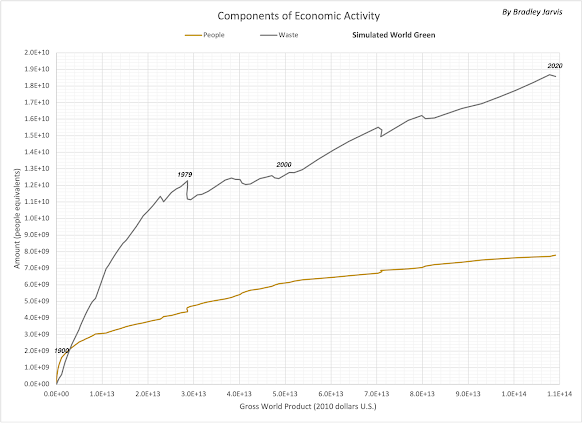
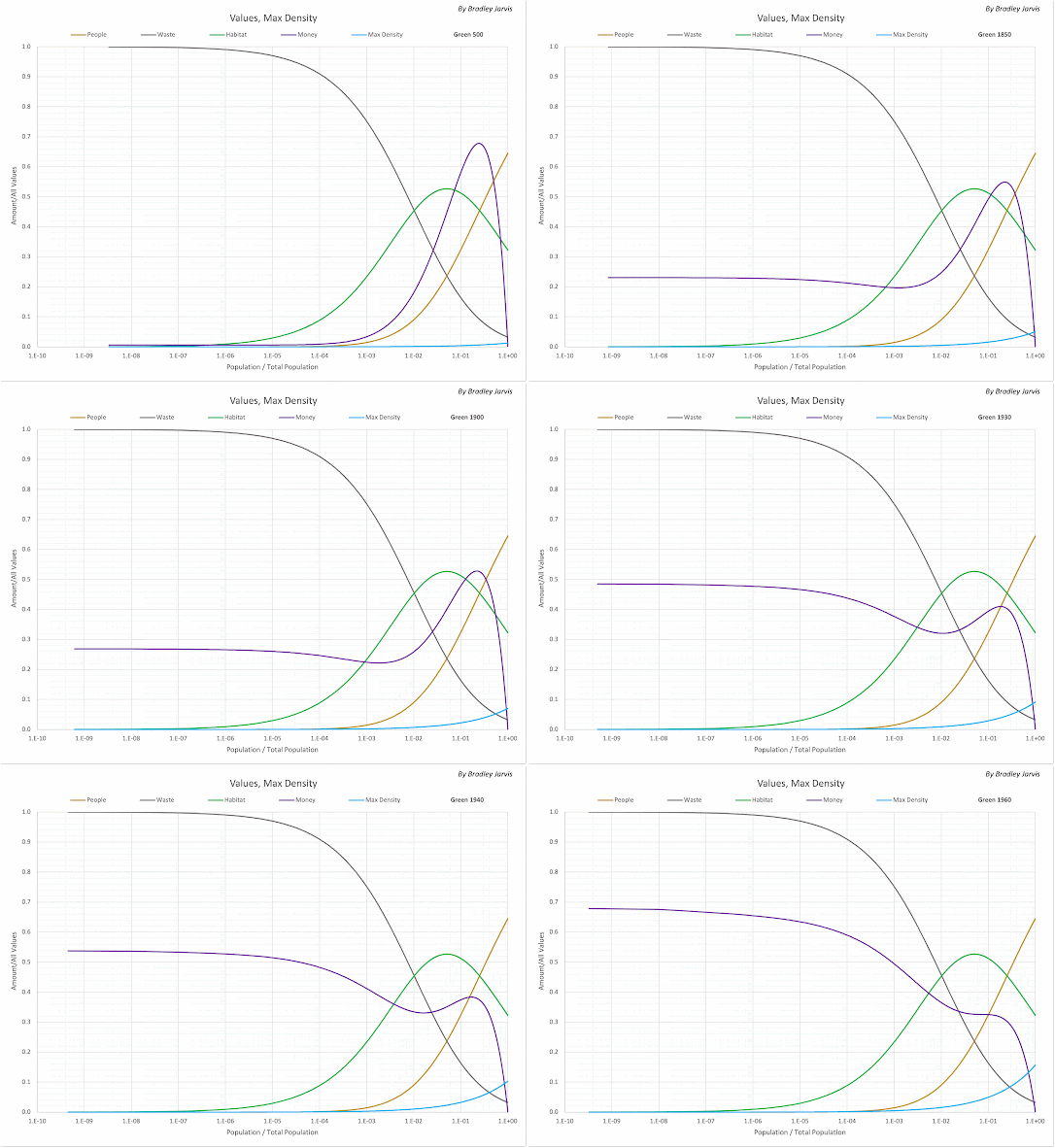
Money as a resource indicating relative economic activity (as indicated in the diagram for small populations and discussed in Economic Distribution) have favored equal value placed on people and habitat (corresponding to half the total habitat available to the population) while promoting increased waste by those who value it most. As shown in the following graph, waste production by a simulated world like ours has outstripped population growth (driving human transactions) as a component of economic activity and remains strongly associated with it. The “rich,” those benefiting most from that activity, and everyone else, represent another set of groups - defined by the value placed on money.

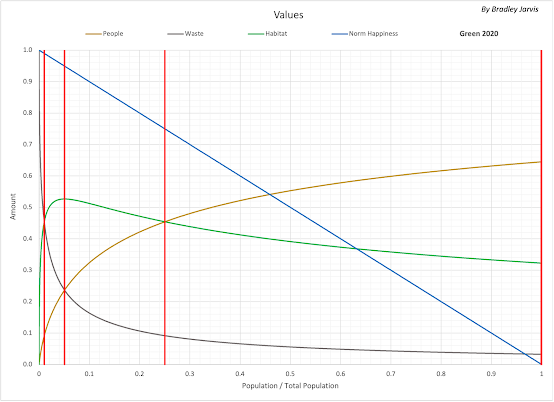
Implicit in this approach to quantifying what someone considers good and bad is the debatable assumption that their current conditions represent what they prefer, and that others they compare themselves to are likewise in preferred conditions. Even using change over time might not be a reliable indicator of preferences; the change could be so far beyond the person’s control and the destination is opposite to their preference. Referenced to groups, a person could move from one group to another due to the actions of others or environmental effects that force change in availability and consumption of resources. This appears to necessitate an additional variable for consideration: choice. Based on national statistics from 1800-2017, happiness varies as shown below, as does life expectancy, where the red lines mark the limits of each the four groups we started with; this suggests that members of a population will tend to prefer a higher value of waste.


As waste effectively decreases habitat, the ability of nature to provide basic biological needs decreases to a point where more people die than are born, beyond which the population crashes. Thus, increased waste decreases how long the population can exist (its longevity). Another set of groups could therefore consist of a group that cares about longevity being longer and the other that doesn’t. The group that cares about longevity would likely value habitat more than anything and waste less than people; the other group would consist of everyone else.


Saturday, August 12, 2023

Economic Distribution

 Distributions of people, waste, and habitat throughout a population are, in part, maintained by economic activity that is reflected by the money people exchange with each other. Like those resources, that money can be treated as a resource and translated into a value relative to the others.

Because it depends upon total quantities of people and waste, exchanged money varies as those quantities change over time. Measured as Gross World Product (GWP), the total has generally increased. How much it is valued throughout the population is determined by the distributions of people and waste.

In simulated world “Green,” whose history is a close match to ours, economic activity until the 1920s was most valued by those who valued both people and waste equally while placing the highest value on habitat. As more waste has been created by economic activity, a small fraction of the population, who values waste more than anything, has increasingly valued money that represents that creation. By the 1950s, the value of money to that group had risen to exceed the maximum value that any other group placed on people.

The focus of economic activity on the growth of waste has continued to the present. For most of Green’s history, 2% of the population has been responsible for 80% of the world’s waste. In 1960, that group was also responsible for 54% of the GWP. By 2020, it was responsible for 68% of the GWP. Increasing waste is largely responsible for decreasing habitat, which includes other species that maintain the habitability of any world; and starting this year, a growing number of people are projected to consume all the habitat available for their survival (a “density” of 1), altering every distribution. Waste, habitat, and people will approach equal value as the death rate increases, and money will be valued more than anything right before all are dead, which is projected to be in 2041.


Saturday, July 15, 2023

Distributions

People are organized into communities that enable the acquisition, movement, manipulation, and use of resources in order to maximize the quantity and quality of what they value. Each community has its own strategy for doing so based on its values, its abilities and the composition of its environment.


Averaged over the world population for more than 70 years, my simulations show that the annual distributions among people of biologically useful resources have maintained a common pattern, with communities changing what parts of the pattern they occupy and the parts they interact with. The primary distributions are people, habitat (resources composed of, and used by, other species), and waste (resources converted by humans into forms that are not biologically useful). 

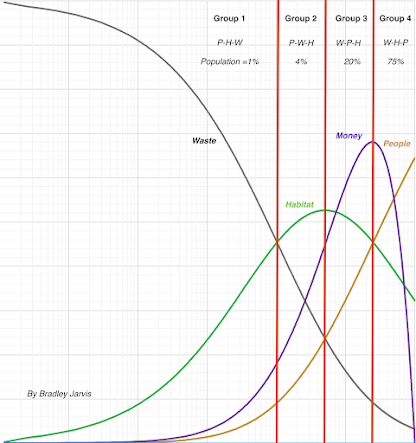
Processed to display how their amounts change relative each other, the distributions can be used to indicate how much different parts of the world’s population value people, natural environments (habitat), and created environments (waste). As the number of people is added up in order of increasing habitat density (people per unit of habitat), the value of people rises; the value of created environments drops; and the value of natural environments climbs to a peak and then falls. This is shown below.


There are three distinct groups defined by the intersections of the trends. The smallest, amounting to 1% of the population, is dominated by the value of waste over habitat and people. The second, amounting to 24%, is dominated by the value of habitat over the rest. The third and largest group, 75% of the population, is dominated by the value of people. Based upon my simulations, any isolated population with limited resources (embodied by habitat), that is not consuming more than a critical amount of them, will have these characteristics. 

Consuming more than two-thirds (67%) of total resources results in the first group growing at the expense of the other two until the amount of remaining resources is less than the total number of people - who will be in just one group that values everything equally. My simulation that best matches history shows that this year humanity will be consuming more than the critical amount, as shown below, and will reach the end point bordering on extinction by 2040.


Saturday, April 22, 2023

Thresholds


In my latest simulation of a world most like ours, which I call “Green,” the human population peaks in 2025 and crashes to zero by 2041. This year the systems that maintain remaining habitat begin to degrade significantly and inexorably, with the effect of waste pumped into the system of life that is in addition to the immense amount that humanity is annually creating. The trigger for the degradation is the elimination of a critical amount of the life that supports those systems.

As I write, those who care about other life and stopping our own global drive toward extinction are cele-brating Earth Day, calculated to be the day that humans are consuming all of the renewable resources that Earth’s ecosystems can furnish annually. Beyond that, we are in overshoot, consuming the producers of those resources in addition to what they produce. 

Inhabitants of simulated planet Green would have marked crossing that threshold three weeks ago, noting that annually a full two-thirds of the world’s total resources are being consumed. The citizens of their United States will be feeling several impacts of that excess consumption, among them passing maximum population in 2017 and peak per capita GDP last year. By the end of the decade, the nation will be func-tionally extinct.

Avoiding extinction for as long as possible is the goal of simulated world Hikeyay, named after a fictional community on a mountain in Colorado that nurtured a key character in my fictional blog SimulatedNews. As part of my effort to understand and help solve the extinction crisis, Hikeyay is a both a simulation and a mind experiment to explore what a solution might look and feel like. That solution involves decreasing total consumption starting in 2019, enabling the amount of healthy habitat to grow in the process. The good news is that extinction is delayed; the bad news is that global average temperature continues to climb.

Monday, January 30, 2023

Lay of The Landscape


For many years I had a bad sense of direction when thinking about how to get from one place to another. One way I learned to cope with that condition was to embrace getting lost as a learning experience and develop a “feel” for the organization of the places around me. By focusing on exploration instead of going somewhere, I became aware of the many ways that places are connected as a landscape instead of as a network of paths.

When someone would tell me how to go someplace, or how to achieve a particular objective, I would use their procedure to imagine a landscape being revealed. What my guide considered useful features along a chosen path, I found to be slivers of visibility into a system-as-landscape that the path and its endpoints were likely just a minor part of. 

If I was responsible for achieving a particular objective, and therefore forced to limit my exploration, I would focus on how being at that end would look and feel, discovering what variables most clearly de-fined it in a way that could be experienced through translation into ideas that made intuitive as well as abstract sense. In many cases, “navigation” involved changing the configuration of a system either directly or by integrating myself into it, where the feeling was largely one of artistically sculpting experience until it matched my definition of the system’s end state.

Often in my careers as a test engineer and technical writer, I was tasked with helping others achieve a given objective; and my exploration expanded to include the people I was helping, as part of the inhabited space. Understanding it as the flip side of being helped, where I had to translate what others shared with me, either by communication or shared experience, I included helping their translation as part of my personal interpretation of the task (a service I greatly appreciated when people would do the same for me). 

I became more conscious of these facts as a consequence of trying to distill a lifetime of experience into a framework for dealing with multiple existential crises that threaten both personal and societal longevity. My personal longevity crisis is simply one of age: biological breakdown is inevitable and imminent for someone this close to his life expectancy. Society, which I think of as the whole of organized humanity, is facing a limit to lifetime that is more self-imposed than inherently inevitable. If the whole of experience is a landscape, the part we share, as well as our own lives, has a rapidly approaching edge. Death defines the space beyond the edge, a world without us.

Taken as merely a region in a vastly larger landscape, our experience may be unique, but it is hardly special in any universal sense. As co-creators of our experience with its many components, we arbitrarily assign value to both it and parts of it, with differences in value a function of how we choose to define it. Large differences in value create contrast in our minds, which we associate with degrees of “specialness” of the underlying experience. Since value is purely arbitrary and we can’t physically access the full range of experiences it would take to define a common standard, we can either acknowledge or deny the limitations of our experience and perception of it. 

At some deep level, I think I have always distrusted people who act certain that where they want to go is the right way to go. That attitude suggests a belief that their experience and their judgment are innately more valuable than the experience and judgment of others. Alternatively, I have no problem with someone who has learned enough to make more useful guesses about how to get somewhere as long as they are honest about what they don’t know and can’t do; and are willing to learn and adapt, encouraging the same for those they might lead. People I trust the most, and who I’ve chosen to emulate, are willing to challenge what they know and what they value, learning and testing both of these by getting more experience and engaging in respectful collaboration with other people. In short, I tend to distrust those who deny limitations and trust those who acknowledge them; but overall, in the spirit of acknowledging limitations, trust is always provisional - especially trust in myself – which might ultimately be the reason I got lost so easily.

Self-confidence is, literally, trust in yourself. With it comes a sense of power and focus that encourages action. The opposite is what I feel as fear and disorientation that elicits indecision to the point of paralysis. An early lesson I learned from my father and later proved for myself through living was that trust must be earned and its basis always tested through observation. This lesson demands a range of caution that accompanies every action and is proportional to uncertainty that never falls to zero (which an honest person knows is impossible) and has an upper limit that enables learning through experience. 

Discomfort is always present but doesn’t have to be intolerable. I discovered what can best be described as fun fatalism: playfully creating new experience that reflects my chosen values that will be frozen in space and time beyond the boundaries of my life wherever and whenever those boundaries might be. The discomfort of provisional trust in myself thus became comparable to the aching of muscles that are stretched will per-forming one’s favorite sport, which in my case is exploring the lay of the landscape of my limited existence.

Note: This post was updated on 2/4/2023 with the image above. It depicts relationships of variables in my Timelines model: population (yellow), remaining nature (green), and happiness (red), as functions of habitat density (horizontal, left to right) and waste per person (depth, close to far).

Saturday, October 8, 2022

Upgrades


For much of this year I nursed a slowing computer while attempting to further my research and to do some writing within time limited by working a full-time job (luckily at home). As has happened in similar experiences, I built up a cache of insights that I could share when conditions permitted while sharing tidbits of related wisdom and information on social media platforms, most notably Twitter (@bradjarvis), which also served as a tool for collecting relevant source information. Just when my computer became unusable due to “upgrades” in the operating system and software that its speed could not handle, I capitulated to the need for a hardware upgrade (a new computer) to keep up with them and maintain the most basic functionality.

My new insights, as the most useful have, came from taking a fresh look at the essence of the mathematical modeling of historical data that has dominated my decades-long research into how basic values and resource availability are coupled to affect how long and how large a population can survive. This phase of the research focused more on what happens to groups within a global population than on projections of what happens to the entire population, requiring many more calculations to provide meaningful results. I had enough results by the time my computer became unusable to begin drawing conclusions that could be tested and used to extract a simple set of rules that embody their derivation.

The most fundamental insight of the model has been that human consumption of ecological resources (provided for sustenance of life in ecosystems) varies predictably with habitat density; where habitat density is the ratio of consumption for needs to the number of resources that remain (which are available to members of other species to meet their needs). One of my new insights is how consumption for needs (which is proportional to the number of people) increases with habitat density, and how the amount not consumed for needs (what I call waste) decreases with habitat density. 

Economic activity, measured globally as Gross World Product (GWP) and on a national level as Gross Domestic Product (GDP), is a function of the number of potential exchanges of resources, which varies with the number of people and the resources they consume. The distribution of people and resources derived from their relationships to habitat density can therefore be used to estimate the range of habitat densities occupied by an economically active group like a nation for which that activity is measured. Related aspects of people’s lives such as life expectancy and happiness show looser correlations with habitat density that can therefore be used on a society level to infer the dominant values associated with those aspects along with the more direct ones: population size and longevity (how long the society can survive with its resource base).

The upgrades to the underlying historical data and its analysis showed that, in general, nations have kept their minimum habitat density the same as the world’s while varying their maximum habitat density. This maintains a link to the people in the society with the most access to resources that can be used to meet needs and are paid handsomely for it. In the extremely rare exceptions where that link has been severed, it appears to have been accompanied by rapid demographic transition or government collapse. If, as most of my simulations of the world’s future show, the minimum habitat density climbs in response to critically depleted resources, what triggered those exceptions may also become outcomes in a self-sustaining feedback loop that accelerates the process, enhanced by environmental feedbacks that further reduce available resources.

For now, my new computer is performing as well as I hoped, apparently matching what my not-too-old computer was able to do. Like humanity’s instinctive drive to increase the number of people in the world, which seems to be our dominant value, my hard drive is filling up with the inevitable upgrades to my software and the files (and increases in file size) that I am generating with each new increment of my research and writing. Some time when I least expect it, a critical amount will be used and a new set of upgrades will threaten to make this computer inoperable, just as our planet is on the verge of becoming unable to sustain life as we know it, forcing us to quickly (and impossibly) find and move to another one or die. Refusing that next upgrade is still an option, as is reducing what we’re already doing with it so we can use fewer resources. Unfortunately, our planet – like my last computer – may be doing the ecological equivalent of changing the operating system so that functions we need can no longer be done without a lot of adaptation. Time is running out to find and implement a solution to this conundrum, and I’ll keep doing what I can to help that process.


Friday, October 29, 2021

Learning As We Go


This week my contract ended and I'm available for work. I've done technical writing about as long as test engineering (14-15 years). Add 12 years of part-time or full-time educational research. Throw in “free time” of writing, research, and other art of my own, and it’s a start.

I try to learn as much as I can so - given enough time - quality matches or exceeds quantity of what I produce. Positive experience is most likely if the definition of quality is the same for producers and consumers, so finding what it is for each is part of that learning.

Understanding the time and resources needed to achieve mutually acceptable quality is part of learning that can ensure fair trade of products and services that embody them. That trade is also part of the experience, beyond use of what’s traded.

Effects of producing and trading on others (not just people) should also be understood, since they have value that may not be included in definitions of quality for what is traded. Neglecting this third “dimension” of learning is fraught with danger for all concerned.

What I’ve learned and ways to better learn are what I’ve carried with me from job to job, while money has evaporated and sometimes the projects have too. For me they’re embodied in the process of living, which I’m doing wherever I am, increasing them however possible.

A “job” in the wild is how one contributes to the life support system that everyone is an integral part of. The key feature, life, is increasingly optional in the substitute systems we humans create and inhabit, where quality can be defined with or without it.

In my “free time” research, I’ve learned that life support isn’t just getting what we need to live, it’s supporting the life that provides it by not consuming too much of it and the life it depends on. Whatever we do must include that as a priority, or risk mass death.

Getting to the point where I understand all of this ideally should have been a “start” to my career instead of coming so close to its end. My skills and hopes are based on the trajectory I followed, which diverges radically from the path I and the world must follow next.


Thursday, March 11, 2021

Values and Responsibilities


Next month will mark three years since I quit my job to work full time on completing decades of research into how actions serve values and translate into global consequences. Beginning with the primary value of survival (because without survival there can be no other values) I had focused on how many people can exist, for how long, and under what conditions. The scope broadened to include life satisfaction, or happiness, which correlates strongly with the number of resources people consume that are provided by other species. Statistical analysis of historical data for population, life expectancy, economic activity, and other variables revealed other correlations that tracked consistently throughout the data and suggested a theoretical framework that linked them together.

Translation of the resulting mathematical model into experiences of individuals and groups enabled testing by comparison with events and stories from the past and present, along with projections of potential futures. The potential futures were extremely disturbing, since they indicated a high probability of an extinction-level population crash in the near future. Because of this, I worked mostly on deriving alternatives and actions that would enable them, much as I had used models of equipment and conditions to troubleshoot problems that I found during my career as a test engineer. I concluded that effort last year after simulations incorporating global warming variables and the effects of the COVID-19 pandemic converged on a narrow range of actions that might significantly delay catastrophe.

With my savings starting to run out and hardly any income from the writing business I hoped could support my efforts, I spent more time searching for another paying job. This experience has been both a necessity and a test case for how to live based on what I learned. Reading hundreds of job descriptions has reinforced a lesson learned during past job hunts and embedded in my model: money flows toward those taking risks to find, exploit, and trade resources that can be used for future growth. Servicing those people or becoming one of them is increasingly a key to individual survival; it is also a surefire way to help decrease the longevity of civilization by eliminating other species that we depend upon for our collective survival because there are no new ecosystems that can sustain us. The fastest and most direct way to extend our lifetimes is to clean up and leave habitat we have taken from use by other life, which is the opposite of what our economy rewards.

Hunting for income triggered an evaluation of successes and failures in past jobs so I could find better matches in the future. Defining success as the meeting of my expectations and my employer’s expectations with minimal difficulty for both of us, I realized that success for me depends on matching my responsibilities with my values. Ability is another factor, but I’ve been able to learn and adapt quickly enough in most situations to keep it from being a major one. Failure, when I experienced it, was typically associated with a conflict between an employer’s expectations and one or more of my values which couldn’t be remedied to the satisfaction of both of us. 

This insight about employment suggested a new way to characterize the results of my research, which I was coincidentally starting to formalize as a scientific paper that could be reviewed by academics and others for strengths, flaws, and potential use in further research. A person in any of three relationships with their environment (growth, overshoot, loss) focuses on attaining one or more states of being (survival, happiness, longevity) for one or more groups (self, other people, all people and other species). Values and responsibilities can both be categorized by focus, which usually includes self-survival, self-happiness, and self-longevity. 


Relationships to environments tend to predispose the people in them to get what they don’t have enough of, so the relationships can be used as proxies for common sets of values and responsibilities. In general, everyone prefers to be in the overshoot relationship - every person that is, since overshoot involves our consuming more than other species can replenish and therefore depends on them dying off. The inevitable decline in resource availability reduces how long the population can survive (its longevity), which is felt by individuals who are forced into the loss relationship and therefore value reversing what caused it. Meanwhile, people in the growth relationship value survival of themselves and people in their closest groups; this drives population growth along with individual consumption that increases happiness by enabling creation of personalized artificial environments.

Although most of my life has been spent in overshoot, I was strongly influenced by a culture of growth. I also experienced loss and have accepted its all-inclusive values. I’ve been questioning the wisdom of unlimited consumption and its impact on longevity since I was 16 years old; and for various reasons I avoided situations where I might have children until it was practically too late. As an older adult facing loss again while trying to maintain a hold on overshoot, I know from my research that the world as a system is about at the same point and is on the verge of moving every person and other species into the loss relationship either by choice or by force.

The scenarios that I derived for delaying catastrophe are simply summarized by one rule: Avoid loss. Keeping everyone from being in the loss relationship with the environment starts with freeing up habitat for those already there, which my most-likely scenario estimates could be 5/6 of the world’s population by mid-year. Completing that move by the end of this decade could also keep global warming from making parts of the world uninhabitable while we develop ways to reclaim even more habitat and learn to live with the result. Notably the (simulated) last time no one was in the loss relationship was in 2001, and the last time no one was in overshoot was in 1949, which provides some historical context for what we might expect.


As improbable as that scenario is, I suspect another one may be emerging that could be considered just another version of catastrophe by those valuing all life. Humanity’s ability to consume more than what other species can provide without harm (thus “overshoot”) is a consequence of large-scale replacement of natural habitat with artificial environments that contribute to happiness and together can be considered artificial habitat. In the new admittedly speculative scenario, attempts to escape the deathtrap caused by reducing the amount of remaining natural habitat are enlisting molecular engineering and machine intelligence to create a new biology that totally redefines what and who we value, including ourselves and our needs. Time is running out for this scenario to play out: my model projects that, on the current trajectory of consumption, people will start dying from lack of habitat by 2026 and humanity will be extinct by 2057. For the new scenario to match the expected one (and what I consider a reasonable timeline for new technology rollout), this may be a manifestation of how the rest of the population transitions from growth through overshoot over the period 2028-2044 while so many others are dying.

The next two decades will either validate or invalidate the concepts I developed over the past two decades. Since exploration is a process and not an endpoint, I expect that if I’m alive then I will have asked many more questions than I answered while helping to more effectively find other answers; and I will be happy to have done so. To the extent that my efforts, whatever they are, contribute to creating a longer and better past for those whose lives I affect directly and indirectly, my life will have served my values. By that standard, I intend to increase my overall positive impact until I can’t, choosing appropriate responsibilities along the way.


Monday, November 9, 2020

Habitat Loss


As our species dominated and the world’s ecosystems, we made them part of our own habitat. The tools we used to do so were simultaneously used to create artificial environments that removed or spoiled resources that could be used to meet the basic biological needs of species we directly or indirectly depended upon for our survival, threatening to exterminate them and - in much the same way - us. This is a story told by statistical simulation of our history by my Timelines model and ecological observation of how extinctions occur.


According to my simulations, resources available for meeting human needs (what I’ve called “ecological resources”) are now only double the amount consumed for needs. This allows for consumption of only 15% more needs before population reaches a peak and then collapses. Most likely, collapse occurs because the populations of species (counted as resources) that supply the resources we directly consume themselves collapse. Our population peak is projected to occur no later than 2024, after which casualties are unavoidable.


ABOVE: Current summary of global variables and their projected trajectories. 


The COVID-19 virus is already exacting a toll on our population. It can be thought of as a consequence of habitat loss, because the other species in our habitat are likewise experiencing habitat loss, being forced to share more of their space with us and enabling those that prey on them to prey on us. Critically shrinking habitat is making this situation catastrophically worse even as our temporarily restrained consumption slows the rate of the shrinking. 


Meanwhile, climate change is becoming a self-sustained feedback of our pollution that is destroying habitat and creating conditions such as melting ice that will drive it further on its own. Our collectively growing obsession with reducing greenhouse gas emissions (climate-altering pollution) might slow the destruction, but more is necessary because we are too close to the critical point where species including ours might not avoid collapse in time to recover. 


As I’ve suggested before, the best option is to radically increase the total amount of habitat by reducing what we are currently consuming (in needs and waste). This will buy time for us and the other species we save to create barriers to further loss, including cleanup of waste such as that threatens to increase global warming. My simulations of such an approach provide insight into the attendant physical and social consequences that be used to craft a strategy for making them a reality and monitoring the results.


ABOVE: Summary of global variables after a reduction in consumption from 2021 to 2030. Reducing the amount of greenhouse of gases in the atmosphere to avoid more dangerous temperatures would need to occur soon.